



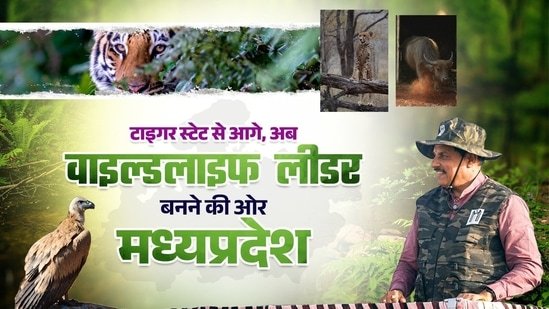
Madhya Pradesh Chief Minister Mohan Yadav visited Kuno National Park on May 10 and 11 to release two female cheetahs that were brought from Botswana into the forest landscape.


According to a government note, the release is being projected as part of a larger transformation in Madhya Pradesh’s wildlife governance model, where the state is attempting to move beyond its long-standing “Tiger State” identity towards a broader, multi-species conservation framework focused on habitat connectivity, conflict management, scientific rehabilitation and eco-tourism.
The two Botswana-origin female cheetahs are being shifted from soft-release enclosures into the wild landscape at Kuno National Park in Sheopur district. Forest officials cited in the note said the animals had adapted well to local conditions during the acclimatisation phase.
The state government said the cheetah population under Project Cheetah had reached 57 following the birth of four cubs at Kuno in April 2026, including what it described as the first recorded wild litter born to an Indian-born female cheetah.
Officials said Kuno was now being developed not only as a cheetah rehabilitation landscape but also as a larger conservation and breeding centre. Gandhi Sagar Wildlife Sanctuary is being prepared as another cheetah habitat, while Nauradehi Wildlife Sanctuary, now linked to the Rani Durgavati landscape, has been approved as a third cheetah habitat in the state.
The expansion of cheetah landscapes comes alongside a wider push to strengthen Madhya Pradesh’s protected area network.
Ratapani was notified as the state’s eighth tiger reserve in December 2024 with a total area of 1,271.4 square kilometres, including 763.8 sq km core and 507.6 sq km buffer area. According to the state note, the proposal had remained pending for nearly 17 years before approval under the current government.
In March 2025, Madhav National Park in Shivpuri was declared the state’s ninth tiger reserve. The Chief Minister also inaugurated a 13-kilometre stone safety wall there, aimed at reducing human-animal conflict along the reserve boundary.
The government note argued that India’s wildlife conservation challenges were increasingly shifting from forests to forest edges, where expanding roads, settlements and agriculture were creating pressure on animal movement corridors.
As part of that approach, Madhya Pradesh has begun developing wildlife-friendly infrastructure, including underpasses and overpasses on stretches such as the Itarsi-Betul section of NH-46. Officials said broader corridor planning was underway across key tiger landscapes including Kanha, Bandhavgarh, Panna and Pench.
The state has also approved a ₹47.11 crore elephant management and human-elephant conflict mitigation plan covering surveillance systems, solar fencing, rapid response mechanisms and community-level interventions. Compensation for deaths caused by wild animal attacks has also been increased from ₹8 lakh to ₹25 lakh.
Apart from big cat conservation, Madhya Pradesh has expanded efforts in vulture rehabilitation, gharial protection and species restoration programmes.
According to the official note, the state has emerged as a major vulture conservation centre through the Kerwa-based Vulture Conservation Breeding Centre run jointly by Van Vihar National Park and the Bombay Natural History Society (BNHS). Officials referred to the case of a cinereous vulture rescued in Vidisha district in December 2025, rehabilitated at Kerwa and later released at Halali Dam, after which it reportedly travelled thousands of kilometres towards Central Asia.
The state has also taken legal steps to expand protected landscapes. In April 2025, Madhya Pradesh notified the Dr Bhimrao Ambedkar Wildlife Sanctuary spread across 258.64 sq km in Sagar district, making it the state’s 25th wildlife sanctuary. Omkareshwar and other protected landscapes have also been identified for conservation expansion, while Tapti in Betul district has been projected as Madhya Pradesh’s first conservation reserve.
The government has additionally focused on crocodile, turtle and gharial conservation in river ecosystems. Officials said gharials and turtles had recently been released into the Kuno river system, while crocodile conservation efforts were underway in the Narmada basin.
Another major species restoration effort involves the relocation of wild buffaloes from Kaziranga National Park to Kanha Tiger Reserve, which officials described as an attempt to revive lost biodiversity in central India.
The state government has also highlighted the economic dimension of wildlife conservation. According to the note, eco-tourism linked to tiger reserves, cheetah tourism and protected area expansion has generated employment opportunities in rural regions and strengthened local tourism economies.
“The objective is to connect conservation with livelihoods, tourism and local participation,” the note stated, while describing Madhya Pradesh’s evolving wildlife strategy as “multi-species, corridor-led and science-backed”.


