



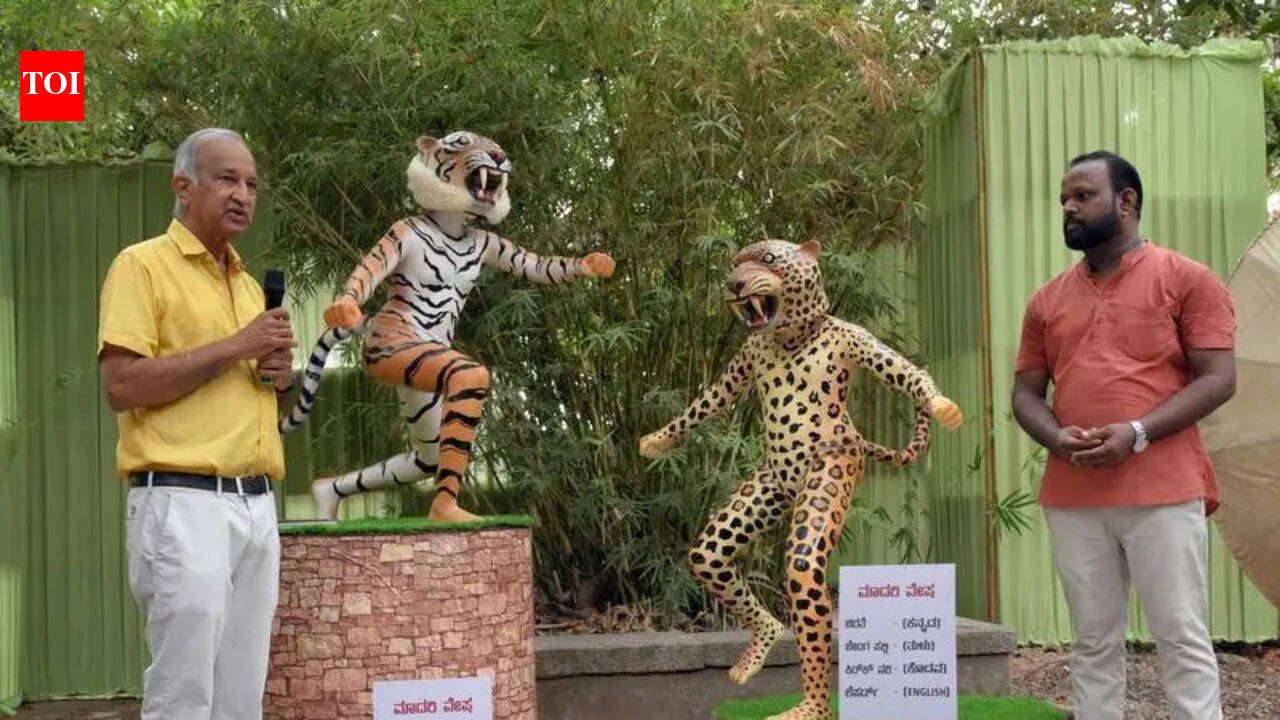
Mangaluru: Zoologist and tiger conservationist Dr K Ullas Karanth unveiled ‘Naturalistic Tiger dance models’ at the Kodialguthu Centre for Art and Culture, Ballalbagh, on Monday. The initiative seeks to bring greater realism and authenticity to Pilivesha, the traditional tiger dance of Dakshina Kannada.The dance models comprise two art sculptures representing a tiger and a leopard, featuring authentic body colours, natural patterns like stripes and rosettes, and detailed elements including headgear and tail. The sculptures were created by artist Harish Kodialbail, assisted by Siddakatte Bhushan Shetty and Nagaraj Bajal, based on extensive research. The project was conceived and curated by Dr Karanth, who provided inputs drawn from his field experience. The sculptures were formally inaugurated by Group Captain Kodialguthu Pradip Shetty in the presence of Pilivesha scholars Chandrashekar Shetty and KK Pejavar. Recalling his early fascination with tigers, Dr Karanth said his interest was sparked by witnessing a tiger dance in childhood and later seeing a real tiger in a circus. He noted that by the 1960s, rampant hunting had brought tiger populations to the brink, prompting conservation efforts led by then Prime Minister Indira Gandhi. “I was so drawn to tigers that I chose to dedicate my life to their scientific study and conservation,” he said, adding that he encountered his first tiger in the wild only after 15 years of fieldwork. Explaining the concept behind the model presentation, he observed that contemporary Pilivesha often lacks a connection with real tiger characteristics. “Earlier, the performance carried social prestige while also reflecting aspects of real tiger behaviour. Today, unrelated colours and patterns are used, and the form has drifted from its roots. By becoming a showcase for glamour and vanity, it has transitioned from attracting children to appeasing adults,” he said, calling for greater research and authenticity in the art form. He urged performers and organisers to move towards more realistic representations. Harish Kodialbail said it was a unique experience to design the sculptures and translate tiger features to human anatomy. Chandrashekar Shetty noted that there is limited documented material on the evolution of tiger dance. K Pejavar pointed out that Pilivesha is closely linked to local traditions of faith, physical culture and community institutions. Complimentary copies of a book on tiger dance authored by Chandrashekar Shetty were distributed by Jyothi Alva of the Kodialguthu family. The event was supported by the Mangaluru chapter of INTACH and Art Kanara Trust.


