



She was already halfway there.
A game up, leading in the second, moving with the same sharp intent that had once made her Olympic champion at the Rio 2016 Games. The semifinal at the Paris Olympics in 2024 was tilting her way, the crowd beginning to sense it too. That tightening grip she had on matches when she smelled the finish line.
And then, mid-rally, Carolina Marín stopped. She leapt for a shot on her backhand side, landed on her right foot, and the knee buckled.
The scream came instantly. Not the sharp, triumphant roar that had so often followed her winners, but something raw and involuntary. She collapsed to the court, clutching her knee, her face tightening in shock before the pain fully took over. The wheelchair came soon after, and so did the tears.
It turned out to be her final match as a professional. “I would have liked for us to see each other one last time on court, but I don’t want to put my body at risk for that,” she said while announcing her retirement. “I wish my career had ended in a different way but in life things don’t always go as we want and we have to accept that,” she added.
That moment in Paris was not an aberration. It was, in many ways, the most honest snapshot of Carolina’s career.
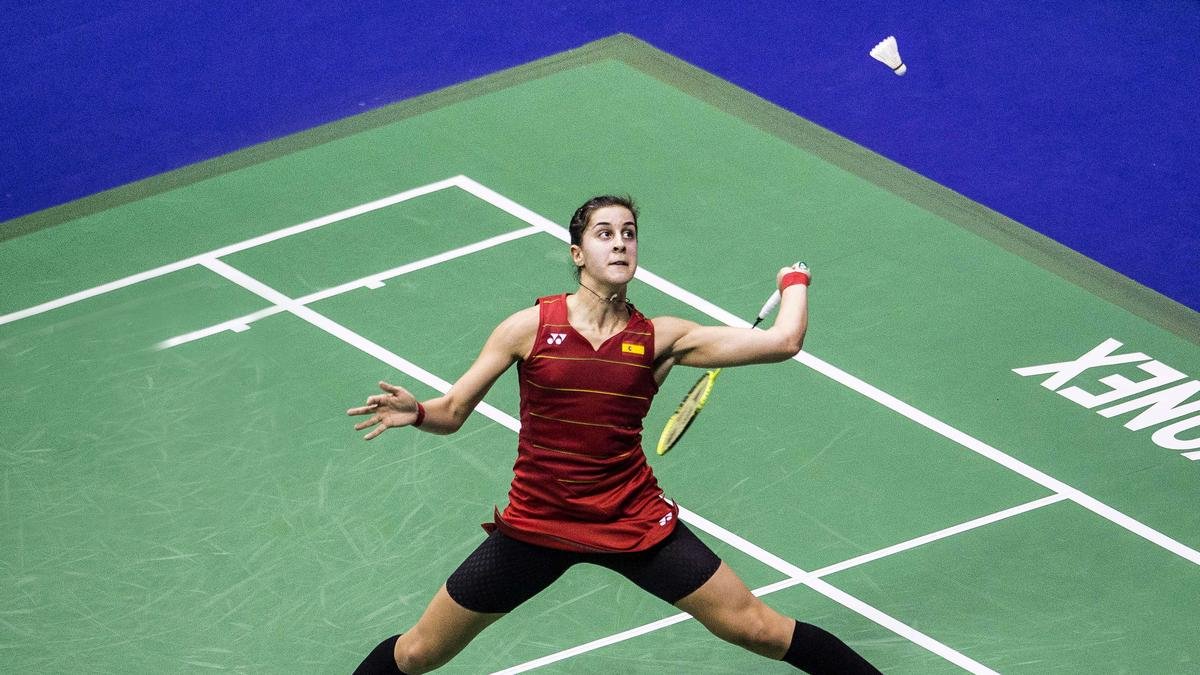
She had always played on the edge. There was no measured version of her game. Subtlety was never her game, and for many, that made her hard to like. In her red sleeveless outfit, she wore her emotions on her sleeve and let the world hear them: She shouted, celebrated and let every point show on her face. Wins brought wide, unfiltered smiles on the podium. Losses and setbacks brought tears just as openly. Nothing was held back. The screams, the urgency between points, the refusal to slow down even for a second — unless the cluster of pins holding her hair tight into a bun called for a conveniently timed adjustment — unsettled opponents and, at times, irritated audiences.
There were enough reasons for people to root against her. But to stop there was to miss the point. Because beneath the noise was a player of rare clarity. She played to win, or not at all! Every rally was chased, every point claimed, every match attacked as if it might slip away if she loosened her grip even slightly. It was what made her the Golden Quartet (Olympic, World Championships, Continent Games, and Continental Championships), as the voice of badminton Gill Clark wrote in her tribute to Carolina. And that was the thing about Carolina. You could dislike the sound. You could question the manner. But past all of it, the results were undeniable.
The breakthrough
At the 2014 World championships in Copenhagen, a 21-year-old from Spain walked into a field dominated by the sport’s most established names and left with the title. On her way, Carolina beat players who defined different generations of the game. She got past Japan’s Minatsu Mitani, then outplayed China’s Wang Yihan, one of the most consistent forces in women’s badminton. In the final, she came from behind to defeat Olympic champion Li Xuerui.
Spain, until then, had no real presence in badminton at this level. The sport’s champions emerged from systems far removed from where Carolina had grown up. No one except Coach Fernando Rivas expected Huelva to produce a world champion.
Coach Rivas first met Carolina, a trained flamenco dancer, as a 13-year-old. He saw a competitor. A teenager who refused to give up on rallies. What struck him was her speed, her instinct to attack, and a command over the tempo of the game. The rest, he believed, could be built. With the right structure, he believed, she could be turned into a champion. And that belief, more than anything else at the time, set the course.
There were players Carolina could not initially solve. Among them was Saina Nehwal, one of the few who was not affected by Carolina’s screams. Where others were unsettled, she answered back in the same vein. For a period, Saina had the edge in their head-to-head. Rivas later admitted that “Saina made me a much better coach than I ever was.”
At the 2015 World Championships in Jakarta, the Spaniard defeated Saina in the final to retain her title, a result that felt like a measure of revenge after earlier losses. It also came just months after Carolina had beaten Saina at the All England Championships. Then they met frequently in 2019, with Carolina winning the 2019 Malaysia Masters semifinal, but Saina winning the 2019 Indonesia Masters final after Carolina retired injured. Their last professional meeting was in 2020, with Carolina leading 7-6.
Peak: Rio, and the rival
If Rio 2016 was the summit of the Spaniard’s career, then P.V. Sindhu was the opponent who gave that peak its shape.
They had crossed paths before, even as teenagers, but the Olympic final laid the foundation for what would grow into a defining rivalry.
Carolina came into the 2016 Rio Olympics as the reigning World champion, already with two titles (2014 and 2015) and an All England crown earlier that year. She had built a game around speed and suffocation. Sindhu, 21 then, arrived as the underdog. Tall, composed, willing to stretch rallies instead of rushing them.
For a brief moment, it looked like Sindhu had cracked the code. She took the opening game. She absorbed the pace, redirected it, and forced Carolina into longer exchanges. And then Carolina did what defined her career. She raised the tempo, shortened rallies, and attacked relentlessly at the net.
When it ended, Carolina dropped to the court, face down, arms tucked under her, as if holding the moment in place. Olympic champion! The 24-year-old became the first non-Asian woman to win gold in women’s singles, breaking a hold that had defined the sport for decades.
But what comes after you have already reached the top?
In the months that followed, the high gave way to a strange emptiness. She and her coach had achieved the dream they had chased for years. Later she talked about phases where motivation dipped, results dried up, and doubt crept in. At times, she feared she might not win another big title. It took long conversations with her team, work with a psychologist, and a willingness to change before the belief slowly returned.
The results returned with conviction when Carolina won the European championships again in 2018. She began to look like a player in control of her game and mind at the World Championships in Nanjing, where she defeated Sindhu again in the final to claim her third world title.
Fall and fight
But just as her mind found the way back, her body began to give way…
In January 2019, at the Indonesia Masters, Carolina went down mid-match in the final against Saina. What initially seemed like a bad fall turned out to be far more serious: a torn ACL in her right knee. It was the first major injury of her career at the very top.
She spent the next eight months away from the court. When she returned in September, at the China Open, she fought through the draw and, in the final, defeated World No. 1 Tai Tzu-ying in three games, overturning a first-game deficit.
In 2021 when the circuit resumed after the pandemic interruption, she started the year with back-to-back Super 1000 titles in Thailand, defeating Tzu-ying in both finals. She also reclaimed the European Championships, a title that had begun to feel almost hers by default, whenever she showed up.
She looked every bit like a contender with the Tokyo Olympics approaching.
And then, just weeks before the Games, it happened again. During a training session, her knee gave way, another ACL tear, this time in the left. She withdrew before the tournament started.
She spent close to a year away from the circuit once more. When she returned in May 2022 at the European Championships, it was déjà vu, another comeback marked the same way as before. She won the title again, as if to insist that even repeated setbacks had not dulled the edge that had always defined her. She also reached the final of the French Open, falling narrowly, but showing she could still go deep in the biggest tournaments.
In 2023, she reached the World championships final, beating top players such as Tzu-ying and Akane Yamaguchi along the way, before losing the gold-medal contest to the rampant An Se-young. By the end of the year, she had climbed back into the world’s top five, a reminder that she was not done yet.
In 2024, she won the All England title again, nine years after her first, added another European crown, and returned to the world’s top three.
At 31, she reached the semifinals of the Paris Olympics, becoming the second oldest player in the draw to go that far. Against He Bingjiao, she took the opening game and was leading in the second, the match tilting her way once more. Then, off a heavy landing from an overhead, it happened again. The knee gave way.
She tried to continue, returning to court with a knee brace and playing a couple more points before being forced to retire due to limited movement. The injury also ruled her out of the bronze-medal match against Gregoria Mariska Tunjung.
“Deep down, I did retire on court in Paris in 2024 (Olympics). We just didn’t know it at the time,” Carolina said in her retirement announcement.


