



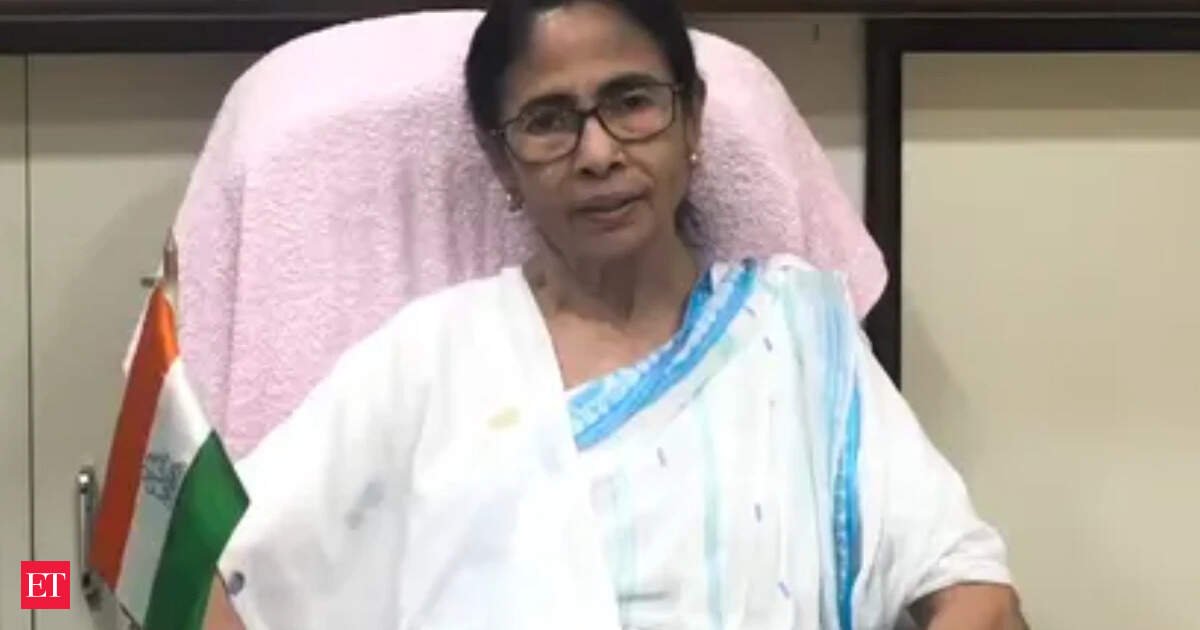
Three competing centres now shape the crisis — the Mamata Banerjee camp, the Ritabrata Banerjee-led rebel faction and 20 Lok Sabha MPs who have moved to the NCPI and extended support to the NDA.
The battle has reached the Election Commission, with rival factions staking claims to the organisation, while the parliamentary rupture has sharply reduced TMC’s Lok Sabha presence.
Also Read: Mamata Banerjee assures support to CJP volunteer after father’s death
For Mamata, the immediate challenge is not to recreate the TMC but to build a party capable of functioning without government and political protection that came with 15 years in office.
The crisis has moved beyond defections to a battle over the TMC’s organisation, elected representatives, assets, legacy and potentially its poll symbol.
The Ritabrata faction has claimed the backing of a substantial majority of TMC MLAs, elected senior legislator Arup Roy as chairperson and announced a parallel leadership structure.The Mamata camp has rejected the exercise as unconstitutional. Kunal Ghosh, one of its prominent voices, dismissed the rebel proceedings as a “comedy show” and said, “TMC is equal to Mamata Banerjee. Everything else is a circus.”
Ghosh claimed six rebel MPs and more than half of the dissident MLAs remain in touch with Mamata and want to return, alleging police pressure was preventing them from doing so.
The rebels are making the opposite argument that the old TMC has already lost its political character.
Sandipan Saha, aligned with the Ritabrata camp, said the ideology with which the party was started “does not exist” anymore.
He has argued that the rebellion was an attempt to reclaim the organisation through more democratic decision-making rather than merely challenge Mamata’s authority.
The rebellion has also gathered momentum around opposition to the growing influence of Abhishek Banerjee, with dissidents accusing the former leadership of abandoning the party’s original political character.
Several prominent leaders, including Madan Mitra, Firhad Hakim and Aroop Biswas, have shifted towards the Ritabrata camp.
The third pole has taken the argument outside the TMC altogether.
Sudip Bandyopadhyay, one of the leaders of the NCPI parliamentary group, has said the breakaway MPs created a political space outside Mamata’s control. “The NCPI is recognised by the EC, and we want to join hands with the Centre for development of Bengal,” he said.
The move matters because 20 of TMC’s 28 Lok Sabha MPs have moved to the new formation, dramatically altering the party’s parliamentary strength.
The next battle will be over the grassroots.
For 15 years, government and organisation worked as a single political ecosystem. Ministers, MLAs, municipal and district leaders operated within a system where proximity to power had tangible political value. That equation has disappeared.
In 2011, Mamata transformed herself from Bengal’s principal opposition leader into the architect of a historic regime change, ending 34 years of Left rule. In 2026, she has to rebuild from the opposite side of the political equation — without the administrative machinery, patronage networks and institutional advantages of government.
That makes organisational survival the immediate test.
Political analyst Biswanath Chakraborty summed up the challenge: “The TMC’s model was built on access to power. Once that axis shifts, the entire structure has to be reimagined.”
The TMC’s old model relied heavily on powerful local leaders who could translate Mamata’s political brand into grassroots control. The loss of office has disrupted that arrangement, leaving the party to rebuild while competing factions fight over its formal structure.
The BJP has an obvious opportunity.
West Bengal BJP president Samik Bhattacharya has argued that there is “no place for arrogance in politics” and that voters had delivered their verdict against the TMC’s arrogance.
The BJP’s larger objective is unlikely to be limited to defeating Mamata electorally. Its real advantage would come if the TMC’s district-level machinery fragmented sufficiently.
But the BJP also faces a timing problem. Once the honeymoon surrounding the change of government fades, governance itself will become an electoral issue.
Administrative controversies, unpopular decisions or failures to meet expectations could give Mamata — once known as a fiery opposition leader — an opening. Her political capital remains the TMC’s strongest asset. She can still mobilise voters and dominate Bengal’s opposition discourse.
Yet that strength is also the party’s structural weakness. The TMC never developed a second centre of authority comparable to Mamata. Abhishek was expected to become that figure, but his rapid rise generated resentment among sections of the organisation and became one of the fault lines exploited by the rebels.
The party faces another obstacle: the baggage of 15 years in office.
Recruitment irregularities, allegations of corruption, cut-money, political violence and accusations of administrative politicisation will remain central to the BJP’s campaign.
A TMC leader from the Mamata camp said, “She can distance the party from unpopular local leaders, empower a younger second rung, reconnect with workers. The TMC still has a substantial political base.”
If Mamata restores organisational discipline, prevents further defections and turns the BJP government’s early years into an anti-incumbency narrative, the 2026 defeat could be remembered as a rupture that forced the party to reinvent itself.
If she fails, the three-way fragmentation could be the beginning of the end of the TMC’s monopoly over the anti-BJP political space in Bengal.
Whether the split remains a post-election rupture or becomes a lasting realignment could determine not just the TMC’s future, but who occupies Bengal’s opposition space in the years ahead.


