






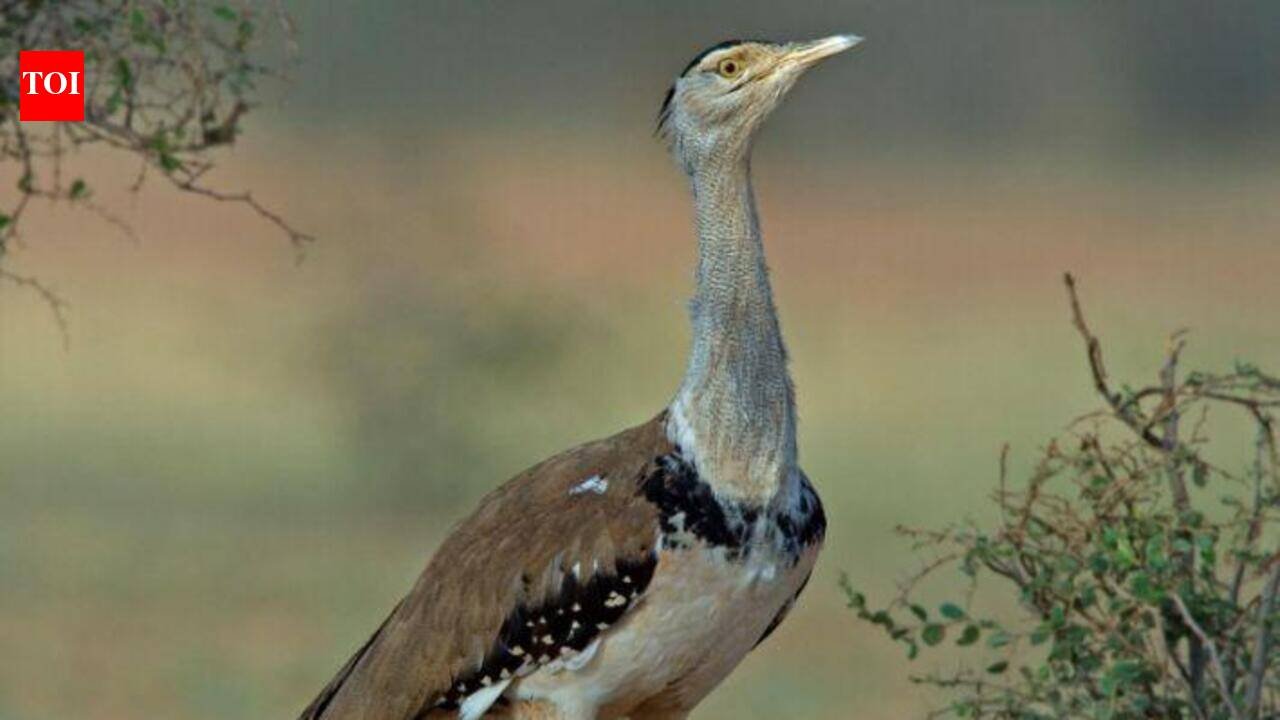
Hyderabad: The Great Indian Bustard (GIB), one of the world’s most threatened birds, has suitable habitat across just 48,000 sq km, or 6.6%, of the 7.2 lakh sq km Deccan landscape, according to a 2026 study that maps potential refuge places for the species and identifies 16 priority conservation areas.The study by Shaheer Khan, Gautam Talukdar and Bilal Habib of the Wildlife Institute of India, published in PLoS Oneon Aug 14, used GPS telemetry from three tagged GIBs, a MaxEnt species-distribution model, 6,436 km of field transects and 1,401 questionnaire interviews.Telangana has key habitat pocketsMaharashtra had the largest proportion of suitable habitat at 7.4%, followed by Telangana at 5.5%, Karnataka at 4.4% and Andhra Pradesh at just 0.02%.In Telangana, the highest suitability was recorded in Rangareddy (25%), Mahbubnagar (17.7%) and Adilabad (15.7%). In Maharashtra, Osmanabad recorded 66.9% suitability and Solapur 50%, while Karnataka’s Gulbarga, Bijapur and Bidar recorded 31%, 28.9% and 26.8%, respectively. Andhra Pradesh’s suitable habitat was concentrated in Kurnool.Researchers identified 16 priority conservation areas covering about 18,000 sq km — 11 in Maharashtra and five spread across Telangana, Karnataka and Andhra Pradesh.Farmlands, fallows crucialThe priority areas were dominated by current fallows (28.6%), kharif crops (24.3%), mixed crops (18.8%) and grasslands (11.6%). Fallows and grasslands occurred in substantially higher proportions than in randomly sampled areas, while deciduous forest was scarce.The study found warmest-quarter precipitation to be the strongest habitat predictor, contributing 40.3% to the model, followed by mean diurnal temperature range at 12.7%. Moderate vegetation greenness during the early monsoon also influenced suitability.Regional population near collapseThe GIB population in the Deccan landscape fell from an estimated 200–390 birds in 1989 to 66–75 in 2008. A 2017 survey found fewer than eight birds in Maharashtra. At Rollapadu Wildlife Sanctuary in Andhra Pradesh, three females were recorded in 2019, while a systematic survey in 2024 found no GIBs.The study flags conversion of grasslands and fallows, shifts towards intensive cotton and sugarcane cultivation, powerlines, roads, railways, pesticide use, overgrazing and feral dogs as major threats. It argues for conserving human-used grassland-farmland mosaics alongside captive breeding and future reintroduction efforts.


