









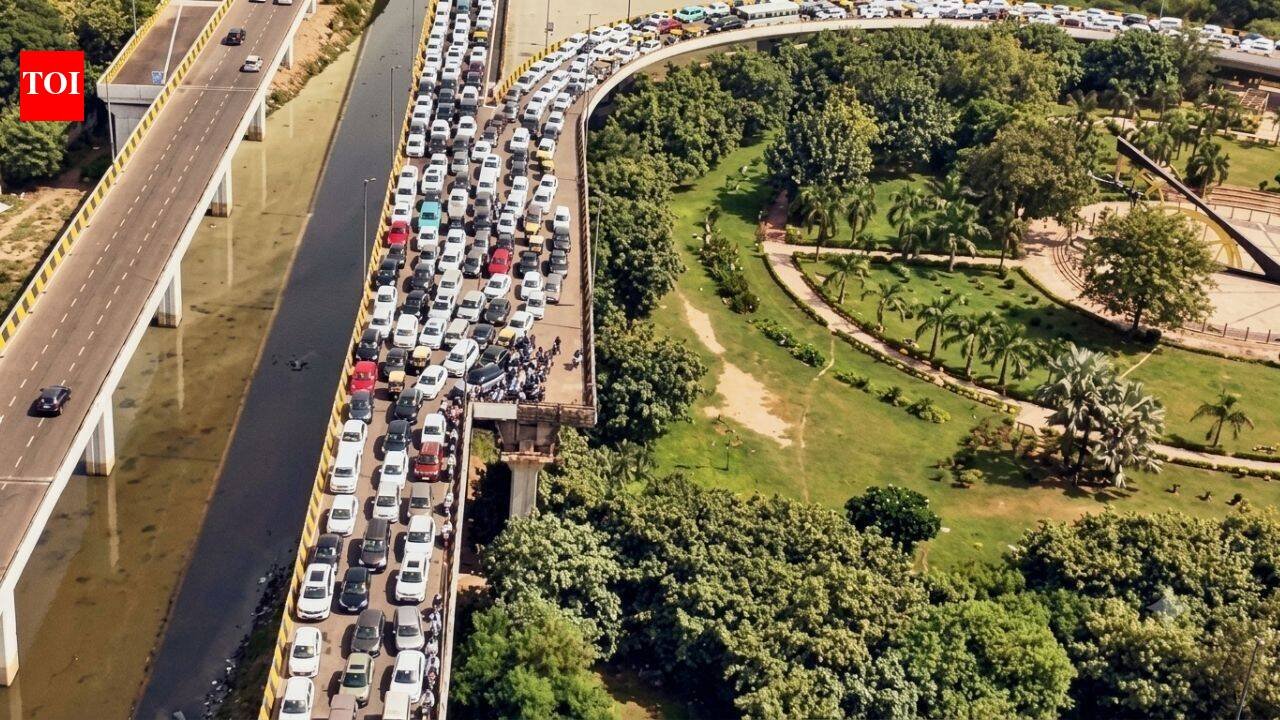
NEW DELHI: The newly opened Barapullah Phase-III corridor has exposed a key design problem near the Sundial Park loop, where traffic from the new spur meets the existing Barapullah flyover.At the merging point, approximately three lanes from the new Barapullah corridor meet three lanes of traffic from the Sundial Park loop. The combined traffic then enters the existing Barapullah stretch, which has only two lanes.
Traffic congestion on the newly opened Barapullah Phase-III corridor has increased significantly since its launch.
The merge also ends abruptly at an angle close to 90 degree angle, making the transition sharper and adding to the bottleneck.The combined traffic then enters the existing Barapullah corridor, which has only two lanes, creating a major mismatch in road capacity.
The problem becomes more pronounced when traffic volumes are high. Traffic police identified the junction as one of the major bottlenecks during an aerial survey conducted after congestion persisted on the corridor.The new corridor has attracted substantial traffic that would otherwise have travelled through NH-24 and the DND Flyway. As more vehicles are funnelled towards the existing Barapullah stretch, the sharp merge and lower lane capacity have created severe congestion.
Commuters reported delays of up to an hour, with traffic tailbacks extending several kilometres on the first day of operation. The congestion subsequently spread to the Ring Road, Outer Ring Road, Mathura Road, DND, Bhairon Marg and other roads in south and southeast Delhi.
Barricades proposed to smooth merge
Traffic police have asked the PWD to place barricades or cones at the problematic junction to alter the geometry and create a tapered, smoother merge. The measure is aimed at preventing vehicles from encountering the abrupt narrowing and reducing conflict between merging streams.
A view of the newly inaugurated Barapullah Phase-3 elevated corridor, in New Delhi on Tuesday.
Traffic personnel have also been deployed at crucial merging points to regulate vehicles and facilitate movement during peak hours. Officials are examining additional measures, including diverting traffic towards NH-24 wherever feasible.
Experts have also flagged the need for better lane channelisation, road markings and treatment of merging areas to guide vehicles through the transition.The Barapullah Phase-III project was approved in 2014 and work began in 2015. Originally scheduled for completion in 2017, the project faced repeated delays. The Rs 1,635-crore corridor connects Mayur Vihar Phase-I with Sarai Kale Khan and merges with the existing Barapullah network, providing onward connectivity towards AIIMS and south Delhi.


