



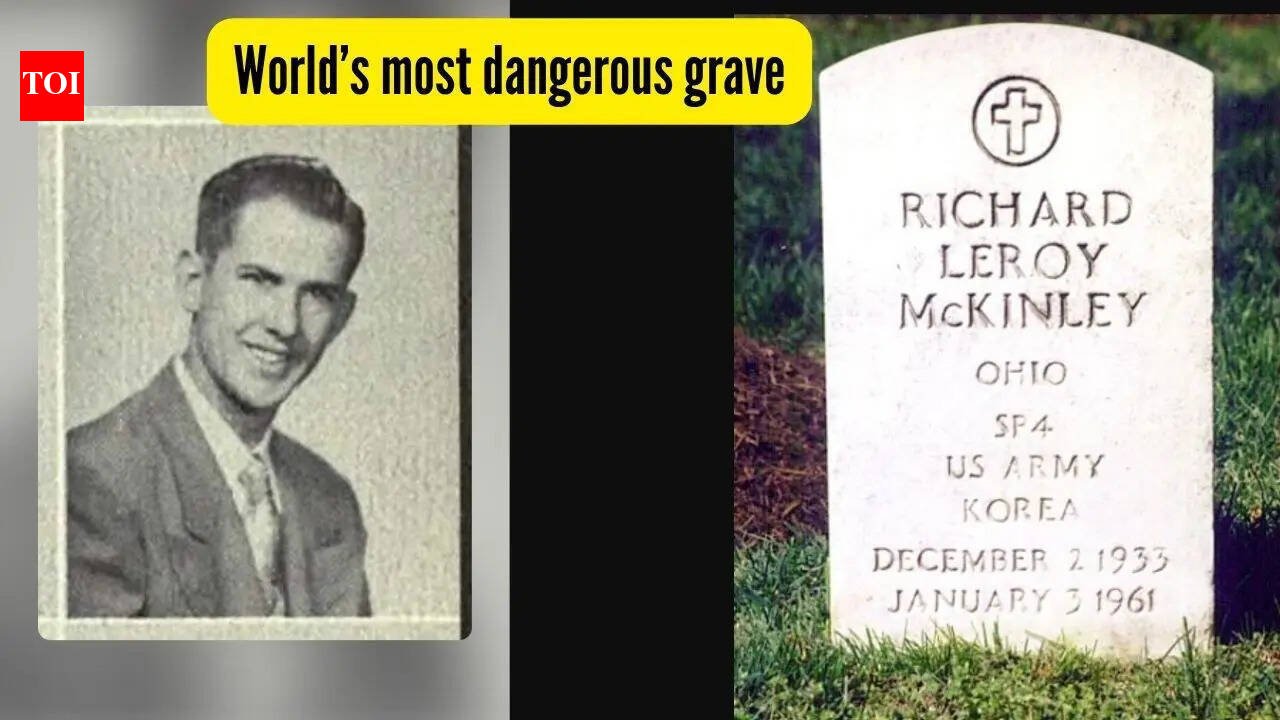
This is not an ordinary story. And this is not an ordinary grave. Situated amid the quiet of Arlington National Cemetery is the grave of a young U.S. Army specialist. People visiting the cemetery are warned not to go too close to this particular grave. Also known as the most dangerous graves in the U.S., you’ll be shocked and saddened after knowing the reason behind it. Unlike the hundreds of other graves at Arlington, McKinley’s grave is not merely a place of remembrance but a controlled containment zone. Official instructions reportedly insist: “Under no circumstances is it to be moved.” Let’s find out whyThe death story of Richard Leroy McKinleyRichard Leroy McKinley’s death in 1961 is among the gravest nuclear accidents ever happened in the history of the U.S. The SL-1 nuclear reactor accident is a haunting reminder of what humans are capable of.McKinley’s story is connected to the Cold War era. It was the time when nuclear technology was advancing in a rapid mode. The experimental reactors were being tested across the United States. McKinley was stationed in Idaho at a remote testing facility where he was a part of a three-man team. These men were responsible for maintaining the Stationary Low-Power Reactor Number One—also known as SL-1. But on the fateful night of January 3, 1961, routine maintenance turned deadly.What happened at the SL-1 Nuclear facility
Canva
During the maintenance, a control rod which was used to regulate the nuclear reaction, was withdrawn manually far beyond its safety limit. In no time, the reactor went dangerous and a fatal explosion released an estimated 20,000 megawatts of power in just 0.01 seconds! It was a sudden burst of energy. The explosion destroyed the nuclear facility, and the three men inside were killed on the spot. But what followed was far more horrific than imagined. McKinley and other two men’s bodies were found heavily contaminated with radioactive isotopes. The recovery teams were completely flabbergasted with the amount of contamination. It was extremely difficult to get the bodies out of the facility. Among all, McKinley’s remains were so radioactive that his burial procedures were called unsafe.Burial operation
canva
Because of this, his burial became an operation. It followed all strict radiological protocols wherein his remains were kept inside a specially designed coffin so that the radioactive particles don’t pollute the surroundings. His coffin was then kept in a sealed metal vault as an added protection. Decades later, the grave still generates curiosity among offbeat travellers. Visitors walking through Arlington National Cemetery pass it without even realizing its historic significance. The weird part is that despite being a critical site, there are no warning signs, no visible barriers.
PC: findagrave.com
How to reach: Ronald Reagan Washington National Airport (DCA) is the closest (about 10–15 minutes away)This grave is a perfect reminder of the unforeseen risks and accidents associated with early nuclear experimentation. While the SL-1 played an important role in shaping future nuclear safety protocols, it did claim some innocent lives which remain etched in our memories symbolising honor and memory.


