



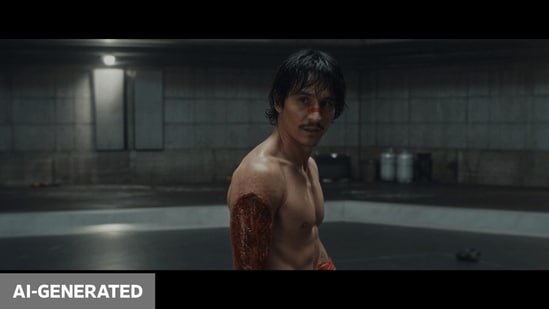
Four street thieves are on the road to hell, literally, in an action-adventure movie debuting at the Cannes Film Festival Thursday. But what’s compelling about “Hell Grind” isn’t the campy plot: It’s that every character, setting and prop in the 95-minute movie was generated by AI.
Startup Higgsfield AI took just two weeks to make the film, and spent $500,000—80% of which went to compute costs.
For the three-year-old San Francisco-based startup, the finished film is essentially a showcase, designed to sell Hollywood studios on the quality of its AI products.
And it debuts as the debate around AI and filmmaking is changing—at least at Cannes.
For years now, AI has dominated the conversation at cinema’s yearly conclave on the French Riviera, with industry players and technologists questioning how much of the moviemaking process—from writing to acting, directing, editing and visual effects—can or should be outsourced to the tech and what it means for jobs and human creativity.
But overall, attendees say the vibe is shifting this year from one of existential fear to cautious acceptance.
During a press conference at the festival last week, actress Demi Moore said actors should find ways to work with the technology. “AI is here. And so to fight it is to fight something that is a battle that we will lose,” she said.
For many in the industry, the question comes down to how it’s used.
“The main aim as a filmmaker is I just wanted to tell stories. This is the case where AI can give you the tool to show the world your story,” said Adilet Abish, an in-house director and creative producer at Higgsfield, who worked on “Hell Grind.”
What might surprise viewers is how much technical film know-how was needed to create the movie, said Adil Alimzhanov, a content lead at Higgsfield who also worked on it.
“You have to understand camera composition, which shots are changed. Like you can’t have two close-ups back to back, you have to start with an establishing shot,” he said. “You still need those filmmaking skills.”
Higgsfield, which was valued at $1.3 billion in its latest funding round earlier this year, crossed $400 million in annual revenue run rate in May. It doesn’t make the actual video-generation models, relying instead on existing tools like Google’s Veo 3. But it does provide the tooling on top to make sure that the visuals are consistent across all the incoming generations.
Lights! … Camera! … Prompt!
The core of the movie-making process here was prompting the AI models and getting clips back, Alimzhanov said. Each prompt would generate about 15 seconds of footage. Those 15 seconds needed to be generated a number of times, with tweaks to the prompt to get the best possible version. The first 25 minutes of the movie required 16,181 initial video generations, which ended up as 253 final shots.
One of the biggest difficulties in making longer-form films with AI is maintaining consistency across the outputs. AI models can be unpredictable, and a feature-length film can’t have scenes that look completely different from one moment to the next.
Because of that, every prompt had to be extremely long and detailed. Each one would typically start with a prefix that defined requirements like style (8k IMAX, photorealistic), lighting (natural light only, “contre-jour” backlight, camera on shadow side) and the type of camera it should look like it was being shot on (“cine lens,” 180-degree shutter motion blur).
The lighting was key to avoiding the AI sheen that typically gets branded as “slop,” said Alimzhanov. AI-generated video tends to over-light scenes in an unnatural way.
That prefix would also have to remind the AI to obey the laws of physics with wording like: “gravity and inertia respected—mass has real weight, correct contact shadows, no floating props.”
The individual prompts were, on average, 3,000 words each.
One aspect of what Higgsfield has built, and sells to clients, is an AI tool that generates these complex, detailed prompts. Users can enter a page from the original script, and the Higgsfield tool will return with a prompt that could be thousands of words long, designed to create production-quality outputs.
And all that prompting is how the company racked up a $400,000 AI compute bill on the project. Co-founder and CEO Alex Mashrabov, however, noted that working with “neocloud” providers, like Nebius and CoreWeave, rather than big hyperscalers, helped it keep costs from going even higher.
But the constant iteration was a necessary part of the process. “I’ve watched hundreds of videos get trashed because Roco’s eye was twitching wrong or his jaw wasn’t clenching or the camera didn’t go all the way to the right,” said Alimzhanov. Roco is “Hell Grind’s” protagonist, who journeys through a dystopian wasteland to save his fellow thief and love interest Lulu.
“You can’t go into AI and say make me a 95-minute cool video.”
Write to Isabelle Bousquette at isabelle.bousquette@wsj.com


