



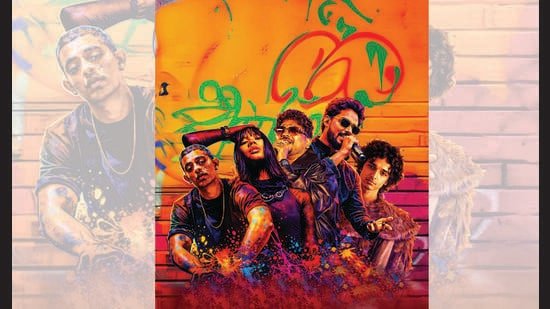
Turn the volume up. India is in the middle of an epic hip-hop takeover. The music – in English and regional languages – was among the top four most-streamed genres in the country, with 490 billion streams. As Billboard launches its awards in India this year, they’re already prepping to formally track DHH (Desi Hip-Hop). India got its own edition of Rolling Loud, the world’s largest hip-hop festival, last year. This year, it is also organising regional warm-ups, club nights and year-round events. Delhi duo Seedhe Maut is taking its sound to Singapore, France, the US and seven more countries this summer. And indie labels are busy signing on the Amdavad sound from Gujarat, desert folk rap from Rajasthan, gaana rap from Tamil Nadu, Dakhini rap from Hyderabad and Karnataka, Koshur rap from Kashmir and more.
Gully Boy references? Leave them back in 2019. The genre is levelling up, branching out and changing our idea of Indian music. Let’s break it down.
Entry is free-ish
There’s less gatekeeping in hip-hop than there is in, say, classical or jazz. “It’s a genre you can participate in without heavy investment or years of training,” says Vidya Venugopal, director at Chennai-based label Atti Culture. “You can go on YouTube, find a beat, pick up a pen, and start writing.” The DIY vibe extends to the recording too. There’s been a sharp spike in the sales of home-studio gear since the pandemic. Most artists start off with a Focusrite interface and condenser mic, and take it from there.
OfRo, the Chennai-based producer who developed Asal Kolaar and Arivu, says that free apps such as BandLab allow a rapper in a small town the same publishing power as a legacy studio in Mumbai. “At its core, hip-hop is about people feeling empowered,” he says. “The feeling of being heard is the first step.” The next, often, is to have something new to say. Hence, new genre-mashups, such as Dapang, which blends global hip-hop with Tamil Nadu’s Kuthu folk beats is one of the many sonic cocktails that only exist here.
Dialect connections rule
In the south, dapang rules, as does gaana rap, which uses the Madras Bashai dialect of Chennai’s streets in its viral anthems. In the north, hip-hop carries the grit of Pahadi drill. In the west, there’s the bass-heavy bounce of Konkani flow. In the North-East, where local music has long been ghosted by the mainstream, hip-hop has changed the locks. “Youngsters want to express the struggles of not feeling accepted,” says 38-year-old Tripura-based rapper Borkung Hrangkhawl. Hip-hop is this generation’s language.
Artists from the region have played Lollapalooza. “When they hear us spit in English, they think we’re from outside India,” Hrangkhawl says. The musicians perform in traditional outfits, turning what was once a drawback into a cool flex. Meghalaya rapper and songwriter Reble (aka Daiaphi Lamare) is 24. But her work has already featured on the soundtracks for Dhurandhar (2025) and Dhurandhar: The Revenge (2026). She also took rap to the Rising Bharat Summit 2026 in Khasi and Jaintiya. In neighbouring Nagaland, Moko Koza has gone viral for rapping about his hometown, Kohima, in Nagamese and English on the 2025 track Kewhira (Remix).
Marathi house is a genre unto its own. Shreyas Sagvekar’s Taambdi Chaamdi draws on traditional Marathi rhythms and features a local kaka (uncle) in the music video. It’s racked up over 54 million views on Youtube and 28.5 million streams on Spotify. It has also been picked up by global heavyweights KSHMR and Spinnin’ Records. Sagvekar played the dholak when he was growing up. He didn’t switch to Marathi – it was always his language of music. “When you see someone comfortable in their own language, you feel like, ‘That’s my brother,’” he says.
Little fires are everywhere
Dalit hip-hop has been around for 15 years, but there’s still plenty to rail against. Vipin Tatad, 28, from Amravati in Maharashtra, doesn’t sing about cars, women and the gangsta life. “Rap is rebellion; it’s about speaking the truth,” says Tatad. Dalit rap, specifically, is about reclaiming the legacy of social reformers like Gadge Baba and Ambedkar. His 2018 track, Samsya Mere Desh Ki, talks about how drinking-water pipes have mixed with sewage lines. It got so much play, that Tatad has talked about it at universities. He’s since given himself an apt stage name: VIP. And he rapped on the track, Crack in the Wall, from the 2022 film Jhund, and Chakka Jaam in the 2022 series Murder in a Courtroom.
Vedan, 31, in his Malayalam track Voice of Voiceless, raps about caste discrimination, the “lived reality” of the oppressed and religious hypocrisy. Alongside, a new subgenre of protest hip-hop is mushrooming. Rapid-response rap addressed specific national crises. Stream Gorjon Kare Jabo (We Will Roar On), by Diksha Dev and Aurko Sengupta. The Bengali and English track pays tribute to the 2024 rape-murder victim in Kolkata’s RG Kar Medical College.
God is watching
Devotional music already accounts for 10% to 15% of the Indian music market share across all platforms, including YouTube, Spotify, and regional streaming services. The 2026 plot twist: Devotional or bhakti rap, in which ancient shlokas are mixed into 808 beats.
In 2020, amid the first COVID lockdown, Chandigarh-based rapper Narci (aka, Shanti Swaroop, 32) releaseda rap retelling of the Ramayana, just as the epic was being re-telecast on screens. Narci’s version drew on the familiar bell sounds from the show’s opening theme, and compressed key moments of the epic into a ten-minute hip-hop narrative. It got 20 million views on Youtube and 8 million streams on Spotify, firing up other artists to explore devotional themes too. Raanjha and Smokey’s 2025 track, Rudra Mahakaal, follows the lives legendary warriors. It has more than 12 million views on YouTube.
“People don’t always have the time to read scriptures deeply,” Narci says. “If we can communicate those emotions through modern forms like rap, it can help them connect.” It explains the current popularity of bhajan parties — youth-focused devotional events that blend chant-based music with club-style staging and high-energy sound design. College festivals and venues across cities such as Ghaziabad, Bengaluru, Noida and Lucknow go wild for artists such as Raghav Raja, who overlays shlokas and Shiva bhajans over hip-hop and drill beats.
Location-sharing is on
Songs and visuals are set in the wrestling pits of Haryana (Chore Haryane Aale by Elvish Yadav and Ankit Baiyanpuria) and the main streets of Shillong (Set It Off by Kim The Beloved and Reble). “The shift happened a decade ago,” says Raghu Babbal, 27, a video director in Mumbai. Naezy owned up to being from Bombay 70 — an area code no one would consider upmarket. For Khamma Ghani, Babbal worked with Rajasthan artist U.D., shooting across Jaipur, Jodhpur, Osian, Jawai and Mumbai, using Nahargarh Fort, the Amer stepwell and Jodhpur’s blue rooftops to match the song’s Marwadi-Hindi texture. On Baalti & Lapgan’s Lime Tikka, the visuals cover everything, from a satellite crash in a village to warding off evil with lime and chilli, “the most Indian thing ever,” says Babbal.
Bollywood is listening
Reble, who contributed to the tracks on the Dhurandhar films, says that hip-hop’s space in mainstream cinema is a sign of “great progress,”, a “coming together as one nation itself”. It reflects India’s language diversity even as it binds us all under a common beat. Film producers know a good thing when they hear it. Saiyaara’s title song was released in a rap version by Rohit Kumar Chaudhary (RCR), an independent rapper and singer from Amritsar last year. Film after film, from the 2022 An Action Hero, to the film Dasara (2023), to Netflix’s 2025 Inspector Zhende, feature hip-hop numbers.
Loyalty is gold
Gen Z fans were in school when they discovered Yo Yo Honey Singh and Mafia Mundeer in 2012-13. They cheered for Divine’s 2017 breakout. They followed the 2024 diss-track battle between Seedhe Maut and Kashmiri hip-hop duo SOS. Gen Z forms 70% of India’s hip-hop listenership. Naman Singh, 27, co-founder of music distribution label Sarvinarck, says “they are now a spending audience.” It means they aren’t hunting for pirated tracks; they have premium Spotify accounts and can pay for concert tickets. Monthly listeners for the scene’s breakout stars have climbed from 5 million to 15 million, signalling a massive shift in spending power.
And brands are sneaking in
In February 2026, snacks company Farmley launched its makhana flour-based snack with a hip-hop song titled Makha Shaka Laka Boom Boom. The campaign featured street-style dance crews such as @FeelCrew_Official and @Crew._X_Official to appeal to younger buyers. Knorr collaborated with Seedhe Maut in May 2023 to introduce K-Pot, a Korean flavoured meal pot. In 2014, Dumb Biryani dissed elaichi in a track of the same name created by Chaar Diwari and Yashraj.
But Converse emerged as a brand that truly “got it”. In August 2024, its Connect With The Unexpected campaign paired up unlikely duos to create new music. What emerged were hits such as Capital, by Karun and Nanku; Huliya, by Pho and BAGI MUNDA; Express Ways, by Krameri and Dhanji; and Her Vacation by Aksomaniac and The Siege. As for Converse, it stayed in the background. The music, however, was exactly where it deserved to be: In the spotlight.
From HT Brunch, March 28, 2026
Follow us on www.instagram.com/htbrunch


