



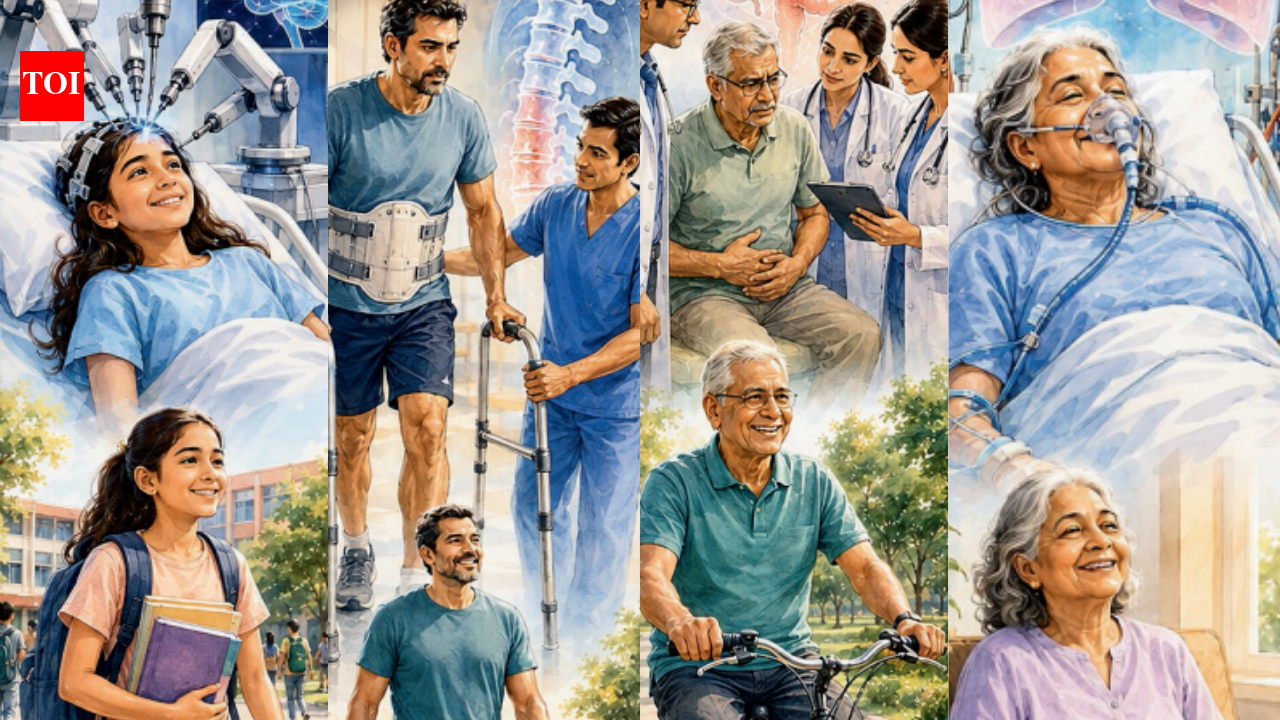
Modern medicine is about restoring lives, not merely saving them. From conducting robotic brain surgeries and life-saving lung transplants to diagnosing rare diseases, doctors are using cutting-edge technology, multidisciplinary expertise and clinical judgement to tackle conditions once considered untreatable. TOI tracks the progress of some of these survivors.A second shot at childhoodFor a decade, a single mother from a Kerala village lived with one hope: that her daughter might one day live a life free of epileptic seizuresThe 12-year-old had battled drug-resistant epilepsy since suffering a severe stroke at the age of nine months. Born with congenital heart disease and dilated cardiomyopathy, she endured one to two seizures every day despite years of treatment. Conventional brain surgery was considered too risky because of her fragile heart.
A second shot at childhood
Determined to find a solution, her mother secured financial assistance through the Kerala chief minister’s relief fund and travelled 2,500 km to AIIMS Delhi in April 2024.After evaluation, a multidisciplinary team led by Prof Manjari Tripathi, head of neurology, opted for robotic thermocoagulative hemispherotomy (ROTCH), an ultra-minimally invasive technique developed at AIIMS. Instead of opening the skull, the procedure disconnects the damaged half of the brain through tiny keyhole pathways, reducing blood loss and surgical trauma.The surgery took a dramatic turn when the girl suffered a cardiac arrest on the operating table. Doctors revived her after nearly 30 minutes before completing the operation.During follow-up, doctors detected a chronic subdural haematoma, a complication that usually requires open brain surgery. Given her fragile heart, Prof Ajay Garg and his neuroradiology team performed a middle meningeal artery embolisation, a minimally invasive procedure that sealed the bleeding vessel and avoided another major surgery.Three months later, the girl was seizure-free.“Earlier, it was tough for her to sit through classes. Now, she feels much better and can lead a normal life,” her mother told TOI.Prof P Sarat Chandra, who led the neurosurgical team, said the case demonstrated what was possible when innovation was combined with multidisciplinary teamwork.Rebuilding life after paralysisFew procedures test the limits of neurosurgery like removing a recurrent spinal tumour that has destroyed a vertebra, invaded the chest cavity and left a patient paralysed.That was the challenge before the neurosurgery team at PSRI Hospital, Delhi, when Kiran Kumar Chetri (40) was admitted in February after undergoing two previous surgeries in Sikkim.
Rebuilding life after paralysis
His tumour had returned aggressively, growing to the size of a tennis ball, destroying a lower thoracic vertebra, compressing the spinal cord and breaching the chest cavity, causing a haemothorax. Within days, he lost movement in both legs and complete bladder and bowel control. The distorted anatomy, previous implants and collapsed spine made another surgery exceptionally risky.A team led by Dr Amitabh Gupta, director of neurosurgery, planned a staged operation involving rib resection, entry into the thoracic cavity, drainage of accumulated blood, and removal of the tumour from both inside and outside the spinal canal. The most delicate step involved freeing the spinal cord, which had been completely encased by the tumour. Once the tumour was removed, surgeons reconstructed and stabilised the collapsed spine.The outcome exceeded expectations for a patient destined for a life of paralysis. Gradually, Chetri regained movement in his legs, bladder control, bowel function and began rehabilitation.“The outcome of operating on recurrent spinal tumours is never guaranteed because each surgery becomes progressively more complex,” Dr Gupta said, attributing Chetri’s recovery to meticulous planning, advanced imaging and coordinated multidisciplinary care.“We can’t imagine he is walking again,” Chetri’s guardian, Milan Subba, said, adding that the Sikkim government paid Rs 7.4 lakh for the treatment.Tummy ache reveals rare diseaseA stomach ache is one of the most common complaints. For doctors at Fortis Escorts Hospital, Okhla, however, one seemingly routine case proved that common symptoms can sometimes conceal extraordinary illnesses requiring innovative treatment.In April 2025, a 61-year-old man walked in with severe abdominal pain that had persisted for two weeks. He had no fever, vomiting, diarrhoea or intestinal bleeding, leaving doctors with few obvious clues. The first breakthrough came after blood tests showed a markedly elevated eosinophil count — white blood cells usually linked to allergies or parasitic infections.
Tummy ache reveals rare disease
Specialists launched an exhaustive search, investigating parasites, food allergies, inflammatory bowel disease and eosinophilic gastroenteritis. Every test ruled out the expected diagnoses.An endoscopy then revealed multiple ulcers throughout the intestines, while biopsies showed dense eosinophilic infiltration, suggesting the immune system itself was attacking the digestive tract.The mystery deepened when a routine cardiac evaluation detected subtle ECG changes and elevated cardiac enzymes. Although a coronary angiography ruled out blocked arteries, a cardiac MRI revealed inflammation of the heart muscle. Soon afterwards, the patient developed numbness in one leg, with nerve conduction studies confirming peripheral nerve damage.Viewed individually, none of these findings pointed conclusively to a diagnosis. Together, however, they painted the picture of eosinophilic granulomatosis with polyangiitis (EGPA), formerly known as Churg-Strauss syndrome — a rare autoimmune disorder in which the immune system attacks small blood vessels across multiple organs.The diagnosis was especially challenging because the patient’s ANCA blood test, commonly used to detect EGPA, was negative. High-dose steroid therapy was started, resulting in a dramatic recovery. The abdominal pain subsided rapidly, his condition stabilised, and he was soon back on his feet.“We diagnosed a rare case of abdominal pain caused by an autoimmune disease that is extremely rare, affecting around one in a million people. On top of that, the disease presenting as abdominal pain is even rarer,” said Dr Shubham Prasad, consultant gastroenterologist.Breathing again after end-stage lung diseaseA year ago, the world of a 65-year-old woman from Faridabad had narrowed to the length of an oxygen tube. Speaking for just a few minutes left her breathless. Diagnosed with end-stage interstitial lung disease caused by scleroderma, a rare autoimmune condition that progressively scars the lungs, she relied on five litres of oxygen every minute. Even daily activities such as bathing and walking had become exhausting.
Breathing again after end-stage lung disease
Today, she can breathe independently. Her recovery follows a successful bilateral lung transplant at Indraprastha Apollo Hospital, marking an important milestone for lung transplantation in north India — a procedure that had previously been successfully performed only once in the region, at AIIMS.Suitable donor lungs are among the scarcest organs available for transplantation because only a fraction of donated lungs meets the criteria for transplant.There was a glimmer of hope for the woman when the family of a 48-year-old man from Noida consented to organ donation after he was declared brain dead.The seven-hour transplant required extracorporeal membrane oxygenation (ECMO) support, a life-support system that temporarily performs the functions of the heart and lungs. This was followed by months of intensive rehabilitation before the transplanted lungs fully adapted.The patient has now resumed an independent life.“Earlier, I found it impossible to carry out even simple activities. Now, I feel energetic and can step outside again,” she said.“Completing one year after a bilateral lung transplant is a significant milestone,” said Dr Avdhesh Bansal, senior consultant, respiratory medicine.According to Dr Mukesh Goel, senior consultant, cardiothoracic surgery, the achievement signals a broader shift in regional healthcare.“Patients from north India once had to travel to Chennai or Hyderabad for such specialised care. Not anymore,” he said.


