






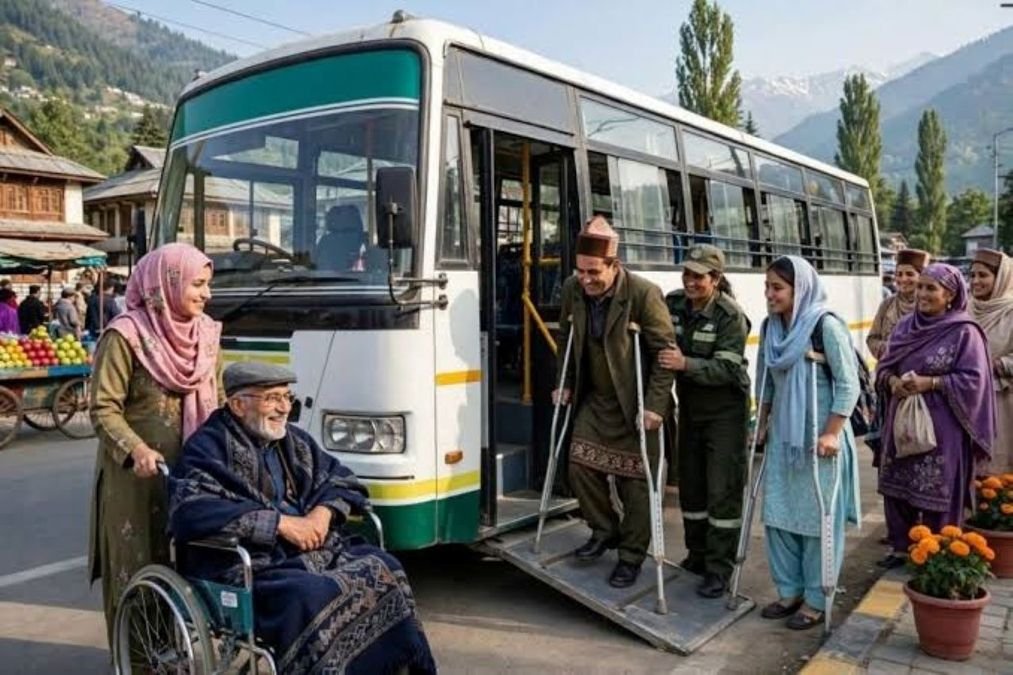
The Jammu and Kashmir Government’s decision to provide free public transport to persons with disabilities is an important policy intervention. The measure, covering Jammu and Kashmir Road Transport Corporation services and e-buses operated by Jammu Smart City Limited and Srinagar Smart City Limited, has the potential to reduce one of the practical barriers that persons with disabilities face in accessing education, employment, healthcare and other public services. It should therefore be welcomed.
At the same time, the announcement provides an opportunity to ask a more fundamental question: what does mobility mean for a person with a disability in Jammu and Kashmir? The answer cannot be reduced to the cost of a bus ticket.
India’s obligations under the United Nations Convention on the Rights of Persons with Disabilities (UNCRPD) provide an important framework for answering this question. Article 9 requires States Parties to ensure access, on an equal basis with others, to the physical environment and transportation, in both urban and rural areas. Importantly, it requires the identification and elimination of obstacles and barriers to accessibility, including those relating to roads and transportation.
The Rights of Persons with Disabilities Act, 2016, which applies in Jammu and Kashmir, reflects this approach. Section 40 requires accessibility standards for the physical environment, transportation, information and communications, while Section 41 places specific obligations concerning transport.
These include accessible facilities at bus stops, access to transport conforming to design standards and, significantly, accessible roads necessary for the mobility of persons with disabilities. Section 41 also provides for incentives and concessions as one component of promoting personal mobility. This distinction is important. The law recognises concessions as part of mobility policy, but it does not treat them as a substitute for accessibility.
A person using a wheelchair may receive a free bus ride but still be unable to reach the bus stop because of an inaccessible footpath. A blind passenger may be entitled to free travel but encounter no tactile guidance, accessible crossing or reliable information to help navigate the route. A person with a hearing disability may reach the bus but be unable to access important travel information if announcements are exclusively audio-based. In each case, the fare is not the principal barrier.
This is why public transport has to be understood as a mobility chain rather than simply a vehicle. The journey begins when a person leaves home, continues through the pedestrian environment and the bus stop, includes boarding and travelling, and ends only when the person can safely reach the destination. A barrier at any stage can undermine the accessibility of the entire journey.
For policymakers, this raises a basic implementation question: how accessible is the infrastructure connecting people to the transport system in Jammu and Kashmir? When was the last comprehensive accessibility audit of roads, pedestrian infrastructure and public transport facilities across the Union Territory? Which roads and bus stops have been assessed against accessibility standards? What barriers were identified? Which of those barriers have been removed? Are accessibility audit reports publicly available?
Author has not found publicly available evidence of a recent, comprehensive J&K-wide audit that would allow these questions to be answered with confidence. This does not establish that no individual accessibility assessments have been conducted by government departments, municipalities or individual projects. It does, however, point to a broader issue: accessibility needs to become measurable, monitored and publicly accountable.
India already has national accessibility standards and guidelines. The Department of Empowerment of Persons with Disabilities lists the Harmonised Guidelines and Space Standards for Universal Accessibility and the Accessibility Standards for Bus Body Code among the standards and guidelines developed under the national disability framework. The issue, therefore, is increasingly one of implementation rather than the absence of a policy vocabulary. Jammu and Kashmir could use the present initiative to establish a much more comprehensive mobility framework.
First, a systematic accessibility audit of major roads, pedestrian routes, bus stops and transport terminals should be undertaken, with the participation of persons with different disabilities. Second, the findings should be placed in the public domain, accompanied by clear timelines and departmental responsibility for remediation. Third, accessibility should be incorporated into the planning and procurement of public transport rather than treated as a retrofit after infrastructure has already been built.
The experience of persons with disabilities should be central to this process. An accessibility assessment conducted without wheelchair users, blind and low-vision persons, deaf persons and people with other disabilities risks measuring compliance on paper rather than accessibility in practice.
There is also a larger policy question about how disability is conceptualised. A welfare-oriented approach asks what additional benefits can be provided to persons with disabilities. A rights-based approach asks what prevents them from participating on an equal basis in the first place. Free transportation belongs within the first conversation, but accessibility belongs firmly within the second. This does not diminish the value of the government’s decision.
On the contrary, it provides an opportunity to build upon it. A free-fare policy can address affordability; accessible infrastructure can address exclusion; accessible information can support autonomy; and reliable enforcement can turn legal rights into everyday reality.
The objective should ultimately be straightforward: a person with a disability should be able to make a journey without having to negotiate a series of avoidable barriers or depend unnecessarily on family members, strangers or the goodwill of transport staff.
The Government has taken a step towards making public transport more affordable for persons with disabilities. The next policy challenge is to ensure that the system itself is accessible. Because mobility is not simply the ability to board a bus. It is the ability to move through one’s community, access opportunities and participate in public life with independence and dignity.
Free transport is a welcome measure. The real measure of inclusion will be whether persons with disabilities can actually use it.
(The Author is the founder of the Indian Society of Disability Studies (ISDS) & Breaking Barriers Fellow with the Department of Empowerment of Persons with Disabilities. He can be reached at: [email protected])


