



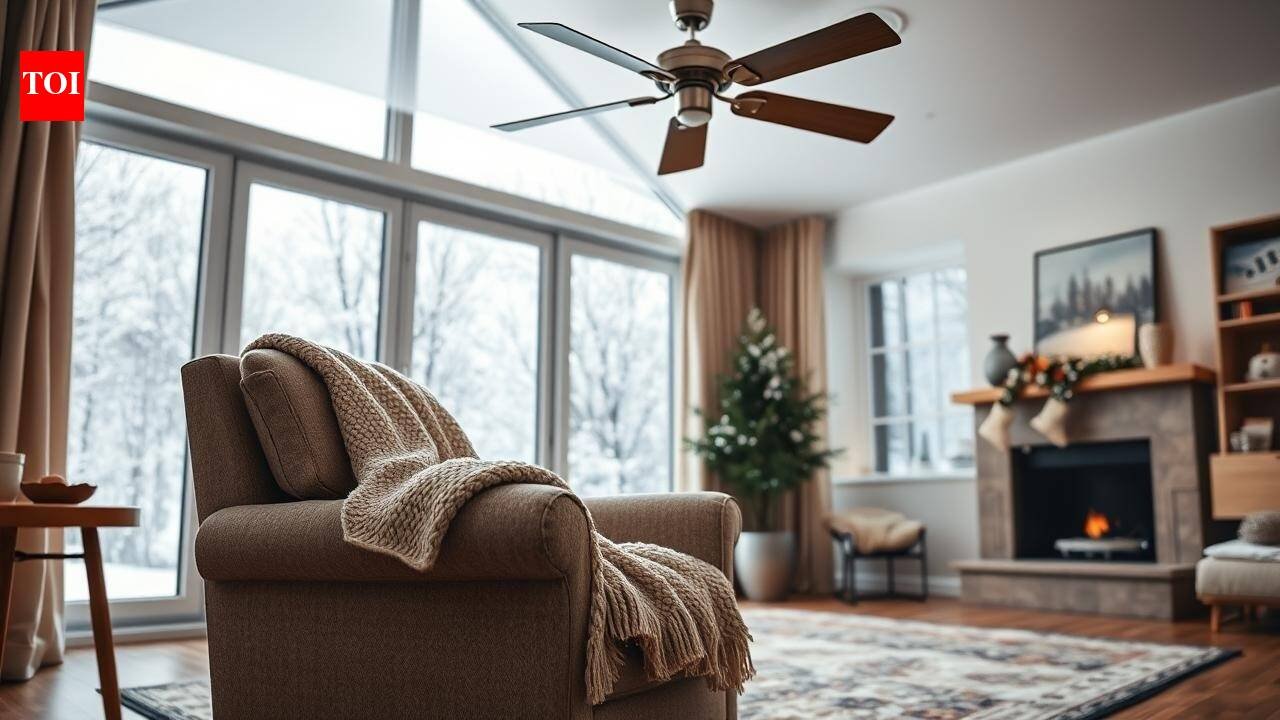
To most of us, the ceiling fan functions simply as an accessory to be enjoyed only during hot weather, and is promptly put back into storage as soon as the first frost arrives. The fan is shut off in September and forgotten about until spring brings its warmth again. However, there is a tiny switch located beside the motor case that transforms this ordinary summer aid into something very useful indeed for the colder seasons. All it takes is to flip the switch and watch as the physics involved opens new doors for your expensive heated air.In the average American household, the winter months are characterised by spending hundreds of dollars keeping warm air blowing inside every room of the house, but then the heat will fail you. Warm air is less dense compared to cold air and therefore floats to the roof of the room, leaving you freezing while you sit on the couch. This separation of the heat causes the furnace to run for too long.The concept of recovering lost heat using a fanThis is when the fan becomes useful. The fan is used as a heat mixing device to bring down the heat that is floating at the roof level back into the space where the people sit. However, if the fan runs in the same way it did during the summer season, it produces a downdraft effect.There is an extensive study conducted in the Energy and Buildings journal on this precise topic. The researchers found out that by reversing the fan direction, it would suck in the cold air from below. This will cause the hot air trapped at the top to move towards the side walls and eventually drop back into the room.It turns out that rotating the fan in reverse helps significantly reduce temperature stratification. Rather than directing the airflow towards people directly, such an appliance helps distribute heated air evenly throughout the room without blowing the air towards people. Consequently, the results indicate that simply mixing up the airflow allows increasing the room temperature at the ankle and waist levels substantially without changing thermostat settings.Balance between Airflow and comfortA frequent concern about air movement that many people have is the cooling effect that wind chill provides. Everyone who worked out had a moment when he or she had to stand in front of a fan or air conditioner to feel cold enough. In July, this phenomenon is a godsend, whereas in January, it is not welcomed at all.
This process reduces furnace run time and allows for lower thermostat settings, saving you money on heating costs.
According to research titled Optimizing indoor air movement for comfort and health, the speed of the fan is just as important as the direction. The study found that when a fan is in reverse mode at a low to moderate speed, the air velocity remains below the threshold that causes a “chill” sensation. Specifically, maintaining an air speed of around 0.1 to 0.4 meters per second allows for effective heat distribution while keeping the “Cooling Effect of Air Movement” (CEAM) low enough that you don’t feel a draft.The study also notes that the clothing we wear affects our perception of air movement. During the winter months, with thicker material and longer sleeves, we become a little less sensitive to the air currents flowing through the room compared to our perception during the warmer weather with thinner materials. This allows you to run the ceiling fan at the low setting in reverse mode, which will hum the warm air down towards you without actually creating much turbulence in the room.A simple procedure to save on heating in the winter monthsOn a day when you have your heat running in your house, stand directly under your fan and see if you feel any air movement. If the answer is yes, then your fan is in the summer setting. Turn off the fan and allow it to spin down before reversing its direction.Running the fan at its slowest setting in the opposite direction, however, will actually improve the mixing of the air within the home. In such a scenario, you should be able to lower the temperature setting on your thermostat by several degrees since the air within the room is already close to the temperature at which the ceiling lights are burning.


