


The conversation around Artificial Intelligence often begins with one question: Will AI replace jobs? But for India’s higher education leaders, the more urgent question is whether universities can evolve quickly enough to prepare students for careers that are already changing. In a world where technologies evolve every few months and employers increasingly value demonstrable skills over academic credentials, the traditional model of higher education is being pushed to its limits.
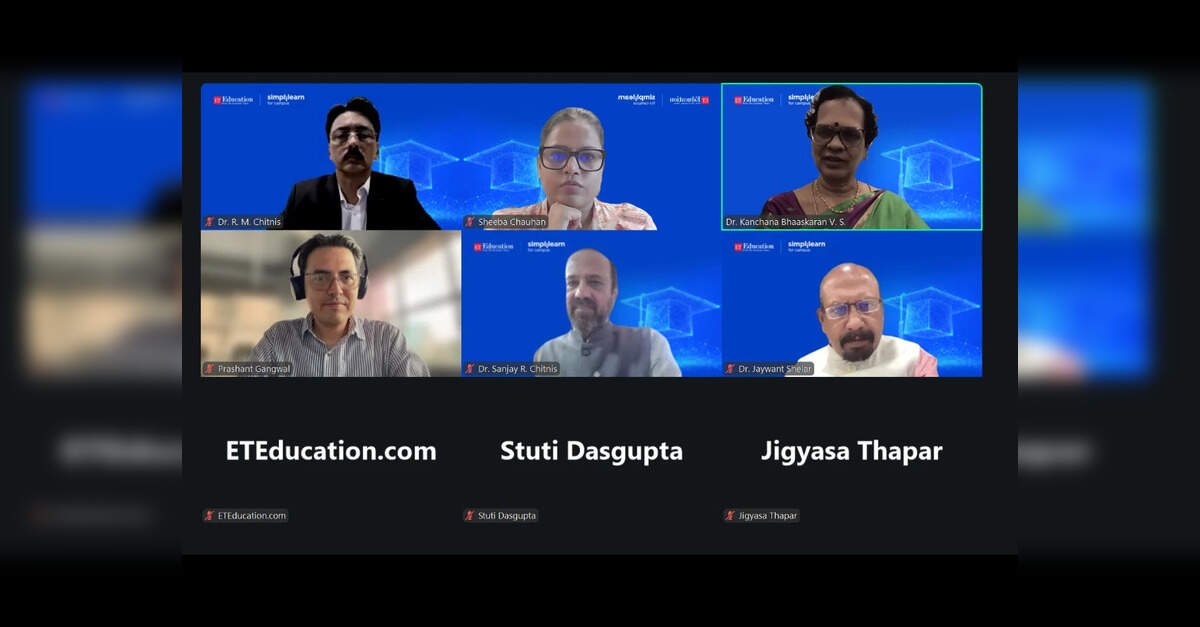
During ETEducation’s and Simplilearn webinar, Reimagining Higher Education with Live Industry-Aligned Digital Skills, Vice Chancellors from leading universities reflected on how institutions are responding to this shift. From embedding AI across disciplines and redesigning curricula to strengthening industry collaboration and promoting experiential learning, the discussion underscored a common belief: the future of higher education will not be defined by the number of AI courses universities offer, but by their ability to cultivate adaptable, innovative and lifelong learners.
Prashant Gangwal, Senior Vice President – Commercial Product & Growth, Simplilearn, who was moderating the session, observed that technology today is advancing far faster than organisations can absorb it. The real challenge is no longer the availability of AI models but the availability of talent capable of using them meaningfully.
AI is becoming a universal skill, not a specialised discipline
One of the strongest messages emerging from the discussion was that AI can no longer remain confined to engineering or computer science classrooms. Whether students pursue law, commerce, architecture, agriculture or healthcare, every discipline will increasingly interact with intelligent technologies, making AI literacy an essential graduate attribute.
Explaining how this shift is unfolding at her institution, Dr Kanchana Bhaaskaran VS, Vice Chancellor, VIT Bhopal University, shared that AI has already become an integral part of learning across multiple disciplines rather than existing as a standalone programme.
“We have introduced AI across engineering, sciences, law, agriculture and architecture. Wherever AI can enhance learning outcomes, it becomes part of the curriculum.
Beyond classroom instruction, VIT has developed an ecosystem that supports practical learning through GPU-enabled laboratories, AI sandboxes, interdisciplinary minors, second majors and specialised programmes in artificial intelligence and machine learning. According to Dr Bhaaskaran, this multidisciplinary approach ensures that students understand not only AI as a technology but also its applications within their own domains.
The discussion reflected a growing consensus among university leaders that AI education must become contextual. Rather than teaching students how AI works in isolation, institutions are increasingly helping learners understand how it can solve discipline-specific challenges, whether in biotechnology, robotics, finance or architecture.
Employers are hiring for capability, not just qualifications
As AI transforms workplaces, university leaders believe employer expectations are undergoing a fundamental shift. Academic credentials continue to matter, but they are no longer sufficient. Organisations are increasingly looking for graduates who can demonstrate problem-solving ability, practical experience and the confidence to work alongside intelligent systems.
Offering his perspective, Dr Sanjay R Chitnis, Vice Chancellor, Reva University, observed that employability today is being measured less by theoretical knowledge and more by demonstrated outcomes.
“It’s no longer what résumé you have; it’s what you have produced.
He emphasised that AI is not eliminating opportunities but changing their nature. While traditional roles continue to evolve, entirely new AI-native careers are emerging across industries. Universities, therefore, must prepare students not only with technical competencies but also with human-centred capabilities such as critical thinking, ethical judgement, creativity and collaboration.
Dr Chitnis also highlighted that programming itself is changing. Instead of focusing exclusively on syntax, students must learn computational thinking, AI-assisted development and product design from the early stages of their education. As AI increasingly automates routine coding, graduates will be expected to conceptualise solutions, supervise AI agents and build products that address real-world challenges.
The message was clear: future employability will depend less on memorising information and more on the ability to learn, adapt and create.
Industry is no longer an external stakeholder—it is becoming part of the classroom
A recurring theme throughout the discussion was the growing integration of industry into academic design. Rather than consulting employers only during placement season, universities are involving industry leaders in curriculum development, mentorship, internships and assessment itself.
At ITM Skills University, this philosophy has become central to academic planning. Dr Jaywant Shelar, Vice Chancellor, ITM Skills University, explained that nearly 40 per cent of members on academic bodies come from industry, ensuring programmes evolve alongside changing market requirements.
Students are introduced to AI from the very beginning of their academic journey, while faculty members are encouraged to pursue industry certifications and regularly engage with organisations to understand emerging trends. The university also integrates concurrent internships, allowing students to work with companies alongside their academic schedules, creating stronger industry exposure and, in many cases, early placement opportunities.
As Dr Shelar succinctly put it,
“Continuous learning will be the mantra for the future.“
That philosophy extends beyond students. Faculty members are equally expected to continuously upgrade themselves as technologies evolve. Several speakers agreed that the pace of AI development makes curriculum revision a continuous exercise rather than a periodic academic process.
Building innovators instead of job seekers
The conversation also challenged the conventional notion that the primary role of universities is to prepare students for employment. Increasingly, institutions are striving to nurture innovators, entrepreneurs and technology creators capable of solving meaningful societal problems.
Sharing examples from MIT World Peace University, Dr RM Chitnis described how the institution has invested in dedicated infrastructure, incubation centres and collaborations with organisations such as IBM, Infosys and Apple to expose students to emerging technologies. One example he cited involved a student whose application, inspired by her grandmother’s difficulty in writing due to age-related tremors, received global recognition from Apple.
For Dr Chitnis, technology becomes meaningful only when it creates tangible value for society.
“Produce graduates who are not only technically competent but capable of conceptualising, designing, building and commercialising next-generation AI-enabled solutions.”
He further argued that faculty upskilling must become a strategic priority, proposing continuous professional development to ensure educators remain aligned with rapidly changing technologies. At the same time, he encouraged universities to focus not only on teaching AI technologies but also on their long-term applications across healthcare, environmental sustainability, manufacturing and entrepreneurship.
The discussion also reinforced the growing importance of innovation ecosystems where students participate in hackathons, multidisciplinary projects, startup incubation and industry-led problem solving. These experiences, speakers agreed, develop capabilities that traditional classroom instruction alone cannot.
The future belongs to lifelong learners
When the discussion turned to the biggest gap in higher education today, the panel identified an issue that extends far beyond curriculum design—the way students are assessed. Several speakers argued that conventional examination systems continue to reward memorisation even as industries increasingly value experimentation, collaboration and problem-solving.
Project-based learning, challenge-based assessments, interdisciplinary collaboration and experiential education emerged as recurring recommendations throughout the conversation. Students, the panel noted, must be encouraged to imagine, build, test and refine solutions rather than simply reproduce theoretical knowledge during examinations.
The leaders also emphasised that curiosity itself needs to become a measurable learning outcome. As technologies continue to evolve, graduates will need to continuously learn, unlearn and relearn throughout their careers. Universities, therefore, must cultivate a mindset of lifelong learning rather than preparing students for a single profession.
The discussion ultimately pointed towards a broader transformation taking place across Indian higher education. AI is not simply changing what universities teach—it is changing how they design curricula, engage with industry, assess learning and define graduate success.
The real campus reset, therefore, is not about adding another technology course or introducing AI as an elective. It is about creating learning ecosystems that are interdisciplinary, industry-connected, experience-driven and capable of evolving alongside technology itself. As India’s universities embrace this transformation, their success will increasingly be measured not by the number of graduates they produce, but by the innovators, creators and lifelong learners they help shape.
