


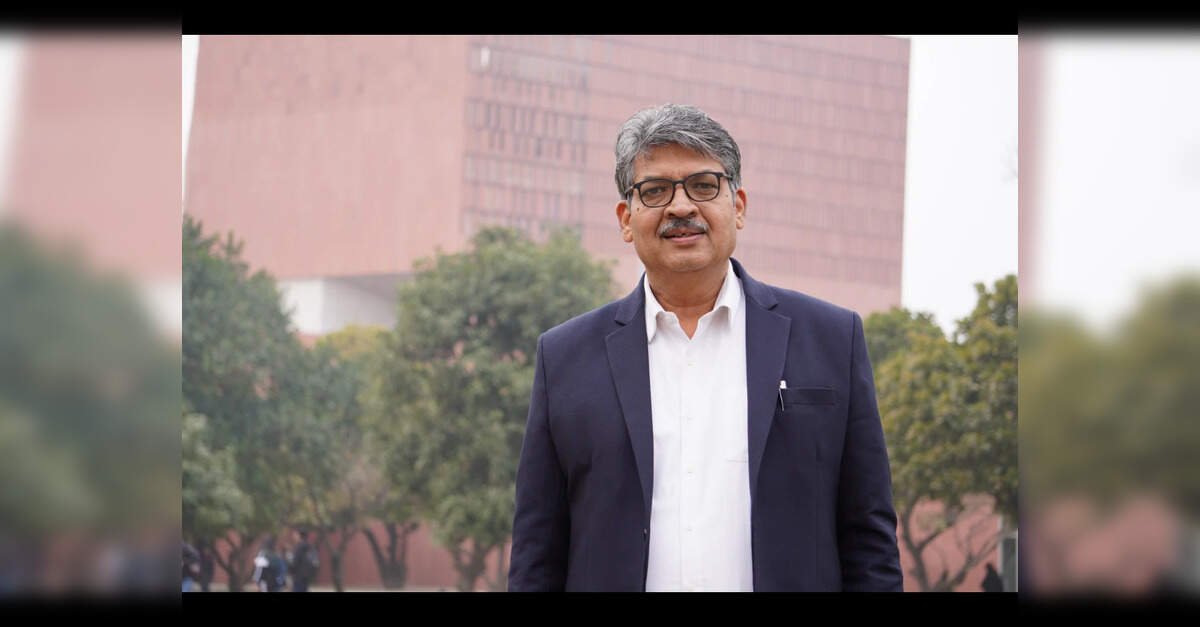
By Prof Ajay Batish.
India achieving a $5 trillion economy is more than a number. It translates to more stable livelihoods and a better standard of living across the country and is historic for its economic influence.
When this goal is discussed, focus is placed on manufacturing, infrastructure, exports, technology, and investment. All of these are undeniably important. Education must be seen as a pillar of this goal and equally prioritised.
No economy can flourish without investing in its people. Stronger economies have been built on greater educational systems for their people. India’s position of having one of the youngest populations in the world, a strong digital economy, and a shift in its entrepreneurial thinking gives it a clear advantage. The focus needs to be on whether we are changing the educational infrastructure of the country fast enough to keep up with its potential.
Employability, not Degree Attainment, is the Issue
India’s educational systems produce millions of graduates annually. However, there are concerns about whether graduates are employed. The number of graduates is less important than if graduates leave the educational systems possessing the skills that are required.
Those who can be critically analytical across disciplines, complexly and systematically solve problems, and are flexible and quick to adapt will create a better tomorrow. These systems and structures do not exist in the current educational systems.
Educational systems must do more than help students pass exams. It is our duty to furnish the youth with the real-world skills that are necessary.
Schools must go beyond simply getting students to pass exams and need to be more concerned about getting future young workers ready to use their skills and the latest tech to survive and thrive in the workplace.
The value of a certification will be determined by how much a student achieves, with the certification being less of an incentive in the future.
Combining Learning and Industry
For India to achieve its objectives in advanced manufacturing, biotechnology, clean energy, semiconductors, artificial intelligence, and aerospace, a highly skilled workforce will be needed.
This puts further emphasis on the need for more integration of higher education and industry.
Partnerships with industry should go beyond college placements. Internships, field projects, joint research, guest lectures, and co-designed programmes enable students to comprehend how classroom learning addresses real-world business challenges.
Universities should not be isolated. They should be major contributors to the country’s talent and innovation systems.
The Campus is the Place for new ideas
Ideas will be as important to India’s economic growth in the next phase as infrastructure once was. Universities will be vital to developing those ideas. The focus of the research and entrepreneurial activities will be to establish an environment where students begin to create, instead of continually consuming knowledge.
The Indian entrepreneurial climate has proven the possibilities. The next step will be to validate that more institutions become hubs to move ideas to the marketplace. Innovation shouldn’t just be an add-on. It should be a regular part of education.
Disciplinary Integration
Many of the problems faced today are interdisciplinary. Artificial intelligence is upending the world of medicine. Climate change requires the collaboration of legislators, researchers, engineers, and economists. The future factory will be reliant on a confluence of data, automation, and digital technologies.
Transdisciplinary learning is a focus of the National Education Policy (2020). It is a welcome addition to the curriculum. The workforce of the future will need to be able to integrate and connect knowledge across several disciplines, as opposed to a singular workforce of specialised disciplines.
The transdisciplinary approach is a necessity, rather than a bonus, for the future. The breaking ground of new technologies is a reality after graduation. After graduating, many relevant skills are obsolete within 10 years. Universities therefore need to partner with the community for education beyond the degree.
The combination of micro-credentials, executive education, and online, flexible and for-credit courses and cohort-based offerings will allow professionals to adapt their learning to the rapidly evolving workforce. In the coming years, the ability to learn new skills and knowledge is going to be one of the most vital skills a person can possess.
Competitiveness Defined by Research
If India wishes to spearhead the global economy, then it must also aim to become the foremost research-led economy. India’s research ecosystem has evolved considerably, but there continues to be large gaps in funded research, applied innovations, and international linkages.
With their skills and resources, universities can address myriad issues including, but not limited to healthcare, agriculture, (not) sustainable, clean/green, and emerging technologies.
Research in this realm is only possible when the government, the private sector, and universities work in tandem.
Growth must also be inclusive
India’s demographic dividend will come to fruition only when all citizens enjoy access to quality education.
While digital innovations have contributed to making education more accessible, gaps still remain with regard to cost, digital literacy, and infrastructure in rural, remote, and marginalised communities. Equity is one dimension of inclusion. Another is ensuring that every deserving individual is given the opportunity to innovate.
India’s research capability and economic potential are proportional to its human resources. The economy of the future is built on education and the foundation of economic infrastructure. When we envision the economy of the future, we think of roads, factories, and digital networks… all necessary.
But a country must not forget to use its unused human potential, as it is equally necessary. Education must not be seen only as government expenditure or social responsibility. It is perhaps the most worthwhile long-term investment.
India already possesses the technical impetus, entrepreneurial spirit, and robust population to emerge as one of this century’s key economies. How well we equip our workers for the future will determine whether we can turn that potential into long-term growth. At the end of the day, capital alone will not build a $5 trillion economy. Critical thinkers, self-confident innovators and purposeful leaders will.
And that adventure starts in our classrooms.
The author Prof Ajay Batish is the Pro Vice Chancellor & Chief Academic Officer of Thapar Institute of Engineering & Technology.
DISCLAIMER: The views expressed are solely of the author, and ETEDUCATION does not necessarily subscribe to it. ETEDUCATION will not be responsible for any damage caused to any person or organisation directly or indirectly.
