



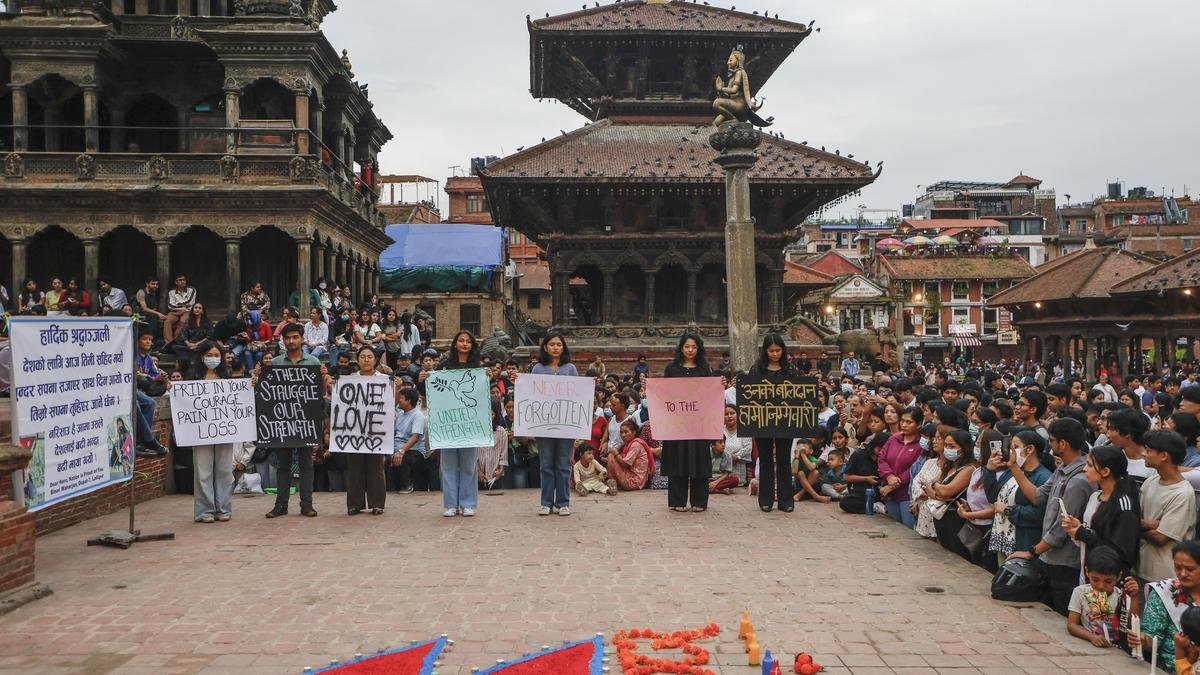
It’s usually still the monsoon season in early September in Nepal, with rainfall gradually tapering off as the month progresses. The weather turns pleasant as the country approaches one of its biggest festivals, Dashain. Tourist arrivals peak at this time of the year.
There was nothing unusual.
What, however, was unusual was this: in a sweeping move, the government on September 4 imposed a ban on 26 social media platforms.
The digital space was abuzz with murmurs, where the youth discussed the government ban and the ills plaguing the country. Corruption, misgovernance, and nepotism dominated these conversations, often directed at Nepal’s political elites. These were not new complaints — but what was different was the medium and the tone: sharper, more irreverent, and largely unmediated by traditional political structures.
Gen Z had not yet properly entered Nepali phraseology, but its presence was already being felt — online, dispersed, and politically unanchored.
Then, suddenly, news broke that Gen Z groups were planning a demonstration on September 8 in Maitighar — the favoured public square in Kathmandu, the capital.
This article is a part of The Hindu’s e-book: Nepal’s new political moment
A small stretch, a stone’s throw away from the Supreme Court and Singha Durbar, the government complex, and about two kilometres from the Parliament building, Maitighar over the years has become synonymous with protests. It is a place where grievances are expressed, demands are put forth, and decisions are questioned. Most of them, however, go unaddressed.
For intelligence and security agencies, a protest planned by youngsters — or so-called Gen Z — was not a major concern. Internal assessments expected a modest gathering with no immediate security threat. Protests at Maitighar were routine; the assumption was that youths would congregate, chant slogans, and disperse.
Kathmandu had what many described as a “strong government” in place. The Nepali Congress and the Communist Party of Nepal (Unified Marxist-Leninist), or CPN-UML, had joined hands to lead the government — the two largest parties in the country.
The simmering tension
What agencies failed to assess was that the issues raised by these loosely connected youth groups resonated far beyond their immediate circles.
Lack of jobs, inefficient service delivery, corruption, patronage-driven politics perpetuated by an ageing political class, and the visible distance between rulers and the ruled had long vexed Nepalis.
The Gen Z call, perhaps unintentionally, drew tacit support from a wider public — many of whom had not been invited, but felt represented. What appeared, on the surface, to be a youth-led protest was in fact tapping into a broader, accumulated frustration.
This was also where a subtle generational shift became visible. Unlike earlier political mobilisations in Nepal, which were organised through parties, unions, or ideological networks, this one emerged from decentralised digital spaces. It lacked hierarchy, but it also lacked the constraints that often come with it.
The protests had no single leader, no fixed structure, and no clearly negotiated demands.
And as often happens in such moments, that fluidity proved both enabling and destabilising.
As slogan-chanting youths began marching from Maitighar towards New Baneshwor, the site of the Parliament building, the crowd swelled. Contrary to the government’s estimates, the crowd was ten times larger — around 30,000.
The first barrier
Less than a kilometre from a major thoroughfare near Parliament stands the Everest Hotel. In front of it, security personnel usually erect barricades during protests when demonstrators attempt to march towards the Parliament building.
A demonstrator waves a flag as he stands atop a vehicle near the entrance of the Parliament during a protest against corruption and government’s decision to block several social media platforms, in Kathmandu.
| Photo Credit:
REUTERS
On that day, however, the barricade was inadequate — perhaps due to a serious underestimation by security personnel. Protesters and police faced each other, separated by iron railings. What began with stone-pelting soon escalated into a breach of the barricade. The crowd moved beyond the control of security personnel.
A group went on to breach the Parliament compound.
At around 12:30 pm, a curfew was announced. Many protesters on the ground were unaware of the order. With the curfew in place, police were instructed to open fire “to protect government property.”
Despite curfew orders, protesters continued to gather in different parts of the capital and marched towards its core. As the day wore on, protests spread across different parts of the country.
The breaking point
By the evening of September 8, at least 19 youths had been killed in police firing. There was no word from then Prime Minister K.P. Sharma Oli.
On September 9, the protests were no longer limited to the youths who had initially called for peaceful demonstrations. The killings of the previous day transformed the mood, drawing people from across social and economic backgrounds into the streets.
With crowds overwhelming security personnel, chaos descended on the capital. The Supreme Court, Parliament building, Singha Durbar, private business complexes, government offices, and even the presidential residence faced the ire of protesters.
What had begun as a loosely organised peaceful youth mobilisation had now turned into a broader public uprising.
Protest organisers later claimed their movement had been “hijacked.” What exactly transpired remains unclear and will likely depend on the findings of the commission formed to investigate the events of September 8 and 9.
Court personnel gather under makeshift tents beside heaps of charred vehicles at the torched Supreme Court premises in Kathmandu on September 14, 2025, to provide legal services to Nepali nationals after judicial operations resumed. Nepal’s new leader Sushila Karki vowed on September 14, to follow protesters’ demands to “end corruption” as she began work as interim prime minister, after “Gen Z” youth demonstrations ousted her predecessor.
| Photo Credit:
AFP
By the afternoon of September 9, Mr. Oli resigned.
The country remained in turmoil as flames and plumes of smoke rose into the sky. Nepalis were left wondering what would come next. There was a political vacuum.
With the old political class effectively sidelined, calls grew for President Ram Chandra Poudel to step forward. But instead, an unexpected actor stepped into the centre of events — the Nepal Army.
Army chief General Ashok Sigdel began holding talks with representatives of the protesters, despite the absence of any clearly defined leadership among them. The shift in power towards Jangi Adda, as the Army headquarters is known, raised concerns. Those concerns deepened when Gen. Sigdel appeared on national television instead of the President.
As the army took control of the streets, a semblance of calm returned. But unease lingered.
Amid this uncertainty, Kathmandu Mayor Balendra Shah — who had openly supported the protests and was increasingly seen as their most visible face — endorsed former Chief Justice Sushila Karki as the next Prime Minister. He also urged protesters to resist engaging with the Army until Parliament was dissolved.
On September 12, President Poudel appointed Karki as interim Prime Minister, with a six-month mandate to hold elections. Soon after assuming office, she dissolved Parliament.
The interim challenge
Ms. Karki had built a reputation for her anti-corruption stance, but doubts quickly emerged about her ability to steer the country towards credible elections.
Mr. Oli, it later emerged, had been evacuated by an Army helicopter during the unrest. He resurfaced two weeks later, largely unchanged in tone. Expressing no remorse over the September 8 killings, he instead focused on the vandalism and arson of September 9, describing the uprising as a “counter-revolution” driven by “external forces” aimed at “destabilising” Nepal.
The old guard, in many ways, appeared unable — or unwilling — to fully grasp the nature of what had unfolded.
Nepali Congress President Sher Bahadur Deuba and his wife Arzu Rana were also attacked at their residence during the unrest.
The UML rejected the election process outright, branding the Karki government unconstitutional and petitioning the Supreme Court to reinstate Parliament. The Congress adopted a more cautious approach, with its second-generation leaders acknowledging the grievances of the youth.
Yet without the cooperation of the two major parties, doubts persisted over whether elections scheduled for March 5 would proceed.
The international community, including India, meanwhile, quickly extended support to the interim government, emphasising that elections remained the only democratic path forward.
The shifting ground
As weeks passed, Nepal gradually slipped back into its familiar rhythms.
Within a month, the country celebrated Dashain with its usual fervour. Tourists returned. Businesses resumed.
The Gen Z protests, however, continued to dominate public discourse, but efforts to translate their demands into policy remained limited. The absence of structure that had initially enabled mobilisation now became a constraint — there was no unified leadership to negotiate and no clear framework to implement.
Prime Minister Karki once remarked that she did not even know how many Gen Z groups there were, and that each had its own set of demands.
Calls for ending corruption and establishing clean governance remained powerful, but diffuse.
Instead, the Karki government found itself mired in controversies over nepotism and favouritism — the very practices that had triggered the protests. The contradiction was difficult to ignore.
Meanwhile, youth migration continued unabated. With one in five people unemployed, an estimated 2,300 Nepalis used to leave the country each day in search of opportunities abroad. The trend continued.
The protests began to feel distant — less like a rupture and more like an interruption.
And yet, something fundamental had shifted.
The uprising did not just unsettle Nepal’s political establishment; it reshaped public expectations. Discontent was no longer isolated — it had become collective, visible, and politically consequential.
“Change” emerged as the dominant public vocabulary. But it remained deliberately broad — encompassing accountability, generational renewal, better governance, and, for many, simply dignity in everyday interactions with the state.
The verdict
After months of uncertainty, March 5 arrived.
Around 60 percent of Nepal’s roughly 19 million registered voters turned out, including about one million added to the rolls after the Gen Z protests.
The Rastriya Swatantra Party (RSP), founded just four years earlier, emerged as the biggest beneficiary of this moment. It had not led the protests, but it became their closest political expression.
Its appeal lay less in detailed policy and more in what it symbolised — a break from the entrenched political order.
In late December, Mr. Shah, the Kathmandu mayor and the undeclared leader of the Gen Z protests, joined the RSP. His presence gave electoral shape to the party’s campaign.
When party chief Rabi Lamichhane declared Shah as the prime ministerial candidate, the election took on a sharper meaning — not just a contest between parties, but between continuity and rupture, between the status quo and change.
The Shah-Lamichhane combination proved decisive among voters seeking a departure from the past.
The RSP now stands poised to form a majority government, securing 182 seats in Parliament — just two short of a two-thirds majority. At 35, Shah is set to become the youngest Prime Minister in Nepal’s history.
The outcome reflected less a wholesale endorsement of a fully formed alternative and more a decisive rejection of the old guard.
Epilogue
Winter is drawing to a close. Temperatures are beginning to rise. Yet this is also the time when Kathmandu, a bowl-shaped valley, struggles with severe pollution. People wait for rain, hoping it will clear the smog and haze.
As Shah prepares to take the oath as Prime Minister, Nepal’s political horizon appears similarly clouded.
A stable government — something Nepalis have long yearned for — now seems within reach. But stability, by itself, does not guarantee transformation and reform. Expectations remain high. Translating them into structural change — dismantling patronage networks, improving governance, creating jobs, and restoring trust — will be far more difficult than mobilising anger.
The question is no longer whether change is necessary. That consensus has already been forged on the streets and at the ballot.
For now, Nepal waits — much like it does for rain — hoping that when it finally arrives, it clears more than just the air.
Sanjeev Satgainya is a senior journalist and political columnist from Nepal


