



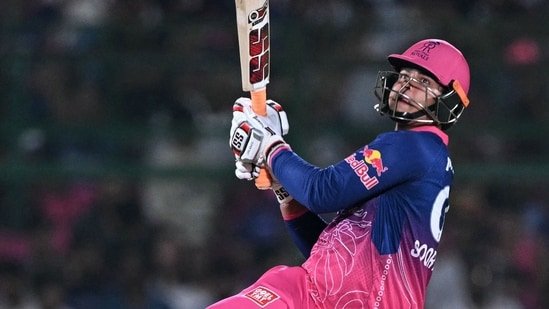
Vaibhav Sooryavanshi’s IPL 2026 has already been defined by violence. The numbers have carried the force of a teenager playing without fear: 579 runs off 245 balls, a strike rate of 236.32, 50 fours, 53 sixes, and nearly 90% of his runs coming in boundaries.
That has become the public image of his season. Sooryavanshi as shock therapy. Sooryavanshi is the young left-hander who can turn the first ten balls of an innings into a wound the opposition never closes. Yet beneath the obvious destruction, a deeper layer of development has emerged. He is beginning to show that his game is not built only on early explosion. He is learning when to wait, when to let the innings breathe, and when to take ownership.
The first sign came against KKR
Against the Kolkata Knight Riders, Sooryavanshi made 46 off 28 balls. By his standards, that almost looked restrained. His strike rate was 164.28, strong by normal T20 standards but well below the range he has created for himself this season.
The innings needs the match around it. Rajasthan Royals finished with only 155/9. Their opening stand was 81 in 8.4 overs, and after Sooryavanshi fell, the innings lost its spine. The rest of the batting produced only 74 runs for eight wickets. That collapse gives the opening partnership its proper value. This was not a flat surface where the openers failed to maximise. This was a game where both Sooryavanshi and Yashasvi Jaiswal had to build because the pitch and bowling did not allow the usual free-hit rhythm.
Vaibhav Sooryavanshi still played the more aggressive hand. He struck six fours and two sixes, but the continuous early acceleration that has marked most of his bigger knocks did not arrive. Jaiswal, too, was held to 30 off 24 while Sooryavanshi was at the crease. The partnership became less about intimidation and more about preservation with scoring pressure attached.
For a batter whose identity has been built on forcing the match to move at his speed, the KKR innings showed a valuable adjustment. He accepted the contest’s pace, stayed long enough to give Rajasthan their only stable phase, and left them at 81/1. What followed after his dismissal made that 46 look less like a missed blast and more like a controlled contribution on a difficult batting day.
LSG showed the sharper maturity layer
The innings against Lucknow Super Giants yielded different kinds of evidence. On paper, it looked like another Sooryavanshi demolition: 93 off 38 balls, seven fours, ten sixes, strike rate 244.73. The final line screamed destruction. The beginning told a very different story.
His first 10 balls produced only five runs. The sequence was brutal in its quietness: 0, 0, 1, 0, 0, 4, 0, 0, 0, 0. Eight dots in the first 10 balls. One boundary. No six. It was almost anti-Sooryavanshi.
That opening phase was unlike the usual pattern of his season. In most of his big knocks, he has used the first 10 balls to attack the match directly: 28 against CSK, 28 against MI, 27 against RCB, 36 against SRH, 30 against PBKS, 27 against DC. Against LSG, Mohsin Khan and Mayank Yadav denied him the early rhythm. They did not give him the clean access he often feeds on. The lines were tight enough, the lengths awkward enough, and the early contact uncertain enough to drag him away from his most natural mode.
The maturity of the innings came from his reaction to that drag. He did not try to manufacture his way out of the slow start. He did not respond to dot-ball pressure with blind hitting. Rajasthan were chasing 221, but Jaiswal had already given the innings oxygen from the other end. That allowed Sooryavanshi to stay inside the chase without forcing the tempo.
The opening stand reached 75 in 6.3 overs. While Jaiswal was there, Sooryavanshi was 25 off 16. That was not a busy strike rotation in the classic sense, because he had only one single in that phase. The more important sign was acceptance of the role. He understood that Rajasthan did not need both openers to attack simultaneously. Jaiswal was carrying the early assault, so Sooryavanshi allowed himself to absorb the harder phase.
Once Jaiswal fell, the innings changed shape. Sooryavanshi scored 68 off his next 22 balls after the dismissal. The split captures the entire story: 25 off 16 while Jaiswal was present, 68 off 22 after Jaiswal was gone.
That was not random acceleration. It was a role change. He had started as the quieter partner because the chase had room for it. After Jaiswal’s wicket, he became the tempo owner and turned the innings into familiar territory.
The aggression stayed intact
The best part of the LSG innings was that Sooryavanshi did not lose his natural game while showing patience. Rajasthan do not need him to become a low-risk accumulator. His value comes from damage, and that damage remained alive even after the slowest possible start for a player of his profile.
From 5 off 10, he reached 93 off 38. That means he scored 88 off his next 28 balls. The early dots did not shrink him. They only delayed the explosion. After the first release came, he moved through gears with frightening speed: 25 off 16, then 49 off 22, then 82 off 31, and finally 93 off 38.
By the time he was dismissed at 180/2 in 13.6 overs, Rajasthan needed only 41 from 36 balls. The chase had been reduced from a mountain into a formality. He had not only repaired his own strike rate; he had broken open the match.
That is the real developmental signal. Sooryavanshi has already shown he can destroy attacks from the first over. Against LSG, he showed he can survive a beginning that does not suit him, read the innings through his partner’s tempo, and still return to his most dangerous form once the moment arrives.
The teenage hitter is becoming a batter
Sooryavanshi’s season still belongs to the spectacular. His 52 off 17 against CSK, 39 off 14 against MI, 78 off 26 against RCB, 103 off 37 against SRH and 43 off 16 against PBKS all carry the same broad signature: early disruption, boundary overload, bowlers forced into panic before they can settle.
KKR and LSG add depth to that picture. The KKR innings showed he could construct when conditions denied easy hitting. The LSG chase showed he could read his partner’s tempo, delay his own assault, and take charge once the innings required a new driver.
This is the mature side of Vaibhav Sooryavanshi: a high-damage batter beginning to understand sequence, role and timing.
The first version of Sooryavanshi could win passages through shock value. The version emerging now can shape an innings before destroying it.


