



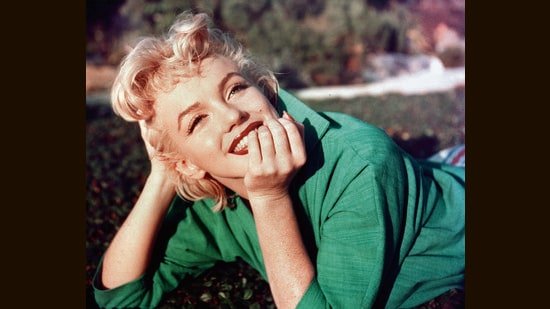
In 1944, Norma Jeane Dougherty’s husband James was shipped out to World War II’s Pacific theatre. Norma Jeane, like so many soldier wives, moved in with her in-laws and went to work at the Radio Plane factory. The Radio Plane Company manufactured small radio-controlled airplanes that Army gunners used for target practice. Dougherty’s mother was a nurse in the company infirmary. Norma Jeane worked on the assembly line as a chute-packer and glue-sprayer.
The next year, the US army sent photographers to Radio Plane to film women engaged in war work. One of them, Corporal David Conover, took pictures of 19-year-old Norma Jeane. When he saw the developed photographs, he told her that she was pretty enough to be a model.
Norma Jeane waited until her husband, then home on shore leave, returned to duty. The day after he left, she moved out, quit her job, and never returned.
Conover took more pictures of her for Yank magazine. He showed these to a friend, who put her in touch with the Blue Book Modeling Agency in Los Angeles, which in turn recommended her to a talent scout, who then landed her a screen test at Twentieth Century – Fox (now 20th Century Studios). Norma Jeane dyed her hair blonde and signed the contract as Marilyn Monroe, borrowing Marilyn from the Broadway star Marilyn Miller and Monroe from her mother. As the world marks the centenary of her birth this month, her story continues to resonate, and not just because of the glamour.
It’s hard to overstate how important this contract was to her. It was a foot in the door that Norma Jeane had been dreaming of since she was a child, abandoned by a mentally ill mother in an orphanage; an entry into the world of the movies, her only safe refuge from a series of abusive foster homes, where she was sexually exploited and blamed for inciting that abuse.
But by the time her contract expired a year later, she had only played negligible roles in two insignificant films. Worse, Darryl F Zanuck, the chief of production, found her unattractive. Her contract was not renewed.
She joined the “party circuit”. Soon, she was a regular at Joe Schenck’s high-stakes gin-rummy game, which took place every Saturday night. Schenck was the board chairman of Twentieth Century – Fox and one of the richest and most influential men in Hollywood. The game was attended by Hollywood’s most powerful studio executives. And Monroe and other aspiring movie stars were expected to spend time with Uncle Joe’s friends in return for dinner and the opportunity to meet the men who could make their careers. She also became a regular at producer Sam Spiegel’s parties.
It was at one of these that she met Johnny Hyde, one of Hollywood’s most influential agents. He was, according to biographer Barbara Leaman, the first person to see her as she saw herself. Within weeks, Monroe had become Hyde’s lover. He helped her get small but visible roles in high quality pictures: John Huston’s The Asphalt Jungle (1950); Joseph Mankiewicz’s All About Eve (1950). Hyde died when she was 24, and his death stalled her career briefly, but by this time, the Marilyn Monroe persona: the breathy baby voice, the hip-swaying walk, the chest-outthrust posture were all in place. More movies followed. Not stardom, not yet, but critical attention and fan adoration. The army newspaper Stars and Stripes pronounced her Miss Cheesecake of 1951, and thousands of letters poured in every week. She was a star without headlining a single film.
AMERICAN IDOL
Monroe’s films in the 1950s were popular, but with the possible exceptions of Billy Wilder’s Some Like It Hot (1959) and Henry Hathaway’s Niagara (1953), are not “classics”. Instead, what we have is a series of iconic images: Monroe in a pink dress, singing Diamonds Are a Girl’s Best Friend; standing on a subway grate holding down her skirt, in The Seven Year Itch (1955).
She was now a sex symbol, an archetype of the dumb blonde who comes out on top through sheer naivete, but it also meant that she was not considered an “actress”. She had expected popularity to open those doors – and they did not open. She had been working closely with acting coach Natasha Lytess since 1948. Lytess was her Pygmalion, advising her on her reading: Rilke, Tolstoy, Dostoevsky, and Proust; music: Schubert, Brahms, Beethoven and Mozart. She was also taking drama, diction and singing lessons. According to Lytess, she would immediately know when something about her performance was “off”, but did not know how to fix it.
By 1955, she was one of the biggest stars in Hollywood. But the good roles eluded her. So she moved to New York to learn the new acting technique, the Method, under one of its leading gatekeepers, the coach Lee Strasberg, at America’s hottest acting school, the Actors Studio. Strasberg and his wife Paula welcomed her, but the Method demanded the use of affective memory or emotional recall, requiring actors to dig into their own past traumas to bring genuine emotion to a character. For Monroe, this was so emotionally stressful that she would visit her psychiatrist before her session with the Strasbergs. The pressure also increased her already considerable drug use. She died of an overdose of barbiturates in 1962. She was 36.
She left most of her fortune to the Strasbergs. A host of conspiracy theories. And some unforgettable images, including Andy Warhol’s iconic painting, which came out that year. Madonna’s Material Girl paid homage to Monroe, including the iconic dress. Biographies and biopics came out at regular intervals. Lee Strasberg’s third wife, actor Anna Strasberg turned Monroe’s legacy into a multi-million dollar payday, periodically auctioning off iconic items, including the figure hugging dress she wore to sing Happy Birthday to US President John F Kennedy in 1962, which would return to the news when worn (and torn) by reality star and entrepreneur Kim Kardashian at the Met Gala in 2022.
We make myths of those who die young. Percy Shelley. John Keats. Carole Lombard, James Dean. Kurt Cobain. And Marilyn Monroe. Forever frozen in time. Forever glamorous, forever alluring. The sex symbol that she worked so hard to construct forever overshadowing the actress she wanted to be.
(K Narayanan writes on films, videogames, books and, occasionally, technology)
.
MORE ON MONROE…
* The actor’s sultry voice was no accident. The deliberate, unhurried pauses and coy trills that blurred the lines between speech and song were the result of a childhood stutter that Monroe struggled to mask. Working with a therapist, she learned breathing and pacing techniques, not predicting that they would one day help give Hollywood one of its most iconic voices.
* Monroe was married three times. Each marriage, and each separation, shaped a phase in her life. At 16, in 1942, she married James Dougherty, a merchant marine, to avoid being sent to an orphanage or foster home. Their marriage ended in 1946, as her modelling career began to take off. She dated baseball superstar Joe DiMaggio, marrying him in 1954. They separated nine months in. In 1956, Monroe married the playwright Arthur Miller. They worked together on the film The Misfits (1961), written by Miller, but divorced later that year.
* By 1953, Monroe had become a pop-culture phenomenon, featuring on magazine covers and in advertisements. She starred in two major box-office hits that year alone: Gentlemen Prefer Blondes and How to Marry a Millionaire. She was nicknamed the Most Advertised Girl in the World by the Advertising Association of the West that year.
* She was determined to be taken seriously as an actor, and attempted to show true talent, in films such as Niagara (1953; in the role of a femme fatale) and Bus Stop (1956; in the role of a naive, hopeful saloon singer). As the shaky, clumsy Cherie in Bus Stop, she broke out of the blonde-bombshell stereotype and earned a Golden Globe nomination. Later, in The Misfits , she delivered a career-defining performance as the newly divorced Roslyn navigating loneliness in Nevada.
* She was also a producer, founding Marilyn Monroe Productions in 1955 with photographer Milton Greene. She independently produced one film, The Prince and the Showgirl, in 1957. She died from an overdose of sleeping pills, in 1962. She was 36.


