






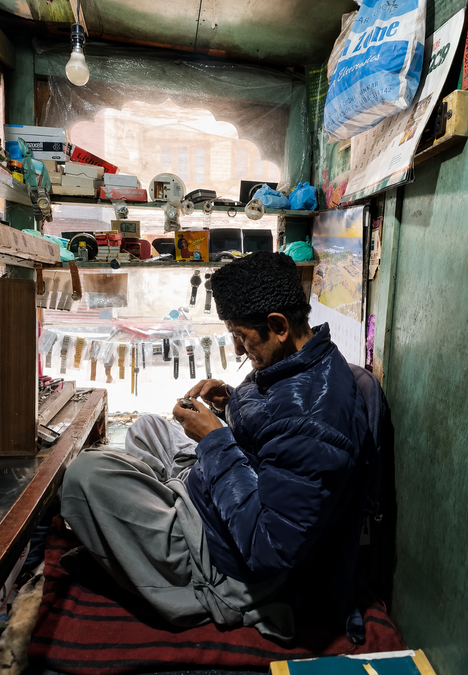
In the old lanes of Fateh Kadal in Srinagar, Mohammad Shafi Zargar sits at his workbench surrounded by watches. Some are ticking, some have stopped, while others are waiting to be brought back to life. For more than five decades, Zargar has worked with these tiny timepieces, carefully opening them, examining their delicate mechanisms and repairing them by hand.
Zargar learned the craft from his father when he was young. What began as a skill passed down through the family eventually became his profession and livelihood. There was a time when his small shop remained busy, with customers bringing everything from ordinary wristwatches to branded timepieces for repairs. A broken watch was rarely something people simply threw away. They repaired it, preserved it and often kept it for years.
“Today, there is hardly any work. Earlier, this profession was doing very well, but now it does not. No one would prefer this work today, and my children will not take it up either, because there is no livelihood in it anymore,” Zargar says.
His words reflect the struggle of a craft that once provided a dependable livelihood but is now slowly losing its place in everyday life. The rise of smartphones, smartwatches and modern gadgets has changed the way people keep track of time. A phone is now enough to tell the time, while smartwatches offer a range of features that traditional watches cannot.
As technology moved forward, the demand for traditional watch repair gradually declined. Today, much of Zargar’s work is limited to changing cells, repairing straps and carrying out minor fixes. The complicated mechanical repairs that once kept him busy have become increasingly rare, and the steady flow of customers has slowed.
For Zargar, the decline is not only about fewer customers. It is also about the future of a profession that once supported families. He knows that the work can no longer provide the kind of income it once did. His children, he says, are unlikely to follow in his footsteps because there is little financial security in the trade.
Yet Zargar continues to return to his shop every day. His hands still move carefully over tiny mechanisms, just as they have for decades. He continues to repair whatever comes his way, even if the work now comes only occasionally.
His story is not simply about an old watchmaker struggling to find customers. It is about a traditional skill slowly disappearing in a world where repairing has increasingly given way to replacing. A watch that once stayed with a person for years can now be discarded or replaced when it stops working, while newer devices constantly take its place.
Inside Zargar’s shop, however, time still has an older meaning. Every watch on his table carries a history, a gift, a memory, a family connection or simply a reminder of another time. For him, repairing these watches is not just about fixing a mechanism; it is the work he has known for most of his life.
With smartphones and smartwatches dominating the way people keep track of time, Zargar remains in the old lanes of Fateh Kadal, surrounded by ticking clocks and tiny tools. His profession may no longer provide the livelihood it once did, but for now, he continues to keep these old watches running even as the craft itself slowly runs out of time.


