



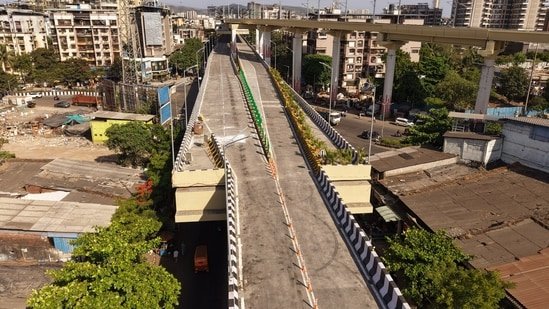
Krishna Gupta, an advocate and activist in Mira-Bhayandar, Mumbai, had seen a brand-new ₹100-crore double-decker flyover take shape over several months. What puzzled him was its curious design: four lanes abruptly narrowed into two, with no warning, signage or proper transition. Just a sudden concrete wall. Gupta raised his concerns informally with officials, but says he was heard and ignored.


Meanwhile, on January 26 — Republic Day — a local resident filmed the flyover and posted the video on ‘Gems of Mira Bhayandar’, a popular social media account. Within hours, it had gone viral. The memes came fast and merciless.
The next day, Mumbai Metropolitan Region Development Authority (MMRDA) replied on its X handle: “The flyover does not ‘suddenly narrow’. The transition from four lanes to two lanes is not a design flaw, but is based on available road-width constraints and future network planning.”
It said that the flyover had been designed with two lanes for Bhayandar East and “future connecting two lanes for Bhayandar West”.
Locals were not convinced. Two days later, Gupta wrote an e-mail complaint to the concerned authorities, raising several critical questions about the Mira-Bhayandar flyover. He asked why a four-lane flyover had been abruptly reduced to two lanes midway without providing the scientifically designed taper and transition length mandated under Indian Roads Congress (IRC) norms, and which specific IRC codes had been followed while approving the geometry.
Gupta also questioned whether any Road Safety Audit (RSA) or Traffic Impact Assessment had been conducted at the design or post-construction stage and, if so, how such a high-risk bottleneck had been cleared. He further demanded to know who proposed, vetted and finally approved the design, and on what basis MMRDA was claiming a “future expansion” when no sanctioned plan, timeline, budget or space for additional lanes appeared to exist.
He says he has received no formal reply so far. Following severe public backlash, the MMRDA collaborated with IIT-Bombay and introduced several safety features, including gradual lane tapers, lane-guiding bollards, reinforced concrete barriers, rumble strips, and enhanced reflective signage.
“If there was nothing wrong with the design, as MMRDA claimed on social media, why did it later call in IIT-Bombay and carry out modifications?” Gupta asks.
MMRDA officials did not respond to HT’s phone calls and text messages for a comment on the issue.
Follies unlimited
Mira-Bhayandar is not an isolated aberration. It is part of a continuing pattern of what many call “absurd urban development” projects across India. While the projects differ in scale and context, they all raise the same disturbing question: how do designs that look obviously problematic to ordinary citizens manage to survive the planning and approval process and end up cast in concrete?
In the past year, several such projects have made headlines — not for what they achieved, but for what they revealed about the systems that produced them. In Bhopal, the ₹18-crore Aishbagh Railway Overbridge went viral for its dangerously sharp “near-90-degree turn”. In Lucknow, a railway overbridge appeared to run straight into a house. In Nagpur, images of the Indora-Dighori flyover almost slicing through a balcony at Ashok Chowk sparked widespread outrage.
The projects quickly became national memes. The Mira-Bhayandar double-decker flyover was mocked as an “engineering marvel”, Bengaluru’s towering electricity pole standing in the middle of a road in Hebbal was christened the “Eiffel Tower of Bangalore”, and Lucknow’s overbridge earned the mocking title of the “8th Wonder of the World.”
And outrage over such projects has not been confined to social media.
On April 1, Greenpeace India activists, along with citizen groups under the ‘Bengaluru Rising’ banner, staged a protest across Bengaluru to highlight what they called the “Stupid Projects”. Blending art and outrage, they plastered giant prints of Edvard Munch’s iconic painting The Scream onto the unfinished concrete pillars of long-stalled flyovers in neighbourhoods such as Rajarajeshwari Nagar, Ejipura, Jalahalli and Dommasandra.
In Rajarajeshwari Nagar, several concrete pillars have stood incomplete for almost three years around the iconic old arch gate, looming as giant eyesores. Locals are uncertain if the ₹72-crore flyover project has been quietly abandoned or is simply indefinitely stalled, as authorities have provided no clear updates despite substantial public money already having been spent.
“A stupid project,” says Amruta SN, climate campaigner with Greenpeace India, “is one that consumes huge amounts of public money, destroys blue-green spaces and fails to deliver what it promises.” The campaign, she adds, is not against development. “It is against thoughtless, unscientific and undemocratic development.”
The bigger question, she says, is: who is really asking for these projects?
“Flyovers, elevated corridors and tunnel roads are often pushed without genuine public consultation. What citizens actually need is something quite different from what they keep getting. People want a walkable city — a city that is slow, caring and offers third places where they can gather without spending money,” she says.
Mitu Mathur, Delhi-based architect and director of GPM Architects and Planners, who has worked on several large-scale urban design and public infrastructure projects, including airport terminals, railway stations and Delhi Metro stations, says the “stupid project” label risks obscuring a more complex reality.
“In cities like Mumbai or Bengaluru, planners are working with extremely constrained and often incomplete ground realities — unclear underground utilities, fragmented land parcels, long-standing encroachments and shifting political priorities. Approvals and land acquisition rarely align with design timelines, forcing projects into phased or adjusted execution midstream,” Mathur says.
But she is quick to add that constraints cannot become a blanket defence. “Relying on ‘constraints’ as a blanket defence masks a critical systemic gap: the lack of unified, holistic planning. When infrastructure is planned in silos, engineering and transit goals are pushed forward without being integrated into a master plan that accounts for urban design and long-term liveability,” she says.
The bigger issue, she argues, is that the country’s planning philosophy remains overly focused on road expansion and expressways. “More roads do not mean fewer urban problems. In many cases, they simply reinforce car dependency rather than addressing core mobility and access,” she says.
Jagan Shah, urban expert and former director, National Institute of Urban Affairs, has a blunt diagnosis. “It is stupidity with impunity — a dangerous combination of incompetence, dishonesty and disregard for public good,” he says.
Bhopal overbridge: the turning points
Almost a year back, when videos of the Aishbagh railway overbridge’s seemingly 90-degree turn went viral, the Madhya Pradesh government acted decisively. Seven engineers, including two chief engineers, were suspended.
Then things got a whole new turn!
A court-appointed expert from Maulana Azad National Institute of Technology (MANIT) Bhopal found that the overbridge’s turn measured 118.4 degrees and matched the approved design. The contractor, it emerged, had built almost exactly what they were asked to build. What the public saw as a ridiculous, dangerous 90-degree turn was, on paper, a sanctioned 118-degree bend. The episode perfectly captured the gap between technical approval and common-sense reality— the turn was still extremely sharp and risky for vehicles.
The Madhya Pradesh government has now leaned heavily on the 118.4-degree angle to defend itself. All seven suspended engineers have now been reinstated. PWD minister Rakesh Singh remains unapologetic about both the bridge design and the decision to bring the engineers back.
“It was never a 90-degree turn; it was a 118-degree turn which was necessitated by the space constraints,” he says.
Why then were the engineers suspended?
The suspensions, Singh insists, were not about the design of the overbridge, but about a failure of process. “We suspended the engineers because they failed to properly coordinate with the Railways and to introduce the required safety features. We are currently working on those safety measures, and once completed, the overbridge will be opened.” On the reinstatements, he says: “Engineers cannot remain suspended forever. The departmental inquiry will continue against them.”
Mathur sees this as the system’s most critical failure point.
“The real concern is not that projects deviate from approved designs, but that the approved designs themselves often become questionable in hindsight. The system typically breaks down when multiple approvals happen in isolation. Road geometry, traffic planning, structural design and right-of-way clearances are often reviewed separately, without a final integrated assessment of how the project will function as a single, lived system,” she says.
“Once these approvals are locked in, it becomes extremely difficult to revisit the core alignment or geometry, even when the design performs poorly on the ground,” she adds.
A former chief engineer at Delhi’s Public Works Department (PWD) agrees.
“Engineers are almost always the first to be blamed,” he says. “In reality, they are at the bottom of the bureaucratic hierarchy and are often the easiest people to hold accountable. Even when engineers identify design flaws and recommend changes, navigating the bureaucratic process to secure fresh approvals can be extremely difficult.”
He argues that the problem lies less with the system itself than with how it is often influenced. “There is nothing fundamentally wrong with the existing system or the approval process, provided vested interests — political or otherwise — do not interfere,” he says.
The blame game: A Nagpur case study
The Indora-Dighori flyover in Nagpur offers a case study in how government agencies handle embarrassment: by blaming everyone except themselves.
When photographs of the elevated rotary at Ashok Square passing alarmingly close to a residential balcony went viral, turning the house into a “flyover-facing” internet sensation, the National Highways Authority of India (NHAI) was quick to defend itself. The balcony, it claimed, was an encroachment and had been flagged to the Nagpur Municipal Corporation (NMC) for removal. The flyover, the NHAI maintained, had been constructed strictly according to approved designs.
The NMC, however, said it had never been consulted during the Detailed Project Report (DPR) stage and became aware of the problem only after the rotary slab had already been cast. The Nagpur Improvement Trust (NIT), one of the agencies involved in the city’s development and land management, also came under scrutiny, with questions being raised about why neither it nor the NMC acted earlier.
Rejecting allegations of poor coordination, NHAI project director Abhijit Jichkar said: “NHAI is not a land-owning agency. We rely on the municipal corporations and other agencies to clear encroachments and hand over the required land. All concerned agencies were kept in the loop throughout the planning and construction process. The flyover was built strictly as per the approved design. There were no coordination issues from our side.”
The system that keeps producing urban absurdities
What surprises Shah is that such projects keep appearing with remarkable consistency — year after year and city after city. Indeed, the absurdity of poorly conceived urban infrastructure projects in India is not a recent phenomenon. For decades, cities have repeatedly built structures that were either awkwardly designed, grossly underutilised, or completely defeated their purpose.
“There is no effective quality-control system. Projects pass through multiple layers of review. A lack of attention to detail, quality consciousness and duty of care results in public money being wasted and public safety being compromised,” he says. “Bad ideas should be nipped in the bud, but they somehow manage to survive the so-called scrutiny and due process.”
Shah is critical of the increasingly popular EPC (engineering, procurement and construction) model of contracting, in which the design is bundled with implementation. “It creates a perverse incentive to cut corners at the planning and design stage. When public scrutiny is weak, quality check is easily compromised,” he says.
Mathur believes the problem runs deeper: “Many official reviews focus on budget limits, compliance with rules, and speed of execution. They often overlook user-centred design, spatial quality, and safety,” she says. “Multiple disciplines are involved in every project — civil engineers, transport planners, traffic consultants, urban designers, but their inputs rarely converge at a stage where fundamental decisions can still be changed.”
“By the time multiple agencies have given their approvals, much of the basic structure is already set. Later interventions have to work within those existing limitations, instead of changing them,” she says.
The “last line of defence”, Mathur argues, should be an empowered independent review layer — road safety auditors, urban designers, and technical reviewers not tied to the project execution chain — sitting above the individual departmental sign-offs.
“Besides, there is a need to switch to AI-assisted simulations, GIS-based modelling, and digital twins to stress-test designs in dense urban conditions before they are frozen. These tools allow us to virtually analyse critical parameters like turning radii, visibility, pedestrian conflict points, and real traffic behaviour,” she says.
Shah says that Indian society has become dangerously accepting of poor standards in the name of ‘development’ and ‘speed.’ “Projects that should be halted and redesigned get greenlighted because the political pressure to show development overrides every professional instinct to get it right,” he says.
Shah also believes that practical knowledge of construction and the importance of quality implementation are receiving inadequate attention in architecture and planning colleges.
But Goonmeet Singh Chauhan, architect and founding partner, Design Forum International (DFI), who has designed several prominent public infrastructure projects, including the ITO skywalk in Delhi, offers a more optimistic perspective.
“Globally, many urban systems evolved through strong cultures of case-study learning, where cities continuously documented both successes and failures to improve future outcomes,” he says. “India is now entering a phase where such institutional learning can become far more deeply embedded in governance and professional practice.”
There is, he argues, considerable scope for stronger partnerships between academia, public agencies and practitioners. “Students need greater exposure to the realities of city-making. As our cities mature, design education will also evolve — from being largely theoretical to becoming more interdisciplinary, systems-oriented and implementation-aware.”
Power of public outrage
In many ways, says Chauhan, social media has become an extension of the public square. “Citizens are far more aware, vocal, and participative in conversations around urban life than ever before,” he says. “And that in itself is a healthy sign for a democracy that is urbanising at this scale. Rather than viewing public feedback purely as criticism, it can also be seen as an evolving layer of civic participation. Cities ultimately belong to the people, and public engagement — whether through formal consultation or digital discourse — plays a crucial role in shaping accountability,” he adds.
Every challenge being discussed today, Singh says, is also generating deeper public awareness about “the quality of urban life we want to build for the future”. “And that collective awareness is often the first step toward better cities,” he says.
Krishna Gupta agrees. “If the local community had not asked questions and made the images go viral, the Mira-Bhayandar flyover would have remained a dangerous, cricket bat-shaped structure,” he says. “Only citizens can bring the change.”


