



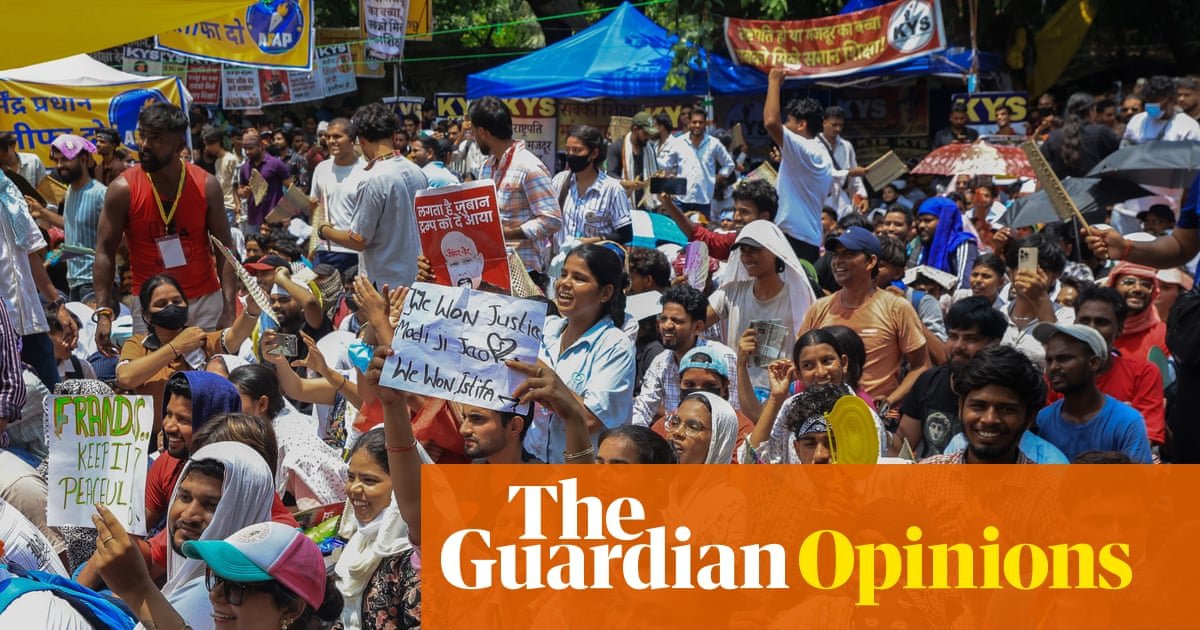
“What if all cockroaches come together?” was the question that humbled India’s strongman prime minister, Narendra Modi. It was posted on X by Abhijeet Dipke, an Indian student in the US with a master’s in public relations. Enraged that India’s top judge likened unemployed youths to insects and “parasites”, and that millions saw medical exams compromised by leaks, Mr Dipke lit a fuse. For India’s nearly 400 million gen Z, public exams are often the only ladder to a secure future. When papers leak or tests are cancelled, that ladder is kicked away. By June, young people were protesting peacefully in Delhi as the Cockroach Janta party (CJP), a parody of Mr Modi’s Bharatiya Janata party (BJP). They demanded the resignation of the education minister, Dharmendra Pradhan.
This weekend, Mr Pradhan became the first senior minister in Mr Modi’s 12 years in power to be forced from office by a mass-protest movement. It came after credible reports suggested police officers attacked protesters marching to parliament. Security sources say it was they who were attacked. This may be just the beginning. The concession has taught the Cockroach movement’s leadership that pressure works. They could have declared victory and gone home. Instead they have accused the government of breaching the terms of the settlement offered by Mr Modi’s government. The CJP claims at least 100 people have been arrested, many on non-bailable charges. Its leaders are now demanding the release of detainees and threatening to remobilise nationally.
Mr Modi has built an authoritarian order which rested upon Hindu majoritarianism and demonising Muslims. Education in the country has been subordinated to ideology and political patronage. But corruption in public exams cannot be divided so easily along religious lines. A Hindu graduate in northern India and a Muslim graduate in its southern cone experience the same anger over leaked papers and worthless qualifications. The grievance, crucially, creates an economic identity that cuts across the BJP’s preferred religious cleavage.
Until Mr Pradhan’s resignation, ministerial accountability to public protest had all but disappeared; loyalty to Mr Modi’s ideological project had mattered more. The CJP has also broken the spell of fear that has dominated the public square. The movement’s leadership were not requesting generosity; they were asserting a claim to clean administration, fair exams and ministerial accountability. Writing in the Guardian, the historian Mukul Kesavan says the CJP’s social-media dexterity is crucial. Like New York’s mayor, Zohran Mamdani, they combine eloquence, message discipline and composure, making Mr Modi look leaden. Their victory may have produced not merely a protest movement, but a new generation of political leaders.
A similar kind of unrest during an anti-corruption movement in 2011 paved the way for Mr Modi to wrest power from the ruling Congress coalition 12 years ago. The next general election is in 2029 and predicting its outcome today is not a worthwhile exercise. But the political scientist Christophe Jaffrelot argues that the CJP represents a much deeper revolt than just anger over exam leaks. It has, he says, become the voice of educated young Indians trapped by jobless growth, poor education and insecure work. Many Indians are either cockroaches now or in the process of becoming them. If they were to come together in a meaningful political way then Mr Modi may be in much bigger trouble than he is in today.
-
Do you have an opinion on the issues raised in this article? If you would like to submit a response of up to 300 words by email to be considered for publication in our letters section, please click here.


