


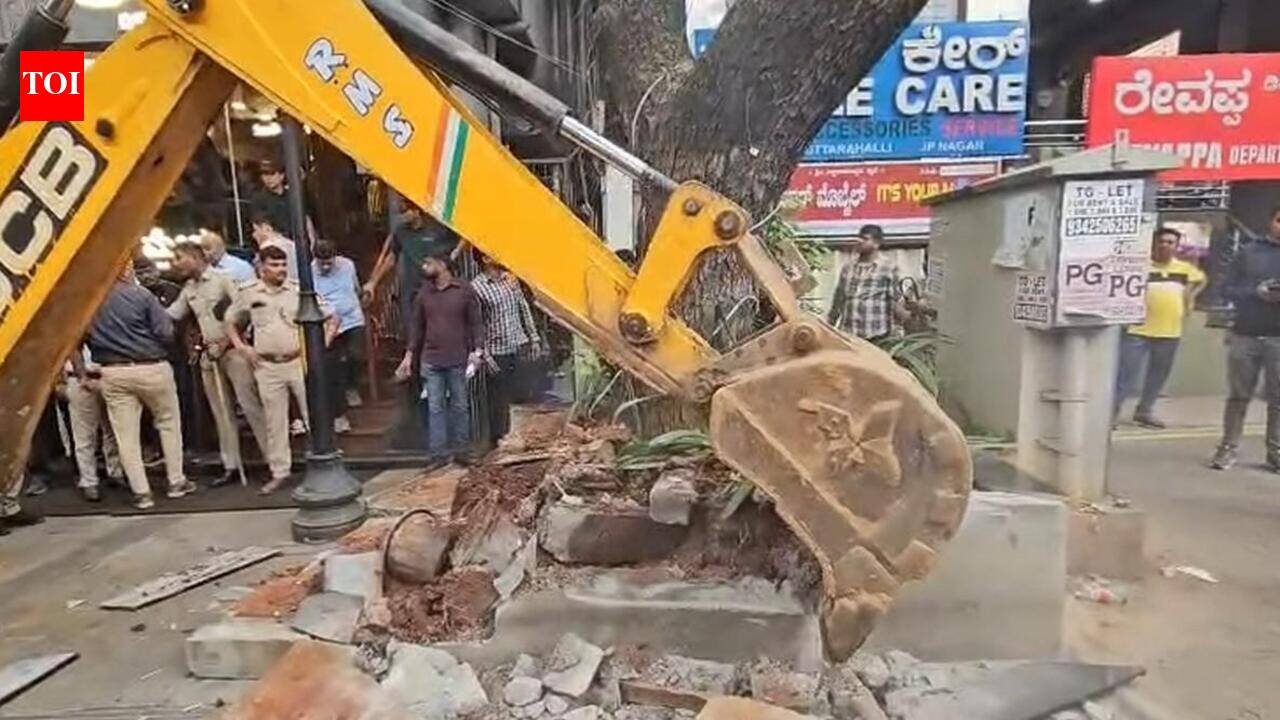
Footpaths are meant for pedestrian movement. But under the shade of its old trees, they have also long offered something else: a place to stop, sit, talk and watch the city go by. Now, as Greater Bengaluru Authority (GBA) removes concrete platforms built around tree bases, the city is debating what it gains from reclaiming footpaths and what it might lose in the process.The structures, popularly known as ‘katte’ in Kannada, are common in neighbourhoods such as Basavanagudi and Jayanagar. For decades, they have been part of the streetscape, functioning as informal seating and meeting points. But many also occupy portions of footpaths, sometimes extending around trees and into pedestrian space.GBA’s ongoing footpath encroachment clearance drive has brought the matter into sharp focus. Videos showing the demolition of tree-base structures, including one outside a popular coffee outlet in Jayanagar, have circulated widely on social media, drawing both criticism and support.“When officials blindly enforce regulations without understanding their purpose, common sense gets lost. Tearing down a basic concrete seat around a tree isn’t removing an obstacle; it’s just taking away a useful public spot for residents to rest,” Instagram user Vikas Jain commented on one such video.Others argued that the spaces represented something increasingly scarce in the rapidly growing city: places where people can gather without having to spend money. One user described the footpath as a “meaningful public space” for conversations and suggested that seating should instead be incorporated into urban design.Another user, Ganesh Cheruku, said Jayanagar was among the few parts of Bengaluru where footpaths remained well maintained, arguing that the locality’s character and walkability should be preserved.A widely shared reel by content creator Whisshobby highlighted the cultural role of the katte. Autorickshaw drivers and long-time residents featured in the video described the tree platforms as some of Bengaluru’s remaining “third spaces” where people could rest in the shade and interact. The video also questioned the lack of public seating and the closure of some parks during afternoon hours.There was, however, also strong support for GBA’s action from those who see any private or semi-private use of footpaths as an encroachment.“Strict action must continue against everyone who has illegally encroached upon public footpaths and is using govt land to run businesses while causing inconvenience and safety risks for pedestrians,” one user wrote.GBA deputy conservator of forests Sudarshan GK said the removals were being carried out in compliance with a National Green Tribunal (NGT) order prohibiting concretisation of tree bases. But he cautioned that demolition itself shouldn’t harm trees.“The important question is why such structures were built in the first place. While it is necessary to remove them, authorities should also ensure that demolition does not disturb the support mechanism of the roots, especially in the case of large trees,” he said.Guruprasad Rotti of the Heritage Basavanagudi Residents Welfare Forum supported the drive, saying katte were sometimes built by commercial establishments to attract customers and extend their business space.“Some people argue that these structures help them care for trees by adding manure, but that is not a natural way to maintain them,” he said, adding that they could obstruct pedestrians and emergency operations such as firefighting.
