






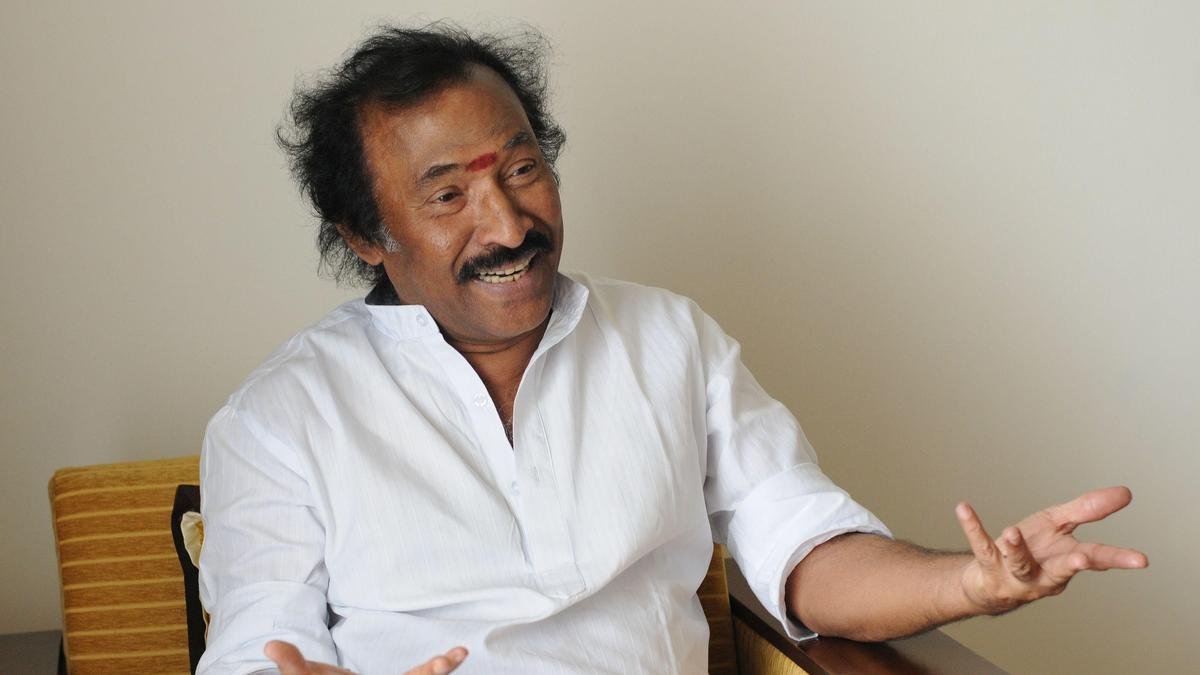
If there were an aural equivalent of elegant, highly readable prose, it would be Deva’s music. At once accessible and appealing, his music has the ability not merely to please listeners, but to draw them closer to sound and the emotions it conveys.
Thinking of his many beautiful songs, I was reminded of the opening lines of Un udhattora sivappe… [Panchalankurichi, 1996] sung by Hariharan and Anuradha Sriram, two singers he worked with extensively. There is something utterly beautiful in the line Hariharan hums before the percussion is introduced in the track and the lyrics begin. In those few seconds of that folksy number, you hear Hariharan like you would if he were singing seated close to you in a casual setting. The music is simple, quite hummable.
That is one of the trademarks of this unassuming and very astute music composer — creating songs that many would love singing, and could actually sing. This is true of not only the Gaana genre many associate him with, but also his charming melodies, relatable melancholies, and the sprightly “intro songs” for big heroes, especially Rajinikanth. In fact, as many have pointed out, it is Deva’s creations, especially his signature BGM bit from Annamalai [1992], that would become the background score to Rajinikanth’s consolidation of his “superstardom” in the 1990s.
What Deva did with some amazing voices in the industry is fascinating. In Konja naal poru thalaiva [Aasai, 1995], a superhit song drawing from a very classical Ananda Bhairavi raga, he gives Hariharan’s voice a lovely, different podium. Three years after a prodigious young A. R. Rahman introduced Hariharan’s magical voice to us in Roja [1992], and around the time we were getting irrecoverably addicted to Uyire… uyire [Bombay, 1995], Deva found new ways of tapping this extraordinary singer’s potential. He often did so in his most elegant melodies, keeping embellishments to a minimum. For Hariharan, this meant expanding his repertoire and range in Tamil film music, while working through a new aesthetic. But what it did for listeners is significant: it brought the singer’s inimitable voice within touching distance.
The nineties were a decade of musical bounty for Tamil film fans. Ilaiyaraaja was riding an incredible creative high for well over a decade, composing masterpieces across genres. A. R. Rahman stormed onto the scene with a sound that was radically new and enticing. Vidyasagar gave us some of the most unconventional and gorgeous melodies. S. A. Rajkumar was busy creating a vibe of his own. There was both richness and diversity at the time, expanding the sensibilities of listeners. It was during this time that Deva, too, entered the fray, his music shining with an indelible mark of elegance.
As in writing or speech, elegance in music takes hard work. Beyond knowing one’s strengths, it requires the ability to synthesise and distil musical ideas, to make considered choices, and to ensure that what one creates is accessible, relatable and, importantly, appealing. This is especially true of film music, where music must aid and enhance the storytelling. It has a clear emotional assignment. A very thoughtful composer, Deva cracked this aspect early on.
A striking feature in his gaana songs is the way that his unvarnished, earthy voice would carry the conversational tone of the lyrics, packing a lot of warmth and care. In an interview now circulating on social media, Deva recalls ace singer S.P. Balasubrahmanyam asking him how he perfected the slang. “I told him you should have lived there, lived that life,” he says, while observing that his songs often tend to appeal to ordinary working people like auto and rickshaw drivers. He had spoken about his own working class upbringing earlier. His father, a postman, had to work very hard to support their large family. Deva did not own a radio until he was 18.
This is not to box him into one category of songs. You simply can’t. For every Kavalaipadade sagodara [Kadhal Kottai, 1996], there is a Kaadala Kaadala [Avvai Shanmugi, 1996]. In another beautiful duet, Engengey engengey from Nerukku Ner [1997], Deva pairs the sensuality of Asha Bhosle’s voice (she was in her sixties then!) with the silken tone of Hariharan. The two had previously collaborated in Hindi film music and on a ghazal album in the 1980s. Within a few years the duo would come together again to haunt Tamil film music buffs in Ilaiyaaraja’s Nee partha parvaikkoru nandi [Hey Ram, 2000].
If I were to resort to a popular Tamil film trope [where the hero’s rags-to-riches transition is captured in one, often charged, song sequence], Deva did not get to the top in one song. Coming from a modest home, he had to deal with his insatiable passion for music with fortitude and patience. Among the many reels that are popping up since his passing is a clip from a television show where he says he had to wait 40 years for a break in the industry. “I had dreamt of coming into films for long. As a youngster, I would close the door and imagine the keyboard, harmonium, tabla, dholak around me and standing there all alone, I would say 1..2..3..4… If anyone had seen me through the window, they would have thought I am mad,” he says. From conducting an invisible orchestra to building a successful career, Deva’s journey illuminated the paths of scores of musicians along the way — offering opportunities and learning experiences that helped them build solid careers, and extending rare warmth, grace and generosity, as many artistes have recalled.
This generosity was evident when Deva spoke of SPB in a television show. “He sang about 1,300 songs for me. It was his voice that gave life to my music, without his voice my music would have been nothing,” he said tearfully about the late singer. In virtually every Rajinikanth “intro song” from the 1990s that we now consider iconic — many tribute articles have zoomed into this angle — Deva employs SPB’s magnificent voice in a particularly catchy tune, capturing the spirit of the lyrics and serving the story.
A late bloomer by his own account, Deva approached composing with a remarkably open mind and a rare team spirit, endearing himself to those he worked with, regardless of their seniority. Ever willing to give credit where it was due, he came across as a sincere and secure musician. The elegance of his music, too, perhaps stemmed from that spirit.
There is art that you look up to in awe and admire. And then there is art that feels like a warm hug. Deva’s music is more of the latter.
Published – October 18, 2026 12:25 pm IST


