



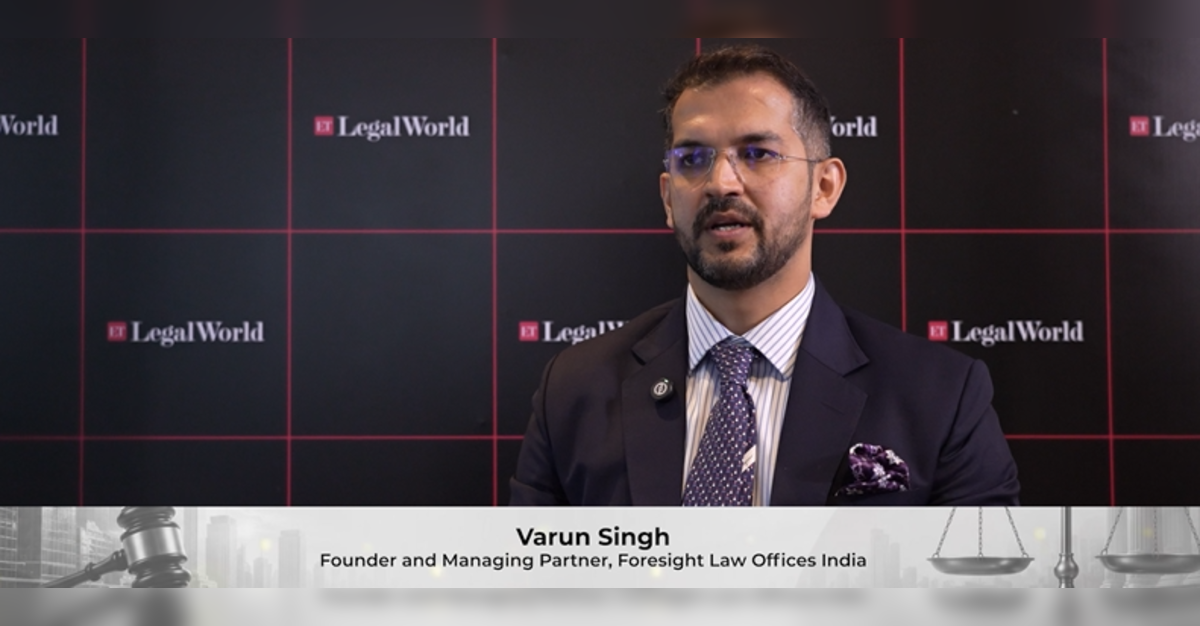
India’s commercial justice system needs to evolve towards faster, more investor-friendly and relationship-oriented dispute resolution, with mediation and online dispute resolution (ODR) likely to play a larger role, Varun Singh, Founder and Managing Partner, Foresight Law Offices India, said.
Speaking to ETLegalWorld on the sidelines of the 5th edition of ETLegalWorld’s Commercial Dispute Conclave 2026, Singh said the conclave’s discussions helped bring together perspectives from legal experts across different fields, including general counsels, litigators and senior advocates.
He said such discussions were necessary to understand the different perspectives involved in commercial disputes and identify potential solutions.
“If you are able to kind of hear problems from every corner, you may be able to have a future which could have more solutions,” Singh said.
Diverse perspectives can help address gaps
Singh said India’s commercial justice system continues to have several gaps and pain points, making cross-sector dialogue important.
“No matter what we do, no matter how good the event is, we all understand that the commercial justice system in India is probably not the most sophisticated. It has a lot of gaps, it has a lot of pain points,” he said.
According to Singh, bringing together stakeholders with different professional experiences can help identify issues that may not be visible from a single perspective.
“I am a GC, I might know something which you might not know as a litigating lawyer,” he said.
He said this was also evident during the discussions around investment treaty arbitration, where the perspective of an investor or business operator can differ from that of a lawyer.
He noted that the decision to pursue investment arbitration can be influenced by the business relationship between the investor and its counterpart.
Investor-friendly exit mechanism needed
Singh said one of the key takeaways from the discussion on investment treaty arbitration was that the overall sample size of such disputes remains low.
From an investor perspective, he said, one reason for avoiding arbitration can be the concern that doing so could damage an existing commercial relationship.
“Nobody wants to spoil a relationship with their counterpart,” Singh said.
He also said India, as it seeks to attract foreign investment while Indian companies increasingly invest overseas, needs to consider mechanisms that are more investor-friendly.
“One thing is very clear from the discussion also that the sample size of investment treaty arbitration or investment treaty dispute is very low,” he said.
Singh pointed to the importance of an effective exit mechanism for investors. He said the presence of an international tribunal that is trusted globally as a forum for resolving investor disputes could provide greater comfort to investors.
“If that becomes the fulcrum or the heart of investor disputes, then people from different countries or other countries would be more comfortable with investing in countries like ours,” he said.
Geopolitical risks could reshape contracts
Singh also highlighted the impact of geopolitical uncertainty on commercial contracts and disputes.
Drawing a parallel with the changes brought about by the Covid-19 pandemic, he said contractual clauses could evolve to address new geopolitical risks.
“Like COVID gave a way for force majeure clauses to have pandemic involved in it,” Singh said.
Similarly, he said changes in the geopolitical environment, including conflicts and potential disruptions to navigation in the Strait of Hormuz, could result in parties incorporating such risks into standard contractual provisions.
“We could possibly see more boilerplate clauses where state of Hormuz issues would be taken into consideration,” he said.
Mediation, faster resolution to define future
Singh said mediation would be an important part of the future of commercial dispute resolution, particularly where parties want to preserve business relationships.
“The future is definitely something which allows people to resolve their disputes fastest without much agitation against each other,” he said.
“If you want to maintain relationship, I think mediation will definitely be a part of that whole package as well,” he added.
According to Singh, the future of India’s dispute resolution ecosystem would involve faster resolution and greater willingness among parties to settle disputes outside courts.
“The future will entail mediation, future will entail faster dispute resolution and future will entail a scenario where people are much more happier to resolve disputes outside the court,” he said.
He also pointed to ODR as another mechanism likely to become part of the evolving dispute resolution landscape.
“ODR is something definitely going to be part of the future,” Singh said, while emphasising the need to sensitise stakeholders about its potential.
Singh said the gap between the current system and the dispute resolution framework India needs would continue to create opportunities for stakeholders to come together and develop more effective mechanisms for resolving commercial disputes.
[Views expressed are personal]
