



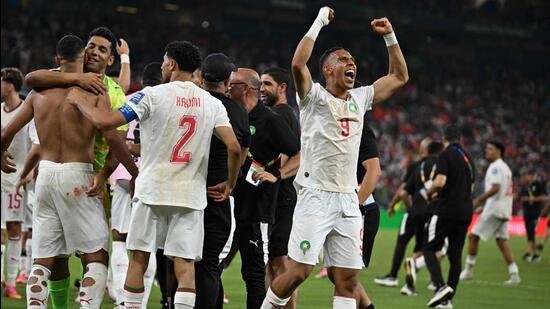
New Delhi: Rome wasn’t built in a day but neither was Moroccan football.


It was shining on Tuesday after Morocco beat Netherlands in the tie-break to reach the Round of 16 in the World Cup.
After a group stage exit in 1998, the Atlas Lions failed to qualify for another World Cup until 2018, and they also missed three editions of the Africa Cup of Nations in the 1990s.
But a long-term project started in 2009 with a singular aim: make Morocco a force in world football. And it’s working.
The men’s team reached the semi-finals of the 2022 World Cup. The women’s team reached the Round of 16 in the 2023 World Cup. The U-17 team reached the quarters of the 2023 tournament. Then, they won their first-ever FIFA U-20 World Cup title in 2025. Each achievement is a step in the right direction.
Gessime Yassine, who was part of the winning U-20 squad, is now at the senior World Cup, as is the U-20 coach Mohamed Ouahbi, who replaced Walid Regragui in March. The link has been established and continuity is key because it ensures that the flame, determination and grit – qualities that saw Morocco beat Netherlands 3-2 on penalties to reach the Round of 16 on Tuesday (IST) – are passed on.
“Every World Cup is different,” Morocco defender Noussair Mazraoui said after the win in Monterrey. “What we achieved was four years ago, and at every World Cup you want to show that you are capable of doing something new. So, I think we are on the right path as a federation and as a national team. I’m happy, and we will stay humble until the end.”
The humility is perhaps a by product of their journey to this moment; a journey that began in 2009, when King Mohammed VI built a football academy at a cost of 13 million euros. The plans were grand but also realistic and the graduates of that academy are the lifeline making Moroccan football stronger at every level.
Academies don’t always work the way they are expected to but this one is carving a special place for itself. It provides education and sporting development with dedicated study spaces, including ten classrooms. It also features a state-of-the-art sports medicine department ready to produce future professionals.
But it also prioritised results. Building a whole new generation of players takes time and there was an acknowledgment of that. So, while the academy could slowly develop talent, one of the remits of the programme was to scout players of Moroccan descent from the age of 12 – before international football becomes part of the equation.
Osian Roberts, Technical Director of the Morocco national team from 2019 to 2021, explained the set-up when speaking to The Guardian in 2022: “We had full-time scouts in Holland, Germany, France, Spain and Scandinavia that were monitoring these players on a regular basis. There was a database for all of those who were eligible for Morocco in all those countries… it was necessary given the amount of players living overseas. That department has been extremely important.”
By the 2018 World Cup, five members of their squad were born in the Netherlands. Four years later, when they became the first African nation to reach a World Cup semi-final, they had 14 foreign-born players in their 26-man squad. This year, 19 of the 26 were born outside Morocco. The point is simple: the best need to want to play for Morocco.
One way to do that is to tempt them with words. The other way is to do it with results. Everyone wants to be part of a winning set-up and right now, Morocco’s star is on the rise and everyone wants to be part of the story.
There has also been a realisation that having local coaches helps the game in more ways than one. So, Moroccan coaches have been given the opportunity to study, learn and gain experience, with a view to coaching the national teams and demonstrating their ability. When Regragui was appointed head coach of the men’s national team in 2022, Moroccan coaches oversaw every age group for the country.
Along with Spain and Portugal, Morocco has won the rights to host the 2030 World Cup. By then, this project should be humming. This will also ensure that the money will keep flowing into the game. It will only make the Atlas Lions roar louder when the World Cup comes home.


