



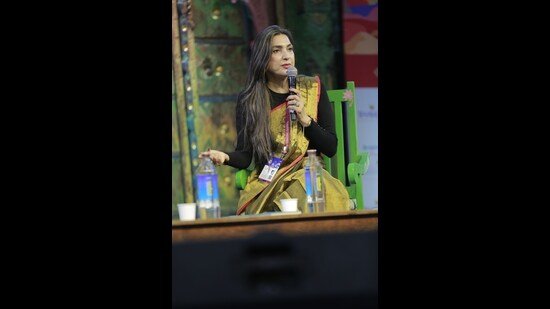
You mentioned in your acknowledgements that Moni Mohsin inspired the title of your book.


I was catching up with Moni over a meal and she asked, “What have you called your book?’ I told her we were struggling with the name and then she asked, ‘What’s the book about?’ I told her in a nutshell. By the time I came back – this was in London — 15 minutes later, I had a Whatsapp message from her: “How about The Long Way Home or The Wrong Way Home?’ That’s how it happened. It was very nice of her to give me that title.
The book almost reads like a meditation on how divorce has become an everyday reality for many with the taboo almost dissipating for a certain class of individuals. Was this part of a longer conversation that you’ve had on your podcast or you’ve been privy to as part of your life?
A lot of my friends are divorced and single and while having a conversation with one of them, who was also my ex-editor, Faiza, we talking about how there aren’t enough novels about divorce and I was saying that yeah, that would be something worth writing about. She said, ‘And in your voice, you absolutely must’. A lot of my friends are divorced and single. So, I have a ring side view to their lives. There is no sense of permanence to Indian marriages any longer. I saw that life really does change a lot after divorce for better or for worse, and society may be all right with it.
It’s not a taboo or a stigma but moving through this world as a single person in your late 30s or 40s makes you realise that you will only be admitted into certain living rooms. That space where you’re welcomed by couples shrinks because the social structures in our world are built in such a manner that things only seem to work out in even numbers. Look around us, dinners are sold for Christmas, Valentines, Diwali party invitations, holiday packages, everything is marketed for couples. It’s a constant reminder to a single person that holidays are around the corner and I better quickly make a plan with my girlfriends or my family because no one’s going to be making a New Year/ Christmas plan with me.
I’ve also seen that single people end up usually hanging out with single people not because they choose for it to be that way. I have seen that if somebody’s single or somebody loses their husband early, they are suddenly dropped out of the dinner guest list. I’ve sensed the loneliness of these single women though they aren’t complaining outwardly. They’re happy because it’s better to be happy single than to suffer in a marriage. My protagonist is holding on to a marriage for all sorts of reasons that on paper make very little sense and I wanted to talk about that. There are many women who are very good at showcasing a happy life and a fulfilled marriage but they’re not really living that marriage and then they’re holding on to those marriages for all sorts of reasons.
A very big reason that doesn’t get spoken about enough is of course it provides you with a scaffolding for social security, emotional security, even if that’s false. Some people also no longer know how to be single after they’ve been married. You’re back in that place where the landscape has changed so quickly. Now it’s not the same dating planet. There are dating apps, there are situationships and there’s bread crumbing and there’s ghosting. I thought what would happen to such a woman if she suddenly became single, she would try dating because that’s the only way to do it but would she be self-conscious? What kind of experiences would she have? Would she still be looking for love? Because no matter what people tell you there is a sad insistent longing in human beings for companionship.
I find ‘love your own company’ to be slightly overestimated as a concept. You need someone to share joys with, to share life with. There is so much sharing going on online because people are so lonely in their own lives. At the Jaipur Literature Festival, Kiran Desai said that during her book signing a lot of people told her that ‘You called your book The Loneliness of Sonia and Sunny and I’m actually really lonely’. The loneliness epidemic is very evident, so I wanted to touch upon that also.
A single girl feels invisible after 40. A single guy getting divorced at 40 or 45 or 50, people will proudly introduce him to single girls and say my friend just got unhitched. He’d say ‘Oh yeah, I was in a long-suffering marriage… I’m finally free’ and next thing you know, he’s having a destination wedding with a really young girl somewhere. It has become a cliche and it’s a cliche for a reason because it’s happening. And a very advertised marriage at that without sparing any thought for the recent ex-wife or children. But a woman when she becomes at 40 and if she wants to opt out of a marriage or she’d been dumped she’s often asked how would you manage by yourself? Because really, this girl feels invisible at the same parties where, as an important man’s plus one, she was a significant other in a genuine way.
Women protagonists, especially in popular fiction, are very underwritten. As a woman writing women are you conscious of this while creating your characters?
I understand women, to whatever extent you can say you understand women. I understand the agonies and the ecstasies. I’m a woman so that plays a role certainly. I have daughters, I am close to my mother, I have a sister, I have girlfriends. So, I feel that I just do it very naturally because I can’t write half-assed characters anyway. Which characters from this particular book did you struggle with writing? With Nayantara (the protagonist). Her mother somehow came very naturally to me and I had her friend Anjali and I even had a queer friend. Some characters, while you’re writing them, you start enjoying them so much that you become more familiar with them. From the very beginning, I wanted a really flawed character because there’s too much pressure on female characters in contemporary fiction to be good. I don’t know why this kind of very high standard of morality is expected from women. We are just as messed up and as confused as men. I wanted her to be a normal girl that you’ll meet in your everyday life. She’s just more self-aware. But she has also humiliated herself and she also does stupid things and justifies all her wrong decisions to herself. So, she was a bit of a challenge. As Namita Devidayal said in her longish blurb, it’s very hard to write a female character who’s not easy to like and yet you end up rooting for her. I’m not in love with Nayantara myself but I understand her.
Some of the conversations that you’ve had as part of your podcast (Not Your Aunty), have they seeped into your fiction in some way or provided fodder for your writing? Actually, no, I finished writing this book two years ago. If you find there is something in common, it’s because, naturally, as a writer I write about things that I feel strongly about. And the podcast is about the things I feel strongly about. As a writer I’ll make my different characters feel that and justify that, like the socialite in my book or the film star, I have empathy for these people, I understand their compulsions, I understand why they are living for appearances. All these people, even though there isn’t that much interiority with these characters, but you get a sense of what they are doing and why they are doing it. But I’m not coming at them from a place of judgment. My podcast is more judgy in that sense. That’s the difference between the podcast and here. But certain things that I feel strongly about those are the things that Nayantara or her mother or that man she meets in Landour feel.
What are you writing next?There is a non-fiction in the works and I will soon start writing my next novel as well. As women, whether you’re single and living with your parents and taking care of them or if you’re married, a mother, we don’t have the luxury of booking a cottage in Goa on Anjuna beach and saying, ‘I’m finishing my novel’ or, ‘I am writing this book of poetry’. At JLF, I had breakfast with Elizabeth Gilbert and I asked her everything I ever wanted to ask her. She said something to me for my life. She said I can do a lot of things because I’m just a single woman but you to be able to achieve all that you want to, you need a wife. I need a wife. Yes, I need a wife. Of course, the reason I can write anything at all is because my husband provides me with the structure to do it, the scaffolding to do it. My children are fairly independent but a lot of things that I manage, it would be much better if I had somebody else to manage that for me, from a creative point of view. That’s why you see that people who become empty nesters, the real creative journey starts only after that.
Simar Bhasin is a literary critic and research scholar who lives in Delhi. Her essay ‘A Qissa of Resistance: Desire and Dissent in Selma Dabbagh’s Short Fiction’ was awarded ‘Highly Commended’ by the Wasafiri Essay Prize 2024.


