



Every neonatologist carries the memory of their first encounter with a non-breathing infant.
For most of us, that moment remains indelible. The appearance. The quality of silence. The sound that should have been there but wasn’t. The instinctive reach for the resuscitation bag before conscious thought caught up. Over time, we come to understand that the transition from foetal to neonatal existence is not instantaneous, but a precisely orchestrated series of events. Fluid clearance from the lungs; the first breath, generating pressures up to 40cm H₂O; progressive alveolar opening; the sudden drop in resistance within the pulmonary circulation; the sealing of the fatal channels between chambers. We recognise how intricately timed each step is, and how unforgiving the process becomes when any single element fails.
We also learn, with time, that the determinants of whether that cascade succeeds have very little to do with us, the consultants, and almost everything to do with whoever happens to be standing by with skills of neonatal resuscitation.
That is the premise on which Nationwide Neonatal Resuscitation Program Day 2026 was built. It is also why, on May 10, 2026, the National Neonatology Forum chose to mark its 35th year of NRP (neonatal resuscitation program) in India not with a conference, but with a coordinated, country-wide act of capacity building.
The minute we keep returning to
Birth asphyxia continues to account for a substantial share of neonatal mortality in India, and an even larger share of long-term neurodevelopment morbidity among survivors. The epidemiology is familiar; what is worth re-stating is how compressed the therapeutic window actually is.
The first sixty seconds, the ‘golden minute’ operationalised in NRP remain the single most consequential interval in human medicine when measured by disability-adjusted life years preserved per minute of intervention. Effective positive pressure ventilation initiated within that window is, in most non-vigorous newborns, the most effective intervention that will be needed. Delay it, and the trajectory shifts; bradycardia deepens; acidosis worsens; the myocardium begins to fail. The simple bag-and-mask manoeuvre that would have been sufficient at sixty seconds becomes a full resuscitation subsequently, with all the neurological consequences that follow.
The intervention itself is not technically demanding. The barrier is almost never equipment. It is the presence, at the warmer, of a provider whose hands have done the sequence often enough that there is no delay, no moments lost to hesitation.
This is the gap NRP was designed to close. It is also the gap that May 10 was designed to close at a large scale.
What ‘at scale’ actually looks like
The day’s headline numbers, over 21,000 healthcare providers trained simultaneously across more than 1,070 centres, are easy to recite and easy to underestimate. What they represent, in operational terms, is a synchronised national training exercise of a kind rarely attempted in any health system, and to my knowledge unprecedented in neonatal care.
The cohort is the substantive point. Trainees included healthcare workers with the strategic emphasis deliberately placed on the providers who actually attend the bulk of India’s deliveries: staff nurses, midwives, labour room interns, postgraduate trainees, and respiratory therapists. This matters epidemiologically. Most Indian newborns are not delivered into the hands of a neonatologist. They are received by a nurse or a junior doctor, often at a secondary-level facility, often with no immediate backup. The gradient of outcome of a depressed newborn in those settings is determined almost entirely by that first responder’s competence in the first sixty seconds.
The underlying collaborating architecture merits attention: the National Neonatology Forum, along with the Indian Academy of Paediatrics, UNICEF, the National Health Mission, and allied professional bodies, stands at the frontier of this initiative. It reflects an increasingly mature model. The academic society sets the clinical standard and curriculum based on Navjaat Shishu Suraksha Karyakram (NSSK), a national newborn care programme. The public sector partners provide reach and integration with frontline systems. It is a model worth studying for replication in other neonatal interventions.
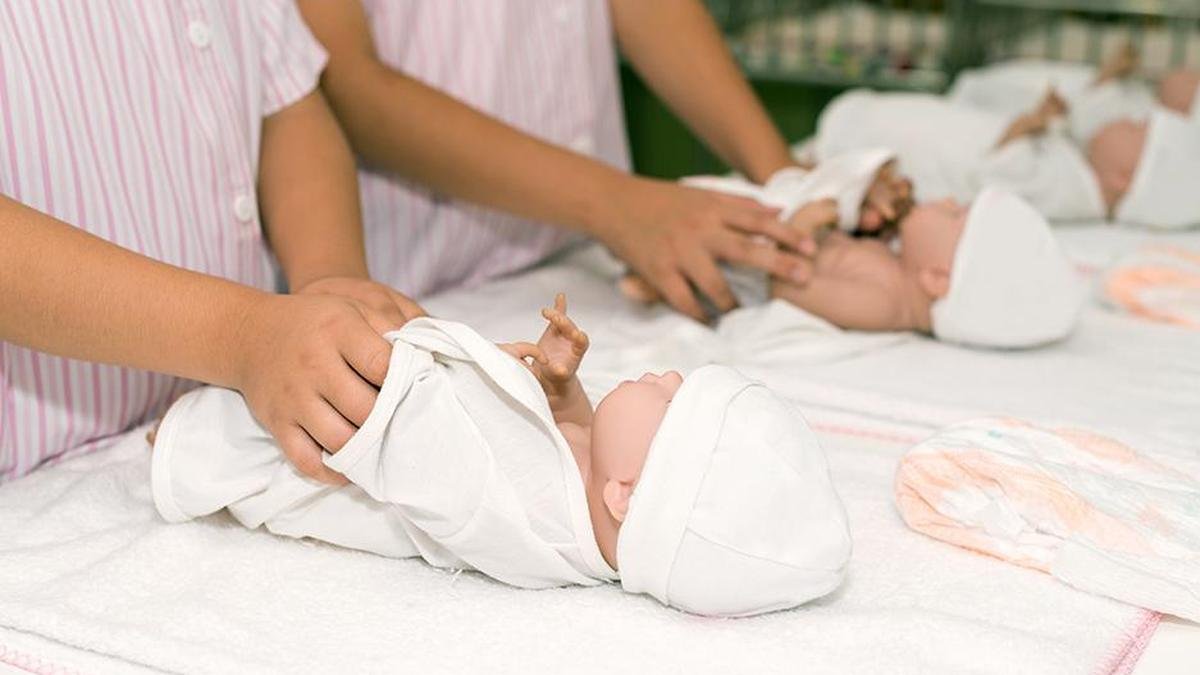
Some training hubs had structured simulation programmes: delivering the neonate onto the mothers’ abdomen; assessing the need for resuscitation; airway positioning; carrying out Initial steps; PPV with appropriate pressures and rates; doing ventilation corrective sequences; escalation pathways. The simulation-heavy format is not incidental. The literature on procedural skill acquisition in neonatal resuscitation is unambiguous on this point. Didactic instruction alone produces unreliable performance under stress. Simulation and hands-on learning produce durable skills, and frequent refreshers preserve them. The challenge for any national programme is operationalising that evidence at all levels. May 10 was, among other things, a working demonstration that it can be done.
Beyond the bag and mask
While ventilation of the non-breathing newborn was the technical centrepiece, the day’s curriculum reflected the broader continuum that determines whether a successful resuscitation translates into a healthy discharge.
Thermal protection was emphasized not as an ancillary skill but as a co-determinant of resuscitation success. It is a reminder, particularly relevant in our setting, that hypothermia worsens acidosis, surfactant function, and pulmonary vascular tone, and that a cold infant is a harder infant to resuscitate. Early initiation of breastfeeding within the first hour, with its established benefits for thermoregulation, glycaemic stability, and immunological priming via colostrum, was framed not as a lifestyle preference but as an evidence-based clinical intervention. Vitamin K prophylaxis, eye care, and early recognition of the at-risk neonate were drilled with due emphasis as PPV technique.
What matters
Generally, people are cautious about declarations of national milestones. Most do not survive contact with the realities of the labour room. I have been practising neonatology long enough to value this with balanced optimism and realism.
This one feels different, and the reason is that the design is correct. The intervention is targeted at the right window, the first minute. It is delivered to the right cohort, the providers who are physically present at delivery. It uses the right pedagogy, simulation with hands-on skill practice. It is anchored in the right institution, a professional society with three-and-a-half decades of accumulated curricular authority. And it is scaled in a way that makes the question of population impact a tractable one rather than a rhetorical one.
What May 10 ultimately represents is not a record. It is a wager. The wager is that if a sufficiently large fraction of India’s frontline birth attendants can be brought to competence in the choreography of the first breath, the country’s neonatal mortality curve, can be made to bend.
That wager deserves our clinical priority, our research attention, and our sustained support.
The first breath is, after all, the one we are all here to protect.
(Dr. Umamaheswari Balakrishna is professor and head, department of neonatology, Sri Ramachandra Medical College and Research Institute, Chennai. Hod.neonatology@sriramachandra.edu.in)
Published – May 10, 2026 05:00 pm IST


