



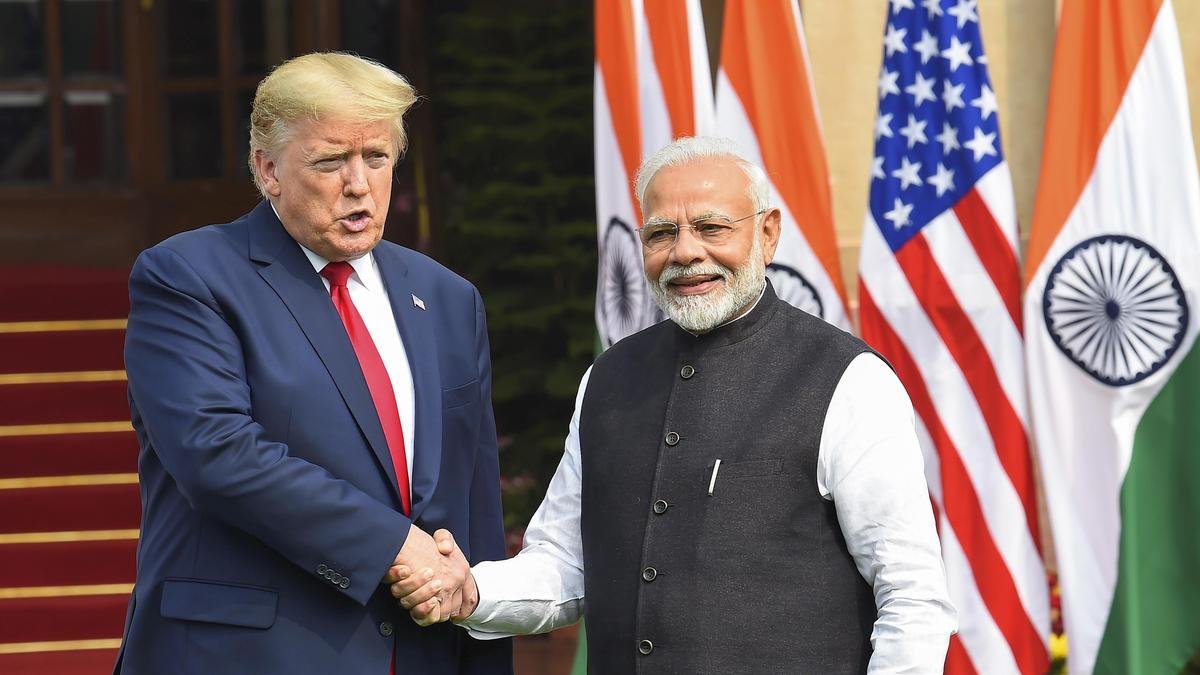
Prime Minister Narendra Modi with U.S. President Trump, at Hyderabad House, in New Delhi, in 2020.
| Photo Credit: PTI
U.S. President Donald Trump has signed several trade agreements with countries such as Malaysia, Cambodia, Argentina, and Bangladesh. These agreements have been signed under the shadow of intimidating and illegal tariffs. The U.S. has also announced a trade agreement with India, for which the two sides have issued a joint statement. Trade agreements exemplify the legalisation of international trade relations. But are all trade agreements the same? Can the India-U.S. trade deal, once finalised, be compared to India’s recent agreements with the EU or the U.K.?
The U.S. refers to agreements signed by Mr. Trump as Agreements on Reciprocal Trade (ART), as opposed to Free Trade Agreements (FTAs). This creates a new category in international trade deals, which now consists of three typologies.
Multilateralism
At the core of international trade treaties is the robust multilateral trade agreement established by the General Agreement on Tariffs and Trade (GATT) and the World Trade Organization (WTO). The GATT untethered the global American project of creating a non-discriminatory trading regime firmly grounded in the most-favoured-nation (MFN) rule (this WTO rule specifies that if a special favour is granted to one country, such as lower tariffs, then it has to be extended to all other WTO members as well).
The U.S. established a multilateral trading arrangement, based on an unconditional MFN rule, due to the pursuit of trade protectionism during the interwar years. Further, the formation of the WTO in 1995 provided an institutional architecture to this multilateral trade project. The WTO expanded trade beyond goods to include services and intellectual property, and established an intricate dispute settlement mechanism. While some view the WTO as part of a global imperialist state, its one-country-one-vote principle provides developing countries with some agency and an opportunity to forge alliances and bargain with the developed world.
Preferential trade agreements
Interestingly, while the WTO establishes a trading regime based on non-discrimination, it allows its members to sign preferential trading agreements on a non-MFN basis. Two such arrangements are recognised in Article XXIV of GATT — free trade areas and Customs Unions (CUs). However, since these arrangements are an exception to the MFN principle, they are subject to stringent conditions. For instance, an FTA creating a free trade area should cover ‘substantially all trade’ between its constituents. Likewise, a CU should not only cover ‘substantially all trade’ but also have a common external trade policy for non-members. These stringent conditions aim to make FTAs and CUs building blocks rather than impediments to trade multilateralism.
Until the 1980s, these arrangements were not popular among countries. However, in the last three decades, there has been a proliferation of FTAs. While most FTAs are bilateral, some are quite large, covering 10 to 15 countries, such as the Regional Comprehensive Economic Partnership (RCEP) agreement. Many of these FTAs are WTO-plus, that is, they go beyond the topics covered by the WTO, by including rules on labour, environment, and foreign investment protection. These FTAs are criticised for thrusting new obligations on developing countries. However, as these FTAs are notified to the WTO as a mandatory legal requirement, they provide countries adversely affected by them with an opportunity to raise questions and scrutinise them.
Agreements on reciprocal trade
The ARTs that the Trump administration has been signing with WTO members are not signed under Article XXIV of the GATT. This makes these agreements legally suspicious. While GATT Article XXIV-type FTAs have an institutional linkage with the WTO, ARTs are completely independent. The most alarming element of these ARTs is that they exemplify the Trump administration’s ‘America First’ trade policy. While the U.S. continues to impose tariff rates inconsistent with its WTO obligations, its trading partner is strong-armed into either eliminating or drastically reducing tariff rates on U.S. goods. Moreover, in addition to WTO-plus characteristics, these ARTs contain several one-sided provisions aimed at bolstering U.S. interests. For instance, Article 4.1 of the U.S.-Bangladesh ART provides that if the U.S. adopts a trade measure to protect its economic or national security, and notifies Bangladesh of the same, the latter, too, in accordance with its domestic laws, shall adopt a complementary restrictive action in support of the former. A provision like this effectively ties the interests of the U.S.’ partner to the U.S. Another key feature of these ARTs is that they restrict the data sovereignty of U.S.’ treaty partners. For instance, Article 3.4 of the U.S.-El Salvador ART proscribes El Salvador from imposing customs duties on electronic transactions.
In sum, the U.S. ARTs are imperial in nature. Additionally, because these ARTs are not notified to the WTO, other countries can’t scrutinise them. These agreements are an attempt to deracinate trade multilateralism and should be stoutly resisted by developing countries.
Prabhash Ranjan is Professor and Vice Dean (Research), Jindal Global Law School. Views are personal.
Published – February 25, 2026 08:30 am IST


