



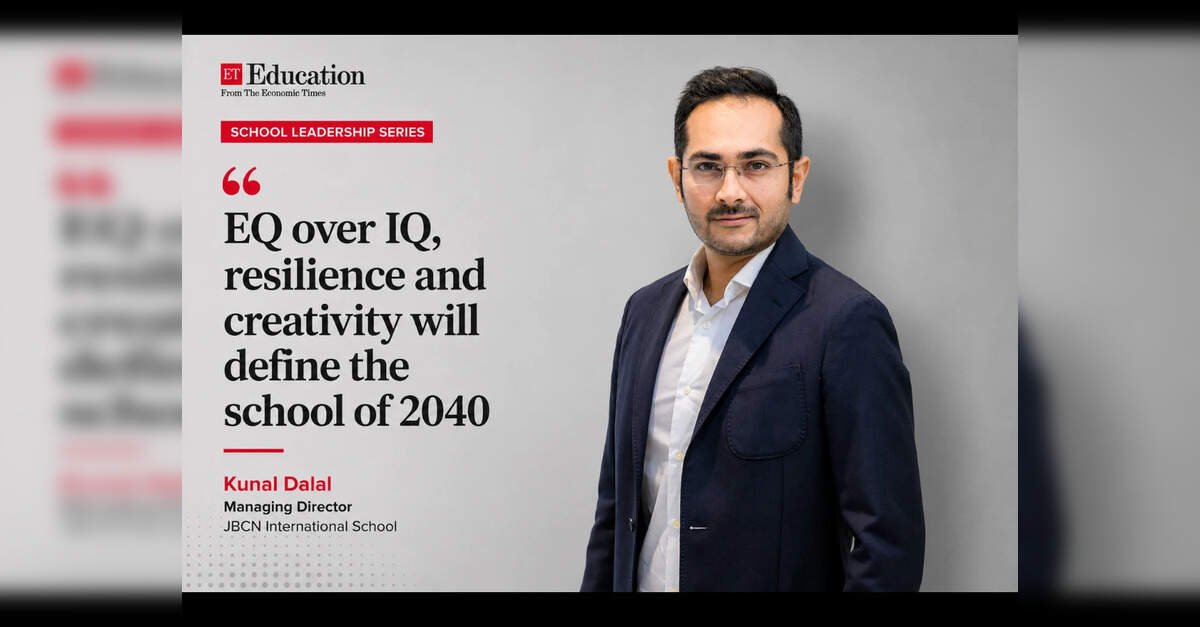
As artificial intelligence reshapes education and the future of work, schools will need to prepare children for more than academic success. For Kunal Dalal, Managing Director, JBCN International, emotional intelligence, resilience and creativity will matter more than ever for students entering the workforce around 2040.
Dalal believes AI should augment teachers, not replace them, while schools must ensure technology does not come at the cost of critical thinking, creativity and human connection. In an interview with ETEducation, he discusses what schools need to change for the 2040 learner, the growing importance of teacher development, and the policy reforms he believes can strengthen Indian school education.
Q. It has been six years since the National Education Policy 2020 was introduced. Looking across the school education system, where have you seen the biggest changes on the ground, and where do schools continue to struggle with implementation?
Kunal Dalal: I think the overall thought process, rationale and policy that NEP came up with is genuinely a very well-thought-through framework. It is a very robust framework.
When you create frameworks like this, you create them for the long term, for 10 years, 20 years, sometimes longer. It is not possible to envisage what will happen over the next 10 or 20 years. AI comes in, tomorrow there could be another digital revolution, so it is very tough to predict that.
My personal view is that NEP 2020 is a beautifully drafted document.
The challenges we face are a few. One is simply the sheer population of the country. Today, when you look at India, such a large percentage of our population is between the ages of six and 16. When you are looking at such a large population, any policy is difficult to implement. One of the biggest challenges is getting to the last mile.
The second challenge is teachers. To educate enough teachers to implement such a policy itself is a challenge. We need to find a way to train as many teachers as possible and make being a teacher an aspirational job, so that more applicants come in, they get trained and are able to implement this policy. And the third, I think, is that I do hope and wish that the government would have a higher GDP spend on education. Whatever the private sector does in education, it cannot reach the whole country.
The best education systems in the world are the ones where the public school system is the strongest. We as educators would hope and urge that the government has higher GDP spending on education to make the public school system world class, where any learner actually decides whether they want to go to a government school or a private school.
Q. Artificial intelligence is rapidly transforming education beyond introducing AI tools. How should institutions fundamentally rethink teaching, learning and assessment?
Kunal Dalal: Two or three thoughts come to my mind. One is making sure that we teach today’s population the ethical use of AI. I think that is the most important aspect of AI because it is a tool of the future.
It is going to help every individual, organisation and industry move at a pace that we are not used to. But ethical use of AI is something children need to learn. Cloud-based AI and tools like ChatGPT are great, but they should not be used as a form of plagiarism. They should not become a substitute for creativity. They should be used as a source where you are able to gather and analyse information at a pace that has never happened before.
But eventually it should be your own critical thinking and your own opinion that comes out in a paper, test or homework assignment. So I think ethical use of AI should be introduced through workshops and topics taught to young children.
Second, apart from using AI as a tool, schools must find a way to use AI to improve efficiency. For example, there are AI tools being developed where a teacher can create an exam or give a rubric and put in past papers and student answers. The system can emulate the way that particular teacher corrects papers.
Today, if a teacher is spending 30% of her time creating and correcting exams, that time can be used for pastoral care, building a relationship with the child and giving them emotional support.
A teacher’s role today is not about giving information or explaining information. It is all available. It is about teaching the right values, supporting the child and giving them the right EQ, along with teaching them content.
If I can make a teacher more efficient and spare time in some of those areas, because she doesn’t have to correct 150 or 200 papers, that for me would be a real evolution of how AI can be used effectively in transforming education.
Q. You have also spoken about the risk of AI affecting children’s creativity. How are you addressing that in schools?
Kunal Dalal: We brainstormed this last year with our senior leadership team when AI came about, and this is what we are implementing in our schools.
We have decided to have alternate homework assignments.
Some assignments are done by the child in school. We allocate a period for them to do assignments and homework. Some are taken home traditionally as homework. What we have realised is that teachers know the students very well because they see all the work that students do in school. They know the level at which each student is working.
So the moment they go and get an AI tool to do an assignment, there is a clear gap in the level of work. That gap is caught, discussed with the student and the work is redone. So yes, use an AI tool, but don’t plagiarise. That’s why I said AI ethics is the first thing schools should teach children.
Q. If you were to redesign an education institution today for students who will pass out in 2040, what three things would you stop doing and what three things would you build differently?
Kunal Dalal: Three things that I would build differently for learners.
One is EQ over IQ.
Ensuring that you have a mental-awareness and mental-health programme and a communication programme. We have various programmes in school where we have conversations with children, where we talk to them about how they feel, what bullying is, what body shaming is and what the right ethics are around social media.
I think EQ in today’s generation is more important than IQ because as these children become leaders, it is going to be about having the right EQ and people-management skills rather than content development, writing an algorithm or writing code.
We have an enrichment programme where we do this at an age-appropriate level. Even in nursery, a four-year-old can come into school and indicate the emotion they are feeling. It could be a smiley face or a sad face. If it’s a sad face, the teacher asks, “Why? What happened?”
It could be something as simple as, “I didn’t like the breakfast Mama made for me today.” But it is about being able to communicate, share your feelings and understand who you are. That’s how we build the programme.
The second thing I would do differently is resilience.
Today’s kids need to understand what they are doing. They are so used to instant gratification and getting things at their fingertips. It is about building resilience, and that is done in many ways.
It can be done through a strong sports programme. It can also be done through making sure repetitive tasks are done because today’s generation gets bored very easily. They will do two things and want to move on to the third thing. But sometimes you have to do repetitive tasks, mundane work. That’s all part of building resilience and patience.
And the third one is ensuring they don’t lose their creativity.
We have introduced a programme called Design Thinking and Problem Solving in all our schools. Students are given real-life problems in school, outside school, of the environment, of the road or of the traffic caused because of the school. They have to come up with solutions.
They have to think out of the box. They are problem-solving and thinking creatively in a manner that is outside the syllabus of mathematics, physics or chemistry, for example.
Q. Students and parents are increasingly looking at education as an investment and an ROI. How should institutions respond to this changing mindset?
Kunal Dalal: Absolutely. There are more and more private schools coming up, and the fee structures of all these schools are very different from the fee structure of schools when you and I went to school.
I think it is fair and good that a parent looks at education or learning as a return on investment because that keeps the school team and school owners on their toes. You need to constantly innovate, constantly evolve and constantly change.
During Covid, on March 20, 2020, we announced a lockdown. We were lucky that it was the exact week we had spring break. Seven days later, we had 5,000 students and 800 teachers online, running the school and curriculum.
Everything had to be done overnight. We had to buy everything, deliver laptops to teachers and get internet connections. Because parents view it now as an ROI and we knew they were paying a certain fee for a private international school, we had to be on point from day one. We couldn’t tell them, “Give me 20 days. I’m trying to figure out how to go online.”
So when parents view education as an ROI, it ensures that all of us continue to improve.
Q. Faculty development and leadership remain major challenges across the sector. How can institutions attract, develop and retain high-quality educators in the years ahead?
Kunal Dalal: Teachers and educators are firstly in this field because they are passionate about what they do. We must allow teachers the freedom to be creative and follow their passion. We should not necessarily be prescriptive about what they can and cannot do.
They should not be told, “This is the script you have to follow in a classroom. This is what you can say and what you cannot say.” I think they must be given the freedom to follow their passion.
Salary, like in every industry, is also a driver. We must be able to pay teachers well, especially those who want to become the sole breadwinner of their family. They should be able to be successful and earn enough by following their passion and becoming teachers.
The third thing is professional growth. People who are in education want to grow and be stimulated mentally. You have to pay well and be compassionate, but you also have to provide growth.
Teachers need to be challenged through teacher training, professional development and learning new skills within the education industry.
Q. If you could recommend three reforms to policymakers that would have the greatest impact on Indian school education over the next decade, what would they be?
Kunal Dalal: The first would be to set a mandatory number of workshops and teacher-training conferences or seminars that every school must undergo for all its teachers.
That should include new teachers, junior teachers and senior teachers. There should be a minimum number of teacher-training and upskilling programmes that they must undertake every year.
Second, from the fees point of view, some states have fee caps. I think there should be a very clear checklist that says if you are providing all these facilities and have this kind of parent satisfaction, perhaps through a satisfaction score, then according to this you can charge a certain level of fees.
It should be crystal clear and transparent. Otherwise, schools also have costs to meet. If they want to cater to those costs and provide the best quality of education, they should be able to charge accordingly.
And third, I think in the near future, if schools can be run not just through trusts and societies but can also be run through private limited companies, that would be a big step forward and take the sector leaps and bounds.
It would attract big companies and private individuals to invest in the space.


