



By: Dr Malini V Shankar
India’s aspiration for Atmanirbharta – self-reliance – is often discussed in terms of manufacturing growth, startup ecosystems, and digital innovation. Yet one of the most strategically significant arenas for true self-reliance lies in shipbuilding, particularly in the development of indigenous marine engines. For students, researchers, and educators in maritime studies, engineering, and public policy, this represents not merely an industrial issue, but a national capability challenge.
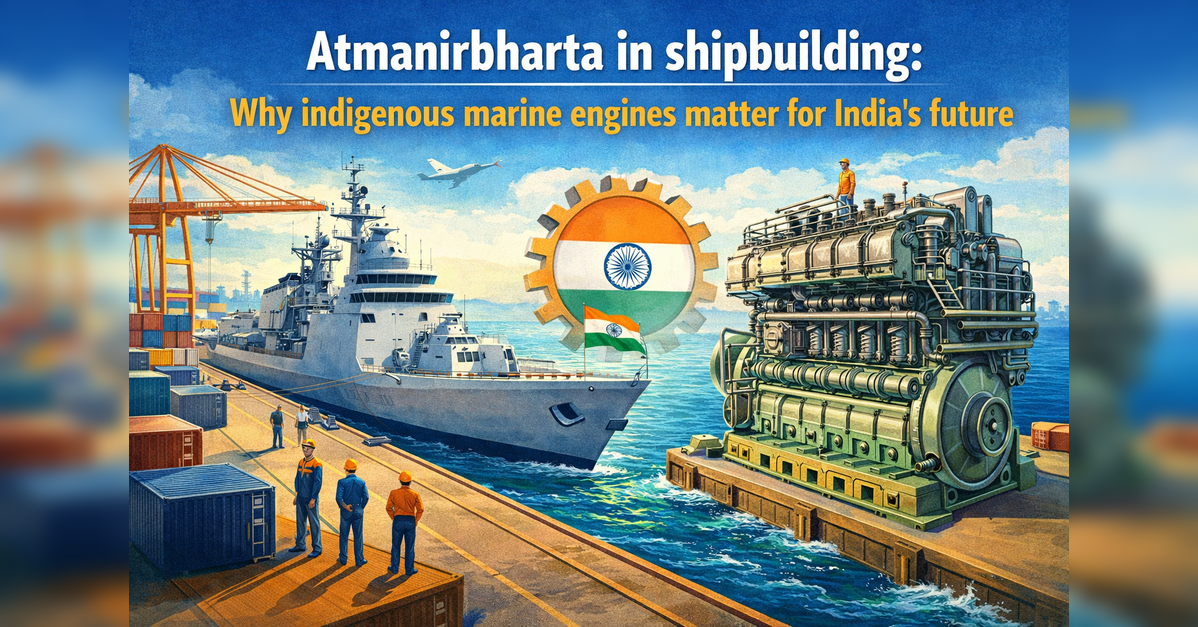
Shipbuilding is frequently perceived as the construction of hulls and physical structures. However, the true technological core of any vessel lies in its propulsion system. Marine engines determine operational efficiency, endurance, environmental compliance, and lifecycle costs. If a country builds ships but imports their engines, it retains only partial control over the value chain. In strategic terms, dependency on imported propulsion systems limits technological sovereignty.
For India, a nation with a revised coastline length of over 11,000 kilometres (as per updated official figures), expanding ports, and growing blue economy ambitions, maritime strength is not optional—it is foundational. Programmes aimed at coastal shipping, port-led development, offshore energy exploration, and naval modernization all depend on reliable propulsion systems. An indigenous marine engine manufacturing ecosystem would ensure that these ambitions are supported by domestic technological depth rather than vulnerable external supply chains.
Economic implications are equally compelling. Importing high-value propulsion systems results in significant foreign exchange outflows. In addition to forex pressures, delays due to imports and supply-chain dependencies often affect project timelines and cost efficiency. Local manufacturing, on the other hand, reduces such vulnerabilities while stimulating ancillary industries—precision components, control systems, testing facilities, and maintenance networks. Over time, this creates high-skilled employment and strengthens industrial resilience.
From an educational standpoint, this presents a powerful opportunity. Indigenous engine manufacturing requires expertise in advanced metallurgy, thermodynamics, fuel optimization, emissions compliance, precision engineering, and systems integration. Universities and maritime institutions can play a transformative role by aligning curricula with these emerging needs. Research laboratories can collaborate with industry to develop next-generation propulsion technologies, including LNG engines, methanol-ready systems, hybrid-electric propulsion, and eventually green hydrogen-based solutions.
However, in addition to research and innovation, industry must also be prepared to “bite the bullet” and commit to manufacturing readiness—with precision, quality control, and promptness. Capability creation demands not only design excellence but execution discipline. Without a robust manufacturing ecosystem that can deliver on time and to global standards, technological ambition alone will not translate into self-reliance.
The global maritime sector is undergoing a sustainability transition. The International Maritime Organization’s emissions regulations are pushing shipowners toward cleaner technologies. If India develops indigenous engine capabilities now, it can position itself not only as a shipbuilding nation but as a technology leader in green propulsion. For students, this means new research pathways, innovation clusters, and interdisciplinary learning opportunities that combine environmental science, mechanical engineering, and maritime policy.
Policy support will be critical. Long-term procurement assurances, research grants, public-private partnerships, and maritime innovation funds can provide the stability needed for such a capital-intensive sector. Educational institutions must be active stakeholders in shaping this ecosystem—through incubation centres, specialized postgraduate programmes, and applied research collaborations.
Ultimately, shipbuilding self-reliance cannot stop at assembling vessels. True maritime independence lies in mastering the technologies that power them. Indigenous marine engine development is not simply an industrial milestone; it is a strategic investment in knowledge, skills, and national confidence.
For India’s education community, the call is clear: preparing the next generation of maritime engineers, policy thinkers, and sustainability innovators is central to building an Atmanirbhar maritime future. When classrooms connect to shipyards, and research connects to industry, self-reliance becomes not a slogan, but a lived capability.
Dr Malini V Shankar is the Hon’ble Vice Chancellor of Indian Maritime University.
DISCLAIMER: The views expressed are solely of the author and ETEDUCATION does not necessarily subscribe to it. ETEDUCATION will not be responsible for any damage caused to any person or organisation directly or indirectly.


