



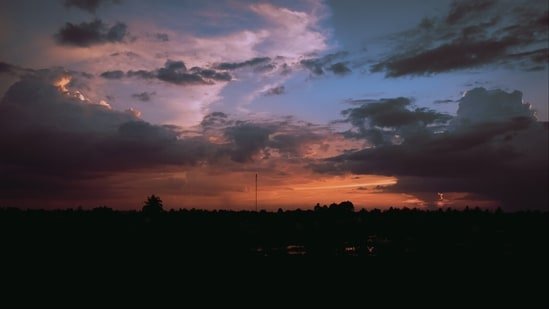
Watching a sunset is hardly a new ritual. But this summer, as temperatures soar, European creators are shifting the spotlight from the golden hour to what comes after it. Videos captioned “POV: You stayed after the sun went down” are finding traction on social media.


That post-sunset pause is at the heart of dusking, a wellness and travel trend that encourages people to step outside at sunset and stay a little longer, simply observing the sky as daylight fades and evening settles in. For Indian audiences, especially during peak summer, dusking can be less about chasing a perfect view and more about reclaiming a cooler, calmer part of the day.
The Dutch ritual making a comeback
While dusking is gaining attention on social media, the ritual itself is far from new. The practice traces its roots to the Netherlands, where it is known as ‘schemeren’. Traditionally, farming families would gather at the end of the working day and sit together as daylight faded. Before lamps were lit and dinner was served, they simply paused. By the 1960s and ’70s, however, modern life and artificial lighting had largely pushed the ritual into obscurity. Dutch poet and author Marjolijn van Heemstra helped revive interest in the custom earlier this year after researching its history and writing about it, later organising public schemeren sessions.
In India, the movement is still in its early stages, but it is slowly gaining attention, as travel and wellness brands have begun spotlighting dusking on social media.
The mental health benefits of dusking
At a time when many people are trying to cut down on screen time and escape constant digital stimulation, dusking offers a simple alternative. “Continuous exposure to notifications, social media and emails can contribute to cognitive overload, attention fatigue and the feeling of being mentally ‘always on’. And Nature holds our attention gently without demanding mental effort, allowing the brain to recover from the cognitive demands of daily life,” says Dr Hamza Hussain, Head of the Department of Psychiatry and Mental Health at Ruby Hall Clinic, Pune.
He adds, “The gradual shift from daylight to evening signals the body and mind that it is time to slow down. Exposure to the changing natural light provides cues to the body’s circadian rhythm, which regulates the sleep-wake cycle. Additionally, observing the changing colours of the sky and quieter surroundings encourages mindfulness and helps people mentally separate from the pressures of the day. By contrast, late-night screen use can keep the brain stimulated while blue light suppresses melatonin production, making it harder to fall asleep and affecting sleep quality.”
The best places to experience dusking
According to Holafly’s Global Dusking Index, which ranks destinations based on atmospheric conditions, clear skies and traveller interest, places like Santorini, Bali and the Maldives are among the world’s top spots for watching twilight. But, you don’t have to travel overseas to enjoy the ritual.
India’s varied landscapes offer plenty of settings to embrace dusking, too. Ravi Gosain, President, Indian Association of Tour Operators says, “Coastal destinations like Goa, Gokarna (Karnataka) and the Andaman Islands offer uninterrupted horizons where you can watch the colours linger long after sunset. In the mountains, places such as Munnar (Kerala), Coorg (Karnataka) and the Himalayan regions around Himachal Pradesh and Uttarakhand provide expansive skies. Desert landscapes like the Rann of Kutch in Gujarat are equally magical. The ghats of Varanasi (UP) also blend the changing evening sky with a deeply spiritual atmosphere.”
He adds that given that dusking can be practised almost anywhere, which makes it a natural fit for modern wellness travel. “Travellers today are increasingly looking for experiences that help them slow down rather than simply tick destinations off a list. Dusking taps into that shift,” he says.
Your guide to dusking
- Know when the sun clocks out: Check your local sunset time and set a reminder for a few minutes beforehand
- Step outside: Head to a balcony, terrace, garden, park bench or beach — any spot with an open view of the sky. If possible, leave your phone behind
- Find the fading light: Face west, watch the sun set and the sky shift. Notice how the colours deepen and change minute by minute
- Don’t leave after sunset: This is where most people miss the best part. Stick around for the full transition as gold gives way to pink, purple and eventually the soft blue tones of twilight. The entire experience usually takes no more than 15 to 20 minutes
- Pay attention to one small detail: It could be a streak of colour in the sky, a cool breeze, birds returning home or the first evening star. Soak it all in and relax


