



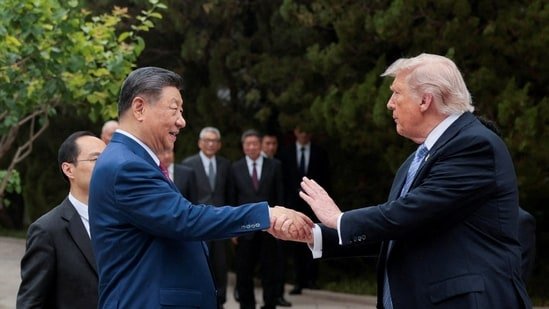
The recent Busan Summit, punctuated by US President Donald Trump’s provocative declaration about the revival of G2, has engendered a new proposition for shaping a global order already teetering on the edge of systemic uncertainty. For years, the world has braced for a decoupling or an all-out trade war; however, the recent high-profile Trump-Xi rendezvous suggests a different trajectory: The birth of the 2-2-4 Global Equation. This strategic pivot, laced by the powerful optics of extravagant trillion-dollar corporate diplomacy, revives the talk of long-dormant G2 illusion that Washington and Beijing are going to mend ways, probably for a North-South cooperation born not of mutual affection, but of sheer necessity at the current juncture of humongous geopolitical and geo-economic turmoil.


Notably, at the heart of this equation are two titanic personalities—Trump and Xi—and four geopolitical compulsions dragging these arch-rivals into a frenemic embrace. The first compulsion is the ongoing episode of the Iran imbroglio, characterised by a vacillating American policy struck by NATO’s actions. The failure of Project Freedom—a military escort plan for tankers—was jinxed at the very outset when Saudi Arabia refused to grant the US access to its bases, fearing a naval confrontation with beleaguered Iran. This has exposed relative military inadequacies and deepened rifts within the oil cartel, specifically between Riyadh and Abu Dhabi.
The second and third compulsions involve a bleak economic scenario that began to unfold following the Strait of Hormuz energy shock. The closure of the Strait has become the primary driver spiking prices of Brent crude to around 70% more compared to its market price in 2025, imperilling the energy security of major importers like China. Beyond oil, the global supply chains of almost 15 to 18 products—from pharmaceuticals to agriculture—are facing severe disruption, making even the export-heavy China desperate for stability to keep its economy afloat. Finally, Washington has recognised its Achilles’ heel: The realisation that it cannot simultaneously intervene in the Taiwan Strait while its military concentration is being swallowed, and munitions depleted by the increasingly stalemated West Asia crisis, creating a performance anxiety loop.
However, the Busan Summit speaks of a constructive breakthrough of a “new management style” that moves past the era of predatory “debt diplomacy” and aggressive tariffs. While a 60% tariff remains a maximalist threat that could drag Chinese GDP growth below 2%, both powers are currently opting for a tactical share-out of global hegemony to avoid an impending global recession. So, as Washington is ceding ground, Beijing finds it opportune to cooperate to ensure that the global scene is not entirely upended.
Yet, there remains ample scepticism about the maturation of G2 because the two giants remain poles apart, both structurally and strategically. Hence, this new understanding is but a cosmetic refuge for collusive oligopoly rather than sound of victory for benign multipolarity. For India, this prospect represents a direct threat to its strategic autonomy as well as the vision of Vishwa-Mitra Multipolarity. New Delhi now faces the dual challenges of managing America to avoid becoming an adjunct partner while engaging China deftly to stabilise its own economic dependencies through multi-alignment.
As the world transitions, China is attempting to reinvent itself as the leading voice of the New South, shifting from debt-heavy infrastructure to soft power initiatives like vaccine diplomacy and promoting connectivity-oriented infrastructure. As such, the significance of the 2-2-4 equation lies not in the capacity of these two superpowers to instil fear of duopolistic hegemony, but in their ability to inspire confidence in an order that no longer accepts old bipolar domination. By choosing cooperation over catastrophe, the G2 consensus might turn out to be a new game-changer to reduce the risk of military conflict, thereby proving that the most bitter of rivals can become pragmatic partners for a better and peaceful tomorrow.
(The views expressed are personal)
This article is authored by Gouri Sankar Nag, head, department of political science, Sidho Kanho Birsha University, Purulia and Arpan Bhattacharya, head, department of political science, Ramananda College, Bishnupur, West Bengal.


