



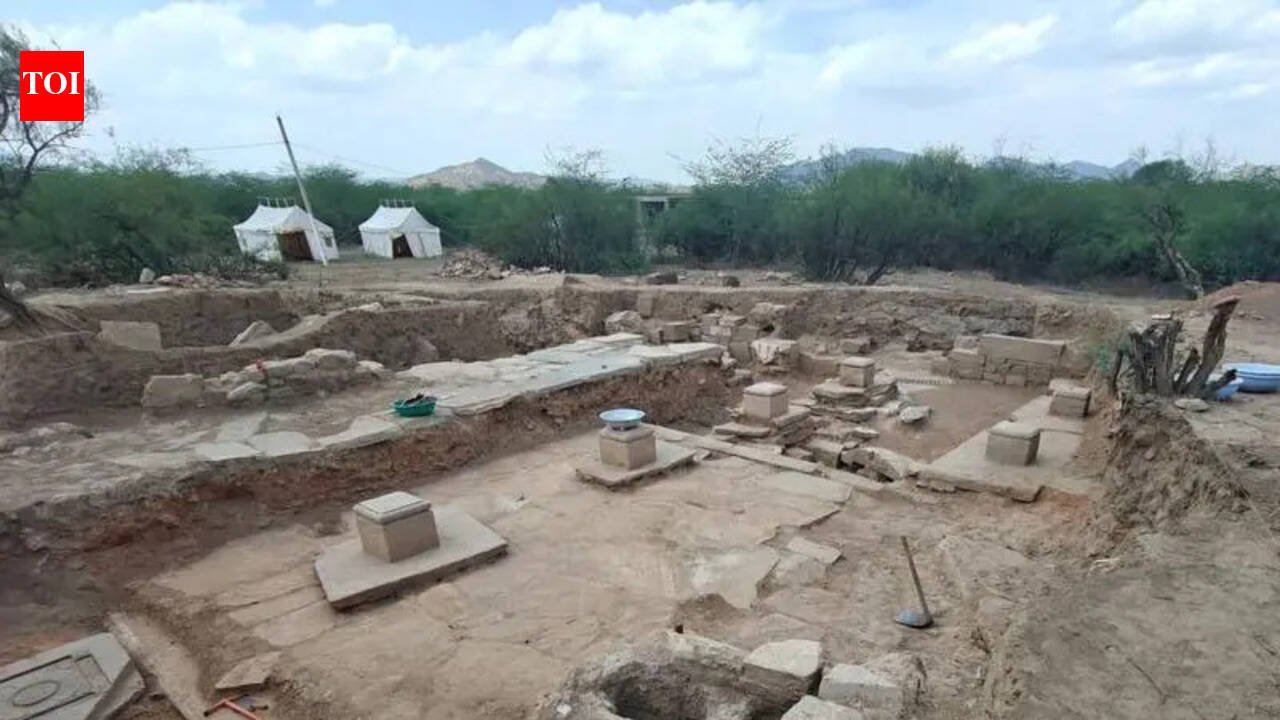
Jaipur: Archaeologists have unearthed a 1,000-year-old temple structure in Rajasthan’s Jhunjhunu district, a find officials say could fill major gaps in the early medieval history of the Shekhawati region. The discovery was made during an excavation underway since Jan 2026 by Rajasthan’s department of archaeology and museums at Tyonda village in Khetri tehsil, at a site locally known as ‘Reedh ka Teela’.Shekhawati is best known for its 18th and 19th century painted havelis, but has comparatively limited documented evidence from earlier periods.A team comprising department of archaeology and museums director Pankaj Dharendra, Jaipur circle superintendent Neeraj Tripathi and Albert Hall Museum superintendent Mahendra Nimhala visited the site Saturday to review progress.“Fragments of idols of Goddess Lakshmi and Lord Ganesha have been recovered, along with pottery and terracotta artefacts from different layers of soil. These finds indicate sustained habitation and religious activity at the site,” Tripathi said.Excavation officer Vivek Shukla briefed officials on the finds, which include a stone temple structure with a defined floor, semicircular architectural remains, pillar bases, door frames and intricately carved stone blocks – all pointing to a well-developed religious complex.Archaeologists believe the site dates back to the early medieval period. “They come from a time when Rajasthan saw the rise of regional dynasties and temple-building traditions that shaped its cultural landscape,” Tripathi said. “While regions like Mewar and Marwar have well-documented temple architecture from this era, findings from Shekhawati have been relatively limited, making this discovery particularly significant,” he added.He also said the excavation could help establish Shekhawati not only as a late-medieval mercantile hub but also as a region with deeper roots linked to settlements and religious activity.During the inspection, Dharendra directed officials to collect samples for scientific analysis and ensure preservation, calling for chemical conservation and detailed documentation, including site mapping and artefact drawings.Senior draftsmen Rajnikant and Sunil Sankhla have been assigned the task of graphical documentation, while conservation is being carried out under Tripathi’s supervision. “This discovery could prove to be a milestone in understanding Rajasthan’s cultural continuum. Our priority is to ensure scientific preservation and accurate dating of these remains,” Dharendra said.


