



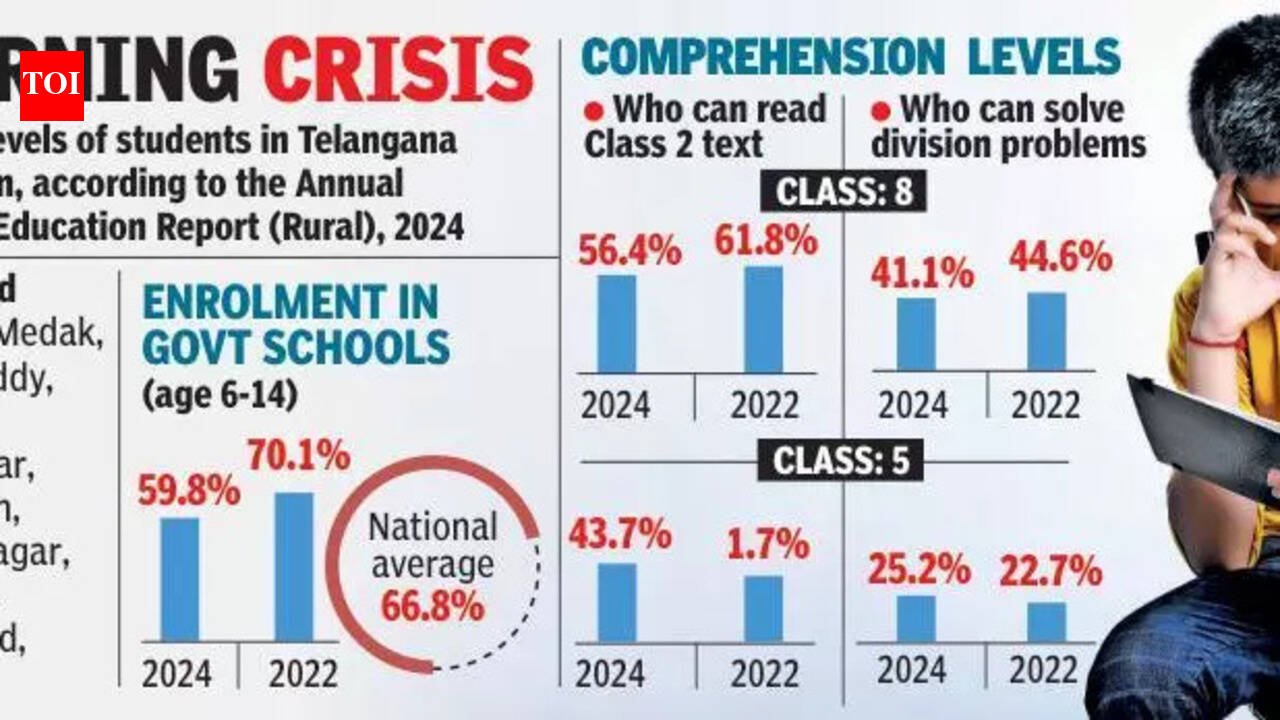
Hyderabad: Even as the Telangana Education Commission submitted its latest report to the govt, a closer look at Telangana’s budgetary allocations reveals a worrying picture.Data from the 2025-26 budget shows that Telangana spends just 9% of its total outlay on education — far below several other states. Bihar, for instance, allocates 21% of its budget to education, raising questions about Telangana’s prioritisation of the sector and long-term investment in educational infrastructure. An analysis of the 2025-26 state budgets further shows that both Andhra Pradesh and Telangana classify spending on schools for Scheduled Castes and Scheduled Tribes under welfare expenditure instead of reflecting it within the core education budget. This accounting practice tends to mask the actual scale of investment in education for marginalised communities. In Telangana, the entire social welfare budget stands at about 8%, which includes allocations for residential schools and related initiatives. Even when considered together, the state’s spending remains significantly below the national average of 14.5% allocated to education. A recent report by NITI Aayog titled ‘Expanding quality higher education through states and state public universities’ flags further concerns. It notes that Delhi (1.67%), Telangana (2%), and Karnataka (2.01%) allocate a relatively small share of their gross state domestic product to higher education. However, the report also points out that Telangana, along with Kerala, Tamil Nadu, Maharashtra and Andhra Pradesh, ranks among the leading states in per capita spending on higher education. The same report highlights sharp disparities across the country. Jammu and Kashmir leads with 8.11% of its GDP spent on education, followed by Manipur (7.25%), Meghalaya (6.64%) and Tripura (6.19%). The findings underline the uneven commitment to educational funding across states. Experts stress that beyond spending levels, quality remains a serious concern. Former IAS officer and policy expert Jayaprakash Narayan said that surveys in Telangana show that nearly 50% of schoolchildren are unable to read watch timings properly, pointing to deeper systemic gaps in learning outcomes.


