



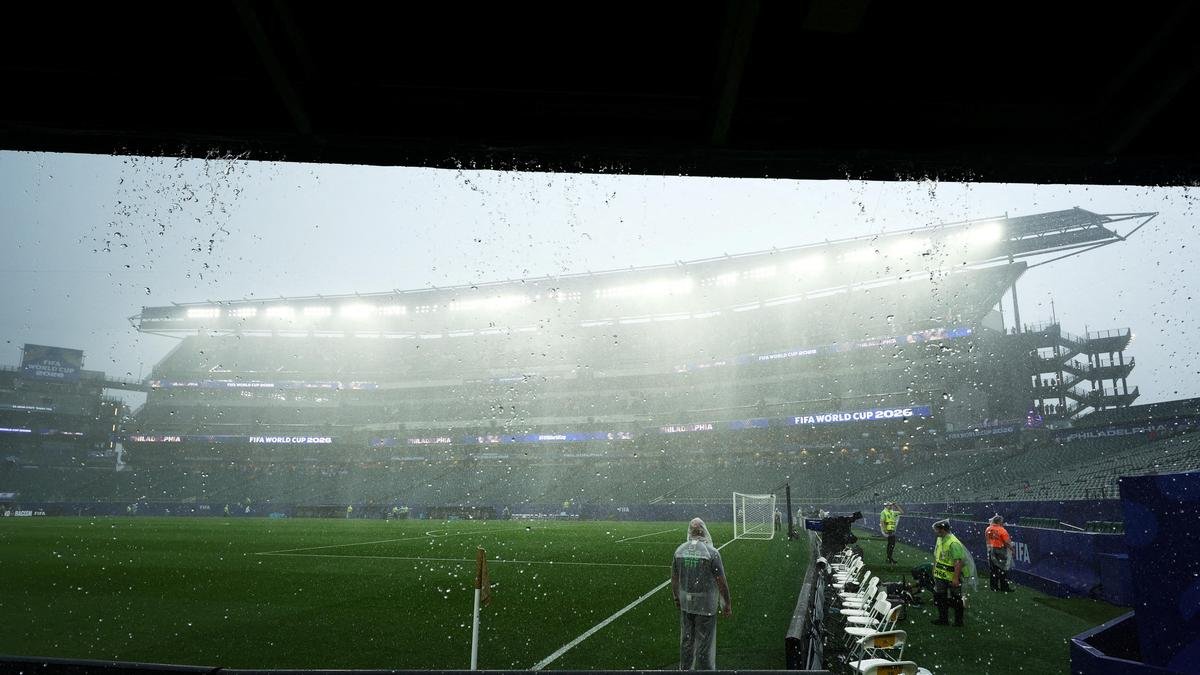
The technology’s value was evident when the France-Iraq clash was delayed due to rain.
| Photo Credit: Reuters
For nearly 90 minutes, Cape Verde frustrated Spain.
Spain, one of the tournament favourites, unleashed 27 shots and dominated possession, yet the scoreboard at the Mercedes-Benz Stadium in Atlanta read 0-0 at full-time. It was one of the early surprises of the 2026 FIFA World Cup and, in many ways, the perfect rebuttal to critics who feared the expanded 48-team tournament would produce a lot of one-sided group-stage matches.
Besides football, this World Cup has become a vast technology experiment. “This is the largest event on the globe that is so technologically powered,” Asia Sheikh, Lenovo’s Global CTO for Sports and Entertainment Technology Innovation, told Sportstar. “This is the first AI-native sporting event of its kind.”
At the heart of that vision is Football AI Pro, a platform developed jointly by FIFA and Lenovo that gives all 48 participating nations access to advanced tactical analysis. “We are ensuring that innovation benefits every player, every team, and every fan everywhere in the world and of course benefits the greatest game of all, football,” FIFA president Gianni Infantino said while introducing the initiative.
For instance, analysts from Cape Verde can for the first time access many of the tactical insights available to a team like Spain. “FIFA has brought the knowledge, the expertise, their analysts and their coaches, and we built this whole agentic AI layer on top of it,” Sheikh said. “Today, 48 teams have the same data. All coaches can see the same thing that is happening.”
Away from the pitch, Lenovo’s Intelligent Command Centre in Miami, which Sheikh describes as the World Cup’s “centre nervous system”, connects weather, transport, venue and security systems across the tournament. Its value became evident when thunderstorms delayed France’s group-stage match against Iraq in Philadelphia by almost two hours and fans were kept updated through the official FIFA app.
“They don’t have to call probably 30 teams and say, ‘here is your next action item’,” Sheikh said. “The command centre automatically does all the next steps for them. Every venue is connected, every traffic system is connected, every weather system is connected.”
Perhaps the most visible use of AI has come in officiating, where detailed player avatars are used to explain offside decisions.
“Fans will still curse,” Sheikh said with a laugh. “But we wanted to bring more transparency. When the teams arrived, we scanned them (all 1,248 players). Before, it used to be some cartoon character. You don’t know whether it’s Messi or Ronaldo. Now we are building the 3D avatar which replicates the skin tones and physical features. The technology gives you a clear picture of where the player was and how the call was made. But, of course, the referee is the one who makes the final decision.”
While the stars still decide the fate of the matches, artificial intelligence and technology are increasingly shaping everything around them.
Published – June 25, 2026 11:18 pm IST


