



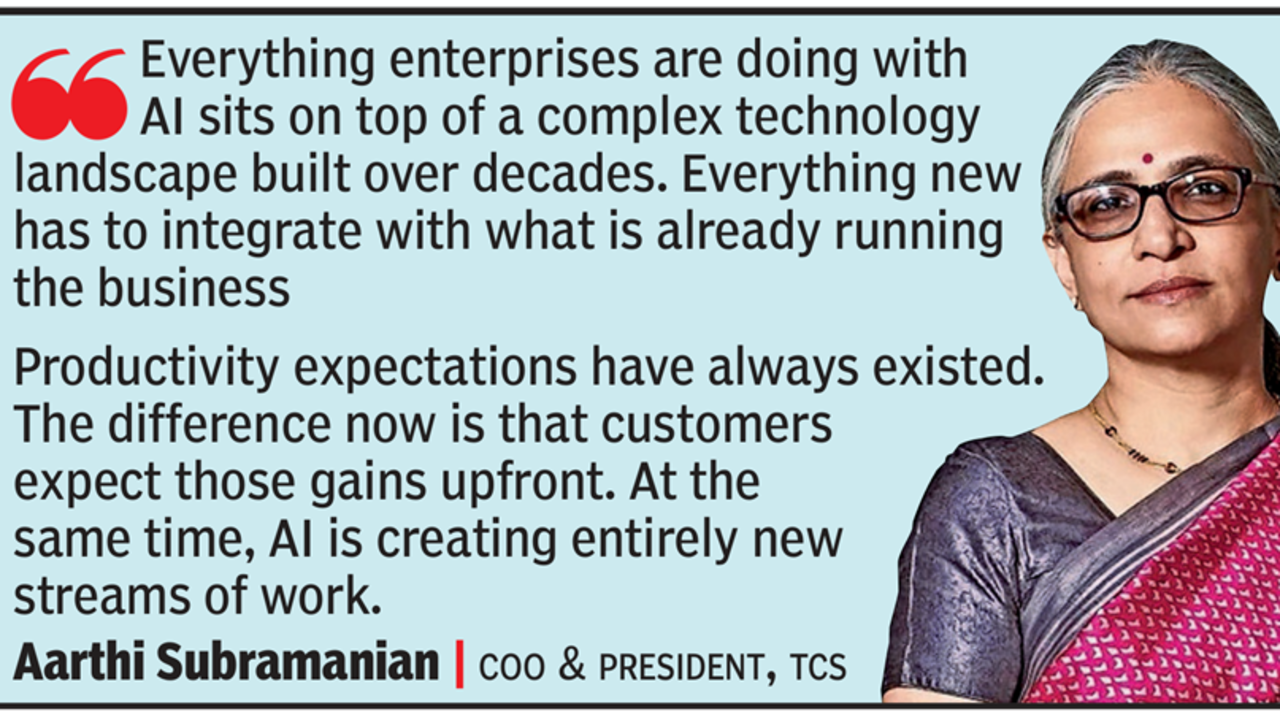
Bengaluru: Scale partners, not sidelined. That is how TCS sees its role in the AI era, even as model developers and technology giants increasingly take AI products directly to enterprise customers. TCS believes AI will expand the role of system integrators, creating new opportunities across enterprise modernisation, AI deployment, and business transformation.Speaking to TOI, TCS president and COO Aarthi Subramanian and chief AI and services transformation officer Amit Kapur said enterprises need much more than powerful AI models to generate business value. The real challenge lies in integrating AI into decades-old enterprise technology environments, business processes and workflows—a task they believe plays to the strengths of IT services firms.“The model is just one layer of the AI stack,” Subramanian said. “Everything enterprises do with AI sits on top of a complex technology landscape built over decades. Everything new has to integrate with what is already running the business.”She described enterprise AI as a full stack stretching from infrastructure to intelligence. While foundation models are an important component, firms also need enterprise data, governance, business context, and workflow integration before AI can deliver meaningful outcomes.“Look at us as the scale partner for product companies,” she said.Her comments come as technology vendors experiment with new go-to-market models. Microsoft’s recently announced Frontier Company, for instance, is a dedicated enterprise AI unit backed by a $2.5 billion investment that deploys 6,000 experts to build and manage AI solutions for customers.Subramanian, however, said the industry has witnessed similar shifts through earlier technology waves involving SAP, Oracle, SaaS providers and hyperscalers.“These companies have always had professional services firms to help customers deploy their products. What we are seeing now is an evolution of that model, not a replacement for system integrators,” she said.She pointed to TCS’s partnerships with OpenAI, Anthropic, Mistral and hyperscalers as evidence that AI companies continue to rely on global integrators because of their enterprise reach, delivery capabilities and decades of customer relationships.Kapur said customer conversations have moved beyond experimentation to preparing enterprises for AI adoption at scale.“There are multiple streams of demand emerging,” he said. “Customers are looking to modernise their technology stack, make their enterprises AI-ready, and then deploy models within their own business context.”While investors worry that AI-led productivity gains could pressure IT services revenues, Kapur argued that productivity is only one part of the equation.“Productivity expectations have always existed. The difference now is that customers expect those gains upfront. At the same time, AI is creating entirely new streams of work.”Subramanian also clarified TCS’s reported annualised AI revenue of $2.6 billion, saying the company uses a deliberately narrow definition that counts only pure-play AI transformation projects. AI used to improve software delivery or support SAP implementations is not classified as AI revenue.The senior leaders also rejected suggestions that AI will significantly reduce white-collar employment.Kapur said AI would change the nature of work rather than eliminate jobs, creating new roles centred on human-agent collaboration while requiring continuous reskilling.Subramanian said TCS continues to hire both experienced professionals and fresh graduates. The company added more than 9,000 employees in the June quarter—the highest net addition in 15 quarters—with experienced hiring focused on niche skills while campus recruits increasingly arrive with an AI-native mindset.“Our hiring continues to be driven by customer demand,” she said. “Many of our freshers adapt to AI very quickly, and for some, their very first assignment is an AI project.”


