



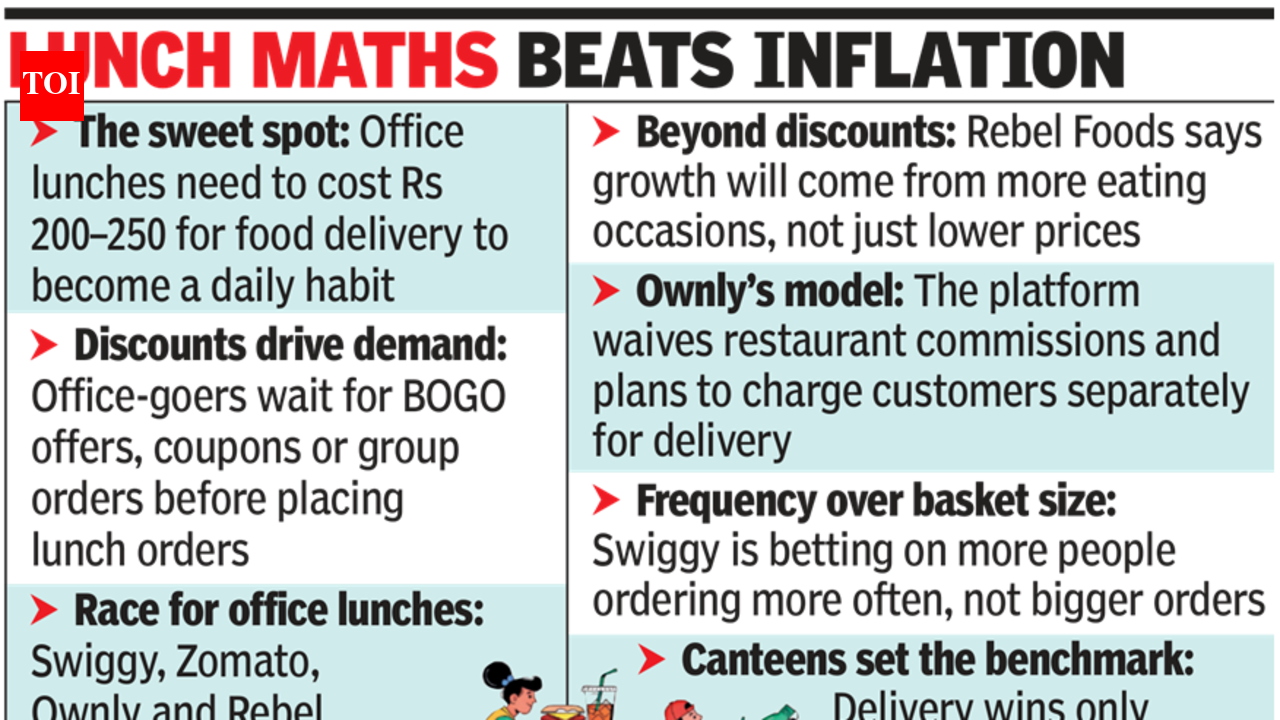
Bengaluru: The bill had to work. And it did. It was reason enough for a group of Bengaluru officegoers to band together and create a separate WhatsApp group just for meal orders.“The other day, eight wraps cost us Rs 699,” said one of them.Manu and his colleagues had grown tired of the same food from the office canteen and nearby darshinis. But ordering separately every day was too expensive. So they began pooling their orders, sharing screenshots of offers and waiting until the arithmetic worked.On one occasion, a buy-one-get-one offer brought a wrap down to roughly Rs 60. Six egg wraps and two chicken wraps together cost the group Rs 699. The deal gave them what the canteen could not: variety at a price that still felt reasonable for an ordinary workday.That small office ritual captures the challenge now facing India’s food-delivery companies: how to make ordering food feel less like a weekend indulgence and more like an everyday habit.Companies are taking different approaches. Swiggy and Zomato are pushing more value meals and targeted discounts. Rapido-backed Ownly is trying a different pricing model, while cloud kitchen operator Rebel Foods is betting that growth lies in catering to different eating occasions rather than simply lowering prices.The push comes as platforms look to expand beyond their base of frequent users and attract more office-goers and value-conscious consumers.“The intention is not the first order,” said Satish Meena, founder of consumer and retail research firm Datum Intelligence. “They want people to rely on these companies for office lunch regularly.”For that to happen, he said, the final bill needs to stay around Rs 200-Rs 250. Younger officegoers may be willing to order lunch, coffee or a snack, but not if delivery fees and mark-ups make it significantly more expensive than eating nearby. Fast-food chains are also introducing lower-priced meals to attract the same budget-conscious consumer.Swiggy has introduced multiple formats to improve affordability. Its Value Store operates within the main app, while Toing is a separate app aimed at budget-conscious users. Swiggy founder and CEO Sriharsha Majety recently said affordability, more than higher spending per order, would drive the next phase of food delivery growth, with recent gains led by more users and higher order volumes.Not every experiment has worked. Swiggy shut Snacc after concluding the category lacked sufficient scale. Toing remains an experiment.Eternal-owned Zomato, meanwhile, has no immediate plans to launch a separate value app, saying it is unclear what problem such a model solves for customers or restaurants. Bistro also remains an early-stage experiment.The company said platform fees apply across users, while discounts are selectively targeted at price-sensitive customers and locations where they help generate incremental demand.Ownly is attempting a more fundamental reset. The platform does not charge restaurants commissions and instead allows them to set their own menu prices. Customers will eventually pay separately for delivery, although those charges are currently waived on most orders.“Whatever an aggregator charges a restaurant is ultimately passed on to the customer,” an Ownly spokesperson said. “Our philosophy is to charge restaurants nothing and ask the customer to pay for the food and the delivery.”Rebel Foods believes affordability alone cannot drive growth.“Food ordering is about occasions,” said cofounder Kallol Banerjee. A customer may choose premium coffee one day and a neighbourhood café the next depending on the mood, company or purpose. “The growth will come from capturing more and more occasions,” he said, adding that affordability matters but is not the only driver.Curefoods has adopted a similar multi-brand strategy through labels such as EatFit, Sharief Bhai for Biryani and CakeZone, catering to different budgets and meal occasions.


