



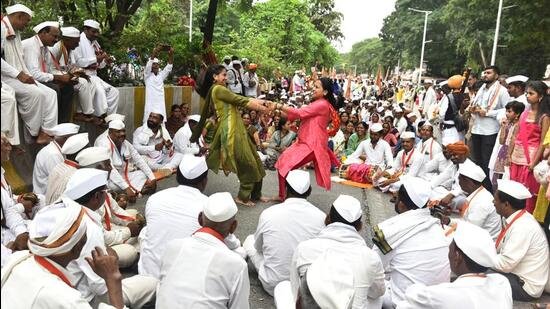
Every year, in the weeks before Ashadhi Ekadashi, Pune welcomes the palkhis of Sant Dnyaneshwar Maharaj from Alandi and Sant Tukaram Maharaj from Dehu as they make their way to Pandharpur. The annual pilgrimage, known as the “waari”, draws hundreds of thousands of devotees, known as warkaris, from across Maharashtra.

The word warkari means one who undertakes a regular pilgrimage to the shrine of a chosen deity. In Maharashtra, however, it has come to refer specifically to devotees who make the pilgrimage to the shrine of Vithoba at Pandharpur on the banks of the River Bhima.
Most pilgrims travel in organised groups, called “dindis”, which are often divided by caste, family, or village, and in some cases, even by gender. These groups frequently maintain separate dining arrangements as well.
Gopal Ramchandra Joshi, the noted theatre critic, narrates an incident in his book “Natyapandhari”. One afternoon in the early twentieth century, the streets of Pune were filled with warkaris on their way to Pandharpur. Small groups of pilgrims walked together, saffron flags resting on their shoulders, while the rhythmic sound of cymbals and mridang accompanied their devotional singing.
Standing on the balcony of the Aryabhushan Theatre, Ganpatrao Joshi, the legendary actor, watched the procession pass below. When a few warkaris looked up, he greeted them with folded hands. They, in turn, gestured that they wished to speak with him. Signalling them to wait, Joshi came downstairs.
“What can I do for you?” he asked.
“We hope to have our lunch before continuing to the next halt,” one of the pilgrims replied.
Joshi immediately called the theatre’s cook and asked him to arrange a meal for them.
At that moment, the leader of the group stepped forward and said, “There are a hundred and twenty-five people in our “dindi”. How can the few of us eat while leaving the others behind?”
Without a moment’s hesitation, Joshi replied, “Please bring everyone. The meal will be ready within an hour.”
Before long, the entire “dindi” had gathered. As chants of “Pundalik Varada Hari Vitthal” filled the air, the pilgrims sat down together for their meal. Joshi made sure everyone was looked after. When the meal was over, the warkaris embraced him before resuming their journey to Pandharpur.
Annadan, the act of feeding strangers, is understood not as charity, but as a form of devotion. Every village and town through which the palkhi passes regards it as a sacred duty to feed the pilgrims and provide them with lodging. Villagers, temples, charitable trusts, families, and local organisations line the route to offer meals and refreshments to warkaris.
Although annadan is rooted in devotion rather than commerce, it mobilises agricultural produce, creates seasonal demand, supports rural livelihoods, and redistributes resources across communities. The wari creates a temporary travelling food system that involves farmers donating grain, merchants supplying provisions, volunteers cooking, women preparing bhakaris and vegetables, and local markets catering to pilgrims.
In Pune, anyone wearing the tulasi rosary, the sacred symbol of the warkaris, was invited to have food in households, temples, and temporary pandals set up by various organisations. Before the warkaris set out from Alandi for Pandharpur in the last century, Gadage Baba, the reformer saint, personally served them jhunka and bhakari.
However, not everyone believed that charitable feeding represented the highest form of public service. As annadan continued to be organised on occasions such as the wari, voices of criticism questioned the large sums of money spent on these charitable feasts rather than funding schools.
By the closing decades of the nineteenth century, education was expanding steadily across Maharashtra. Schools were being established in towns and villages of all sizes. Yet for many non-Brahmin students, pursuing education away from home remained difficult because they had no place to stay or obtain regular meals. To address this need, community leaders from different castes began establishing hostels for students. Chhatrapati Shahu Maharaj was among the foremost supporters of this movement, building institutions that made education more accessible to those who had long been excluded from it.
The warkari community brought together people from many different castes. Most warkaris came from Maharashtra’s rural society, and many had little or no access to formal education. Greater access to education could have opened new opportunities and improved their lives.
In April 1926, during the intercalary month (“adhik maas”), around ₹75,000 was spent on feeding pilgrims at the “namasaptaha” held in Pandharpur. The feeding continued until July, when thousands of warkaris descended upon the holy town for the annual pilgrimage.
The Marathi periodical “Swarajya” questioned this expenditure. While it welcomed the feeding of the warkaris, the journal argued that large-scale community feasts, particularly those organised for Brahmins, ought to be reconsidered. It urged Maharashtra’s wealthy to introspect how much they were investing in education, an effort that could ensure people had enough to eat every day rather than only on special occasions.
At Alandi, Vishnupant Jog had established the Warkari Shikshan Sanstha to educate members of the warkari community. “Swarajya” argued that feeding pilgrims was undoubtedly a worthy act, but educational institutions for warkaris were equally necessary. It lamented the monetary crunch faced by Jog’s school. Redirecting even a portion of the money spent on charitable feasts for Brahmins and warkaris towards establishing schools across Maharashtra, it suggested, would serve a larger and more lasting purpose. Such an investment, it maintained, would yield lasting benefits, for the spread of education was a service not only to individuals but also to the nation.
The Marathi newspaper “Dnyanaprakash”, on July 29, 1931, published a letter written by Balwant Ramchandra Shinde, Secretary, Kshatriya Shikshan Parishad, Ahmednagar. The letter was addressed to Shri Savata Mali Punyatithi Utsav Committee. It was observed that the saint’s memorial anniversary usually consisted of annadan, devotional singing, and other programmes, for which considerable funds were collected. Most of this money, it noted, was spent on feeding people. “The true teaching of the saints,” the letter argued, “lies in serving society and guiding them towards truth and progress. Education is the foundation of all advancement. The merit of imparting knowledge is greater than that of giving food, and what society needs most is educated men and women.”
At the time, Pune was home to the Shri Savata Mali Boarding, which provided accommodation and food for students. Shinde wrote that if the money spent on annadan was instead donated to the boarding, it could support another hundred students.
The memorial anniversary of Sant Savata Mali fell on August 12, and Shinde suggested that rather than organising annadan, the occasion should be marked with bhajans and speeches highlighting the saint’s life and teachings while impressing upon people the importance of education.
Similar appeals were made by the members of the Shimpi community in May 1931.
The debate was not about abandoning annadan, but about balancing the traditional merit of feeding devotees with the emerging ideal of education as a form of public service. These appeals, however, found only limited support. Annadan continued to occupy a central place in the wari, while efforts to redirect charitable giving towards education remained relatively modest.
Chinmay Damle is a research scientist and food enthusiast. He writes here on Pune’s food culture. He can be contacted at chinmay.damle@gmail.com


