



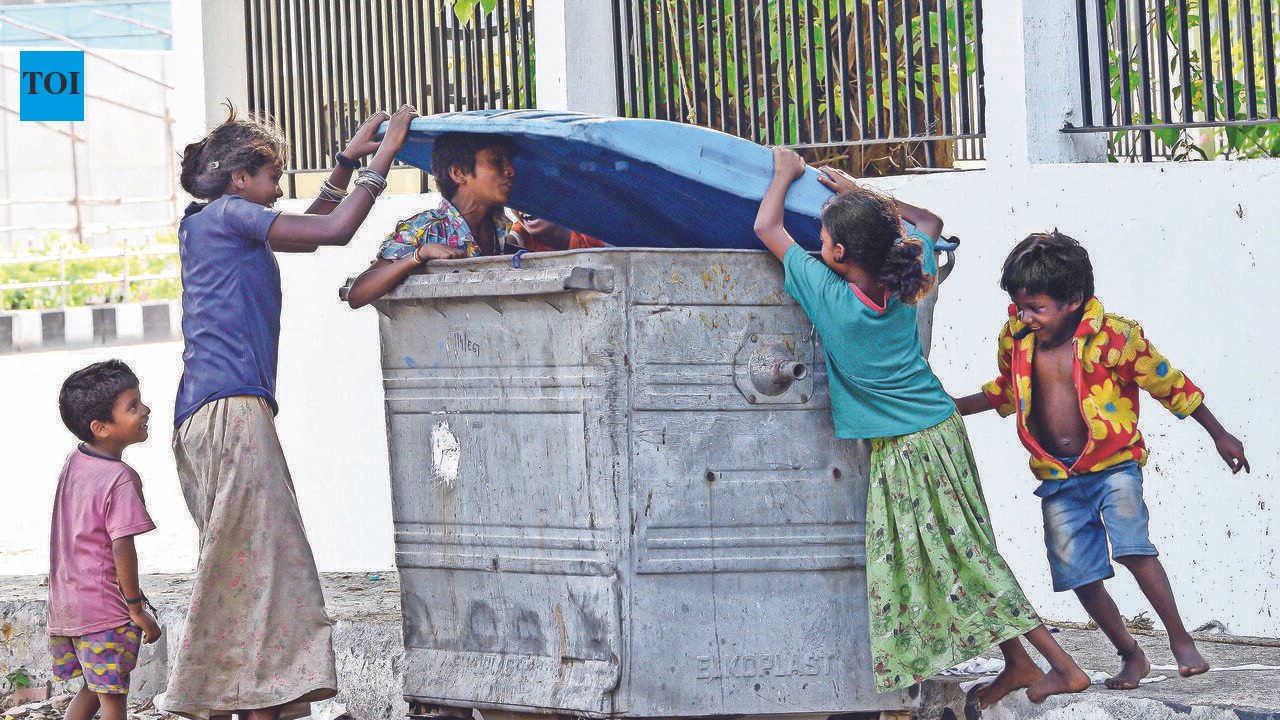
Sridevi* was 10 when she was found living on the streets of Semmancheri with her grandparents. The family had no identity documents, little food and no safe place to stay. Local vendors had begun pressuring her grandmother to send her away as a live-in domestic worker. Following intervention by local residents, Sridevi was rescued and placed in a childcare institution.Tamil Nadu has 10,674 children in street situations, according to National Commission for Protection of Child Rights’ (NCPCR) 2022 figures. Many like Sridevi are outside formal education and welfare systems, working on the streets and living without identity documents, sanitation, healthcare or protection from exploitation. The Children in Street Situation (CiSS) Policy, framed by the NCPCR under Mission Vatsalya in 2022, was meant to address these gaps. Four years later, child rights activists say Tamil Nadu is yet to implement the framework.“Without a way to identify children living on streets, many remain invisible to the child protection system,” says Paul Sundar Singh, secretary of Karunalaya, a non-profit that works for street children.“Unless a passerby, resident, NGO or the police notices and rescues them, they continue to live in danger.” Unlike the existing system, which comes into play after children are rescued, the CiSS policy provides for the proactive identification of children living on streets and preparation of individual rehabilitation plans.“The policy was intended to fill critical gaps such as the absence of a mechanism to identify and enumerate those living on streets,” says Vanessa Peter, founder of Information and Resource Centre for the Deprived Urban Communities (IRDUC). “But it needs coordination among urban local bodies, district administrations, child protection units, police, and departments of social welfare and women empowerment, health and education, along with civil society organisations.”Vanessa says the lack of coordination affects what happens after children are rescued. Those with behavioural challenges, substance dependence or self-harming tendencies are often turned away by childcare institutions that are not equipped to support them. In other cases, children are reunited with families without a comprehensive social investigation report. It increases their risk of returning to abusive or unsafe environments.“Rescue alone is not rehabilitation. Rehabilitation requires ensuring are not pushed back onto the streets,” she says.Although children in street situations are covered under the Juvenile Justice Act and can access services through Mission Vatsalya, Vanessa says there is no programme exclusively meant for them.One of the biggest challenges faced by children in street situations is the lack of identity documents. Without birth certificates or Aadhaar cards, children cannot be enrolled in schools or access welfare schemes and healthcare.“Two children in our shelter who are orphans don’t have birth certificates. The process has been pending for months, because of which we are not able to enrol them in school,” says Paul.Virgil D’Sami, executive director of Arunodhaya, a non-profit for working and street children, says many are exposed to begging rackets and drug peddling. “Adolescent girls have no privacy to bathe or change clothes,” says Virgil.Paul says many children are abandoned or neglected and are vulnerable to physical and sexual abuse. “They do not have enough food, hygiene or healthcare. We try to provide a place of safety.” Over 30 years, Karunalaya has provided education for more than 6,000 children, and advocacy and legal support to more than 2,000 children.Even if children are admitted to schools, keeping them there is a challenge. “Many struggle academically and face discrimination from peers and teachers, and drop out,” says Paul. He adds that a bridge school — an educational programme that reintegrates out-of-school children of guest workers or dropouts into the formal education system by helping them catch up on foundational academics — is the solution.“While Chennai has no bridge schools, we are coordinating with NGOs to reintegrate out-of-school children,” says Greater Chennai Corporation commissioner G S Sameeran.“We are planning a socioeconomic survey of urban habitat tenements to identify children needing enrolment.” Although officials told TOI that the policy has been implemented, repeated requests for details on how its provisions have been operationalised in Tamil Nadu went unanswered.(* name changed)


