



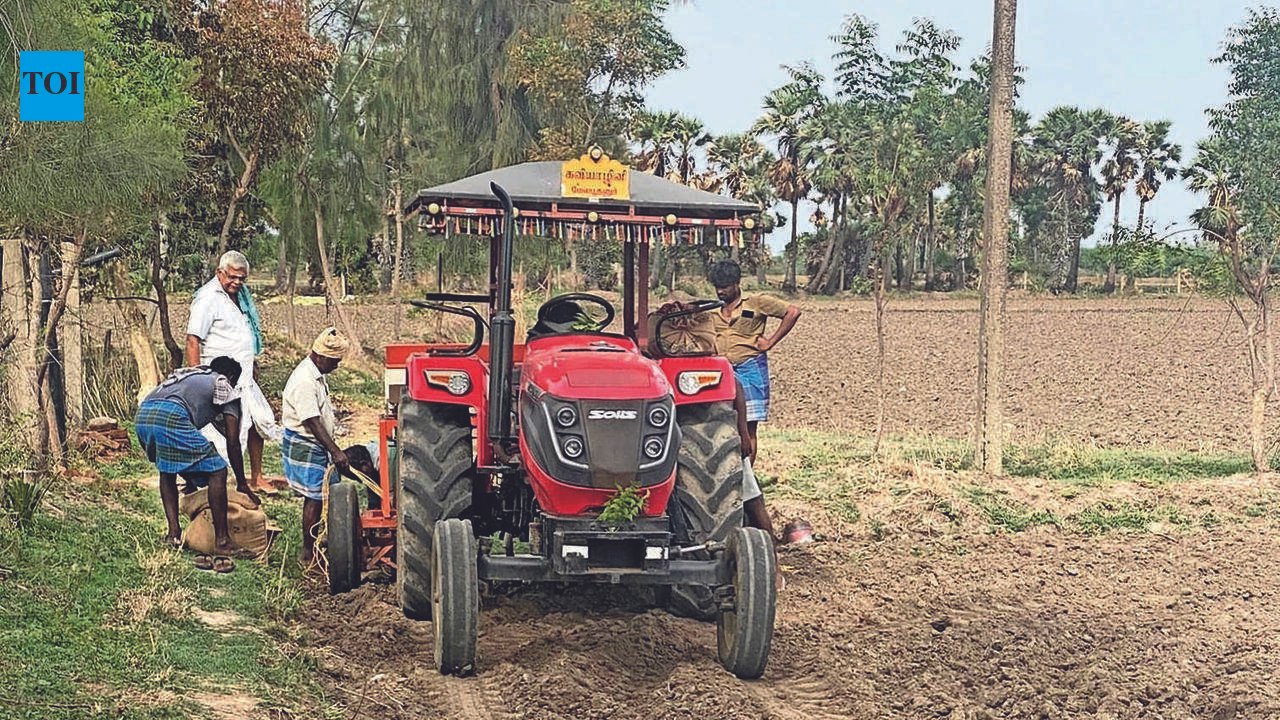
Ever since Sept 1, when Tamil Nadu chief minister C Joseph Vijay opened the Mettur dam in Salem district and released Cauvery water for irrigation, farmers in the delta, who missed the kuruvai (short-duration) season, have begun preparing for samba (long-duration) and thaladi (second-season) paddy cultivation. But, they’re racing against time.Officials have told farmers that water can be released continuously from Mettur for only about 45 days. The limited window has left delta farmers worried, especially those who depend solely on canal-based irrigation. “We need water to be released for at least 90 days so we can irrigate crops till they reach maturity,” says Cauvery V Dhanabalan, representative of Tamil Nadu kaviri vivasaayigal pathukaapu sangam. “We want the TN govt to put pressure on Karnataka to ensure continued releases.” Water resources department (WRD) officials say they are “hopeful of continued releases from Karnataka” and for a benevolent northeast monsoon in the catchment areas to ease the shortage.Some farmers say cultivation this year is going to be a gamble because the discharge may not be enough to support crops till harvest.“Some farmers could not wait for the release of Cauvery water and planted kuruvai crop using groundwater,” says an official. “They began sowing in May and June and are now harvesting. They plan to start thaladi cultivation by Sept-end and harvest by Jan.” Some farmers, says the official, began samba cultivation in the last week of Aug after learning of the Mettur dam opening.Water level in the Stanley reservoir at Mettur stands above 92ft (maximum level is 120ft). The dam has been receiving an inflow of more than 7,000 cusecs (cubic feet per second) following releases from Karnataka’s dams over the past two weeks, while Mettur continues to release 7,000 cusecs. Sources in WRD say 10tmcft (thousand million cubic feet)would be used for drinking water and another 10tmcft lost to wastage, leaving only 35tmcft for irrigation.Officials say that after the Grand Anicut (Kallanai) opens on Sept 6, water will be diverted to the Cauvery, Vennar and Kollidam rivers as well as the Grand Anicut Canal. It is expected to reach farmers in Nagapattinam, Mayiladuthurai and Karaikal by Sept 15, marking the beginning of the main irrigation season for the Cauvery delta after months of uncertainty.In preparation for the release, WRD and the agricultural engineering department have completed desilting across 7,400km of channels in the Cauvery delta region. WRD desilted 4,972km through 959 works spread across 12 Cauvery basin districts at `100 crore under its special desilting scheme.The agricultural engineering department (AED) desilted 2,375km at `10 crore in seven districts. The rural development department cleared smaller interior branching channels.“The large-scale clearance is expected to improve both water delivery efficiency and field drainage, reducing waterlogging risks later in the season,” says a senior WRD official.This year, because of the delayed release, kuruvai was cultivated on 9.7 lakh acres, down from 13.8 lakh acres the previous year. With the present release timed for samba and thaladi, the agriculture and farmers welfare department is targeting 13 lakh acres of cultivation in Thanjavur, Tiruvarur, Nagapattinam, Mayiladuthurai, Cuddalore, Trichy and Ariyalur.The department has also begun stocking paddy seed at its agricultural extension centres for subsidized distribution now that samba sowing has begun. Private dealers are also holding stocks for sale.Emphasis is being placed on medium- and short-duration varieties to help farmers cope with limited water. Long-duration varieties are being stocked for those who can meet higher water requirements from other sources.“We are recommending medium- and short-duration varieties because their water requirement is less,” says a senior agriculture department official, adding that the department is working with ICAR-Krishi Vigyan Kendras and the Tamil Nadu Rice Research Institute on contingency measures against drought.But many farmers focus on yields and are reluctant to sow drought-resistant varieties that offer only moderate yields despite the water shortage. “Every farmer wants a yield of 1,800kg to 2,700kg of paddy per acre. Or, it can lead to losses,” says G Sethuraman, a farmer from Jaganathapuram in Tiruvarur district.Officials recommend direct sowing over manual transplantation, machine transplantation, or the climate-smart system of rice intensification, which includes direct sowing to eliminate water-intensive nursery preparation and reduce water use by 40%.Additional drought-management practices being promoted include seed hardening before sowing. “Alternate wetting and drying irrigation throughout the crop cycle also minimizes water use. Farmers can irrigate periodically only when hairline cracks start forming in their fields,” says V Kannan, an agronomist at the Krishi Vigyan Kendra in Nagapattinam.With desilted channels ready and farmers adopting shorter-duration varieties and water-saving methods, the season holds promise if releases continue without interruption. The coming weeks will be crucial in determining whether the available water, combined with adaptive farming practices, can secure a successful harvest for the region’s agrarian communities.


