


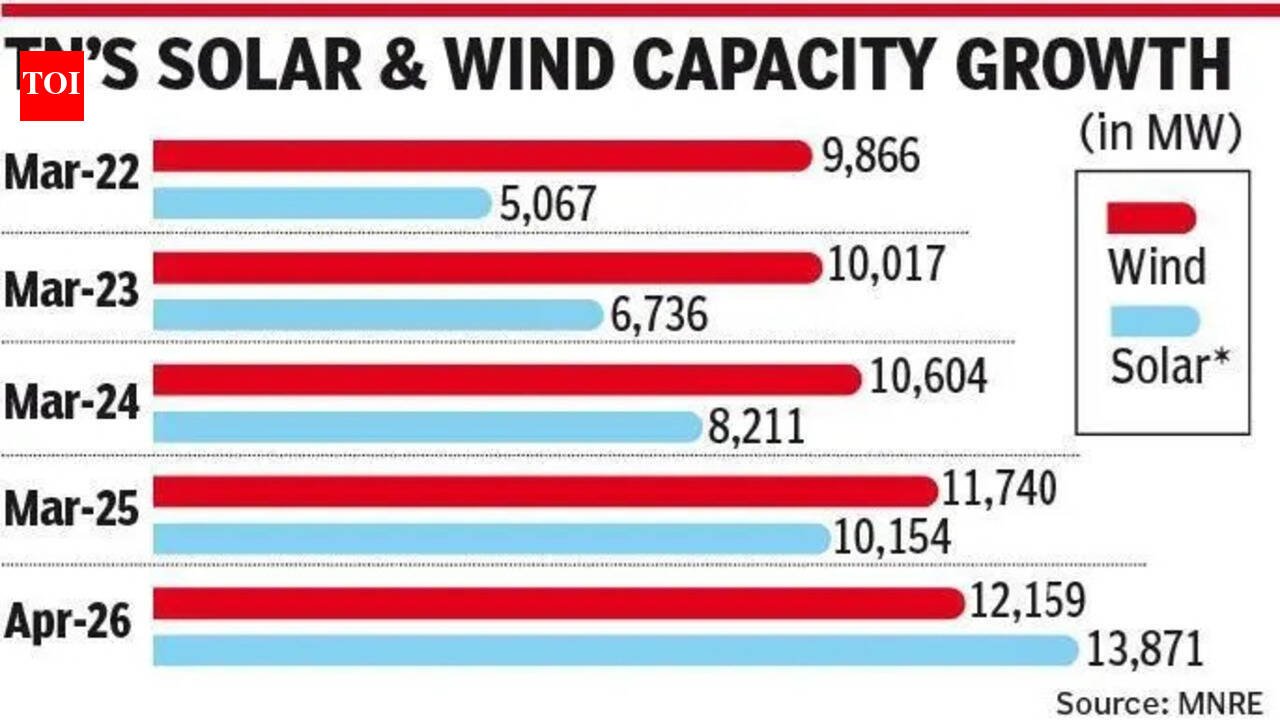
As one of India’s earliest movers in renewable energy, Tamil Nadu built a formidable wind power ecosystem. For years, it held the distinction of being the country’s largest wind energy producer. Although Gujarat overtook the state in installed wind capacity a few years ago, Tamil Nadu remains the nerve centre of India’s wind industry and is seeking to regain its leadership through repowering, grid upgrades and fresh investments.Yet Tamil Nadu’s renewable energy story is no longer driven by wind alone. In a significant milestone, the state’s cumulative installed solar capacity — across utility-scale, rooftop and other segments — has surpassed its wind power capacity. As of April 2026, installed solar capacity stood at 13,871MW, compared with 12,159MW of wind capacity.The state’s solar capacity has expanded rapidly over the past four years, transforming TN from a wind-dominated renewable energy market into a major solar powerhouse. Tamil Nadu ranks fourth in solar capacity, behind Rajasthan, Gujarat and Maharashtra.TN’s installed solar capacity has nearly tripled from 5,067MW in March 2022 to 13,871MW in April 2026, an addition of 8,804MW, representing a growth of about 174%. The pace of expansion has been particularly striking in recent years, with installations crossing the 10-GW milestone in March 2025 and rising by another 3,717MW in just over a year.“The addition of more than 3GW of solar capacity in the last year reflects overwhelming investor interest in the sector. If we can provide adequate grid connectivity, annual additions of 5GW to 6GW are achievable,” said Aneesh Sekhar, former MD of Tamil Nadu Green Energy Corporation.According to him, one of the key drivers has been the state’s favourable open-access policy framework. In addition, industries are increasingly committing to green-energy targets, while Carbon Border Adjustment Mechanism (CBAM) regulations in Europe are creating additional compliance requirements, encouraging companies to source renewable power. This strong industrial demand is helping fuel solar growth in the state.Another factor supporting solar expansion is the rapid development of battery energy storage systems. “Solar now has a viable storage solution through batteries, making us more comfortable adding solar capacity than wind capacity. Wind is seasonal and does not yet have an equivalent large-scale seasonal storage solution. Solar generation follows a predictable diurnal pattern, making it easier to store and manage. This will continue to drive solar growth in the future,” Sekhar added.Tamil Nadu has also emerged as a major destination for solar manufacturing investments, with players such as Tata Power and Vikram Solar establishing large cell and module production facilities in the state. Tata Power’s Tirunelveli facility, developed with an investment of about ₹4,300 crore, houses 4.3GW each of solar cell and module manufacturing capacity and is among the country’s largest integrated solar manufacturing units.Solar energy has therefore emerged as the new growth engine of Tamil Nadu’s clean-energy transition, expanding rapidly on the back of abundant sunshine, supportive policies, declining technology costs, growing storage deployment and rising demand from industries and households. What was once known primarily as India’s wind capital is steadily evolving into one of the country’s most important solar power hubs.The wind sector, meanwhile, continues to gather momentum in the state through repowering initiatives and transmission upgrades. Nearly 2,500MW–3,000MW of ageing wind capacity is estimated to be eligible for repowering, which could significantly increase generation from existing sites. Industry stakeholders pointed out that the repowering of ageing wind turbines, in particular, has the potential to transform the sector by significantly increasing generation from existing wind sites and reinforcing Tamil Nadu’s longstanding leadership in renewable energy.Meanwhile, high land costs in Tamil Nadu, compared with states such as Andhra Pradesh, Gujarat and Karnataka, continue to constrain new greenfield wind investments. Industry players expect the new govt to bring greater transparency to land transactions to attract fresh investments and strengthen the State’s position in clean energy and allied sectors.
