


Human beings are not just shaped by their actions, but they are also creatures of circumstance. This is especially true in the sporting world, where athletes’ performance not only depends on their quality but also on who the rivals are, their prevailing standards of excellence and the setting in which the competition is being held.
It is like playing blackjack at a casino, a game of skill and strategy no doubt but one where luck is a big determinant of the two cards the dealer deals to each player at the beginning.
Constantly thwarted
In the decade or so that he has been playing tennis at the elite level, Alexander Zverev has been experiencing this first hand. The German has been in the top-10 for a good part of these 10 years, won 24 ATP Tour titles including seven Masters 1000s and two year-ending Finals, and clinched the singles gold medal at the Tokyo 2020 Olympics.
However, he is yet to taste success at the Grand Slams, having lost thrice in the finals. And he has been thwarted by not one or two but three generations of players.
When he first broke through, the stranglehold established by Roger Federer, Rafael Nadal and Novak Djokovic was still intact. In 2020, in his maiden Major final at the US Open, he was beaten by his peer Dominic Thiem despite leading two sets to love and serving for the trophy in the fifth.
Of late, he has been ambushed by the irresistible duo of Carlos Alcaraz and Jannik Sinner, who have swept the last nine Slams and beaten Zverev in 13 of their last 14 meetings combined.
The latest of these came at the Madrid Masters earlier this month, Sinner winning 6-1, 6-2 in just an hour and 13 minutes. Three weeks shy of Roland-Garros, the reverse would have been chastening, for it was his ninth straight defeat to the Italian World No. 1.
Zverev, 29, followed it up by combusting spectacularly at the Rome Masters, losing early to the unheralded Luciano Darderi, including 6-0 in the final set after fluffing four match-points in the second stanza. But there is little doubt as to which of the two defeats would have left a lasting scar.
Zverev’s current state is a paradox. He has been secure in the ATP top-four starting French Open 2024, made two of his three Major finals in this period and exhibited a much-improved level of play that is deserving of the sport’s most important prizes.
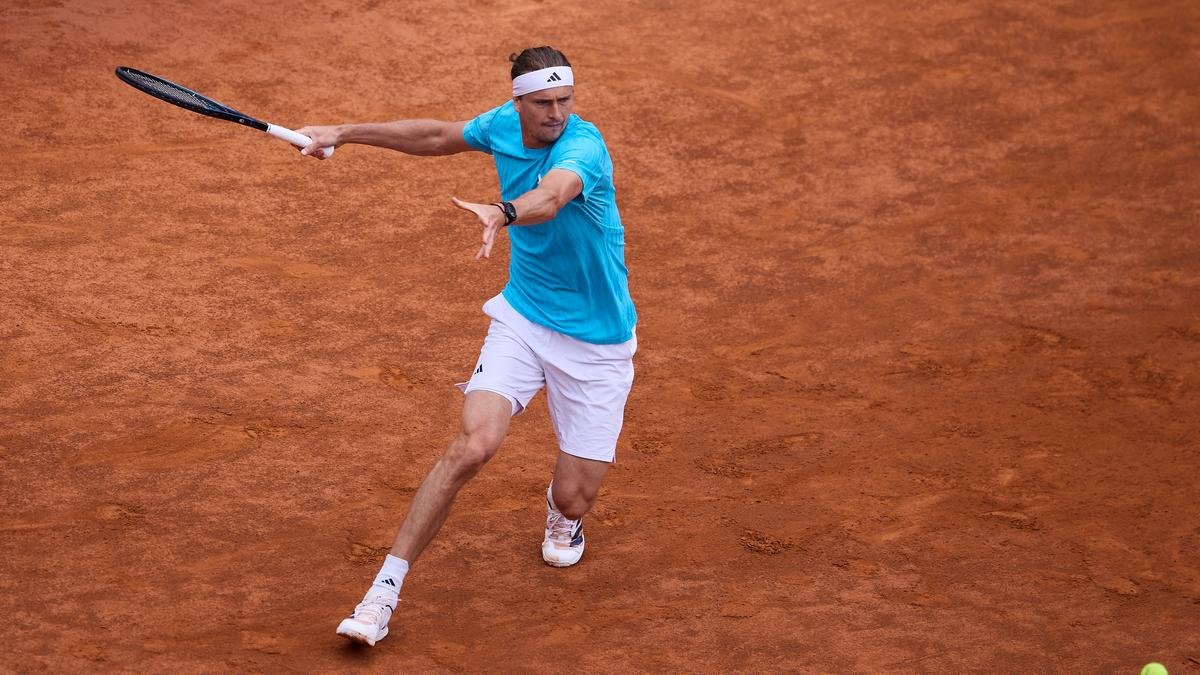
A big-serving counter-puncher with an imposing on-court presence, Zverev, from a height of 6’6”, possesses one of the best serves on the circuit. His backhand is ruthless, he is solid on the return and moves extremely well despite his towering build.
A big-serving counter-puncher with an imposing on-court presence, Zverev has added significant aggression to his game.
| Photo Credit:
Getty Images
At the Australian Open, he hit with new-found depth and spin, and also added significant amounts of aggression. “I’ve worked on my first shots after the serve, my first forehand after the serve… if those things work for me, then I think success will come,” he had said.
In the semifinal in Melbourne, he came up with a first-rate performance, battling Alcaraz for five hours and 27 minutes before losing the riveting fixture narrowly. If he had served out the contest at 5-4 in the fifth, an even-odds final against a 38-year-old Djokovic would have been his reward.
Yet, he is currently in a peculiar position, placed a creditable third behind Sinner and Alcaraz, though a distant one at that. In the four Masters 1000 tournaments after the Australian Open, Zverev finished a semifinalist or better, but lost in all four to Sinner. The difference in points between him and Alcaraz in second spot is more than double his own tally of 5,705.
Monopoly? Duopoly?
Interestingly, Zverev believes that men’s tennis is a monopoly and not a duopoly. “There’s a big gap between Sinner and everybody else,” he opined after his Madrid surrender. “There’s a big gap between Alcaraz, myself, maybe Novak, and everybody else,” he added.
The attempt to bracket himself with Alcaraz rests on the evidence of the close encounter Down Under and the fact that they had split the six previous matches equally. In the 2024 French Open final, Zverev even led the Spaniard two sets to one before falling apart.
With Alcaraz pulling out of Paris and Wimbledon with a wrist injury, Zverev will have to wait longer to prove his proximity to the seven-time Major champion. But if he recovers sufficiently from his own back injury that put him out of Hamburg this week, he will have his clearest shot at Sinner on the Grand Slam stage.
“I do have to believe that I’m capable of beating him [Sinner],” Zverev, who is seeded second at the second Major of the year, said after Rome. “I do have to believe it, otherwise we can just give him the trophy without playing the tournament.”
Zverev says he believes he can beat Jannik Sinner, but nine straight defeats to the Italian World No. 1 will have left deep scars.
| Photo Credit:
Getty Images
Though Sinner is on a mesmerising 29-match winning streak, Zverev can draw confidence from his own affinity for clay. Roland-Garros has been the gangly German’s most rewarding Slam — three quarterfinals, three semifinals and a final in his last eight visits.
Four of his seven Masters crowns have come on the dirt, and he boasts of a better win-loss percentage on the surface (73%, 182-66) than both his overall career number (70%, 548-232) 70%) and figure on hard courts (69%, 321-143).
However, his past record at capitalising on the absence of one of his two great rivals is a giant red flag. In February 2025, when Sinner accepted a three-month doping ban, Zverev had a golden chance to be Alcaraz’s biggest challenger.
When the expulsion kicked in, Sinner’s lead over Zverev was 3,695 points. Despite missing four Masters 1000s and a couple of ATP 500s, the Italian returned to action at Rome still ahead by 1,645 points.
Zverev played eight tournaments in the time Sinner was away, but won more than two matches at just one event — Munich 500, where he hoisted the trophy.
Presently, though his game is better rounded than earlier, he still has the propensity to be passive at crucial junctures. And despite his vast wingspan, his skills at the net and his transitions to the forecourt leave much to be desired.
There are also seeming temperamental flaws. Last October, he extrapolated Federer’s observation that surfaces were being slowed down and said, “they [authorities] want Jannik and Carlos to do well every tournament, and that’s what they prefer”.
Off-court drama
After the recent exit from Rome, he called the courts — where he has two titles and a runner-up finish — the worst he had ever played on. Two days after that, he went after Tennis Channel, accusing it of “wasting his time” and loving to “hate on him” after the American network, allegedly, dropped promotional videos involving him.
For someone who is at the peak of his career, these are distractions he could do without. It will be in his — and men’s tennis’ — best interests if he can marry his upgraded style with a better mental disposition, and let the headlines write themselves from within the four corners of the court.
