



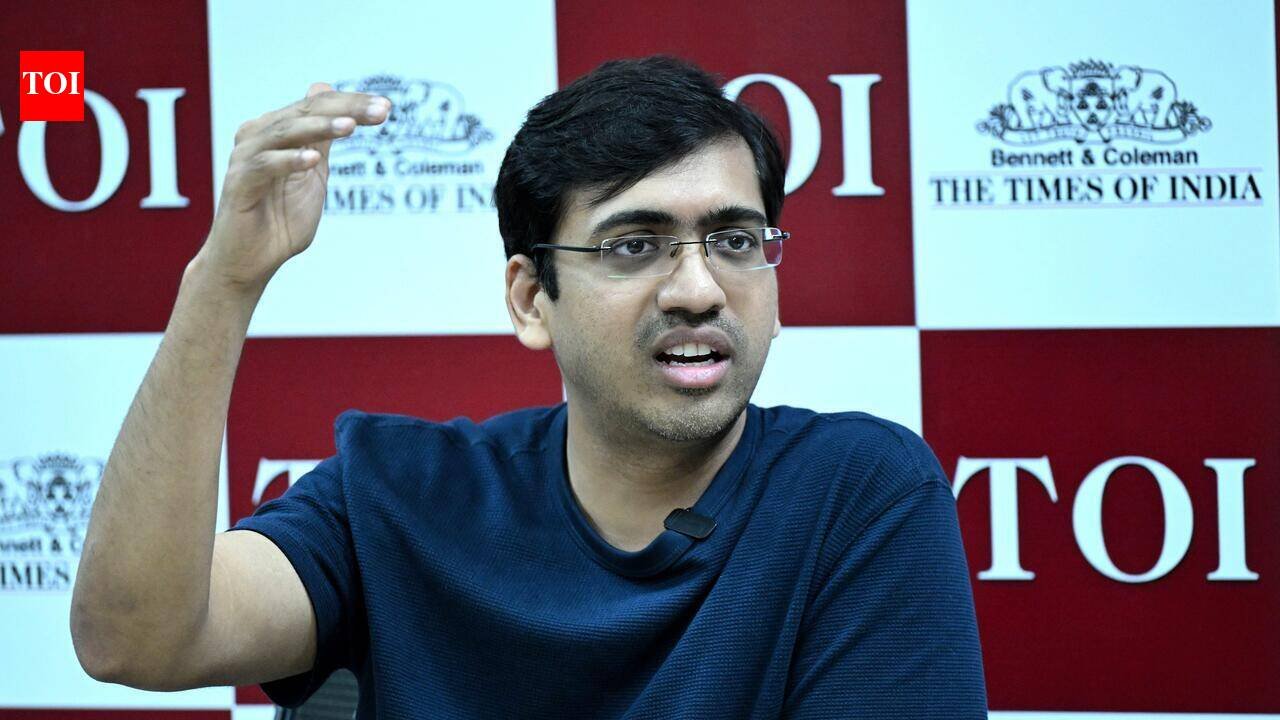
Q: What are your key takeaways for Gen Z and Gen Alpha?Pawan: Take high risks. India needs more entrepreneurship, and risk-taking is now encouraged in a way it was not earlier. Start early. Students can build companies or serious projects while still in school. Choose deep tech. Space, defence, advanced manufacturing and other deep-tech areas can create a major impact for the country and for people’s lives.Q: What do engineering school not teach?Pawan: Degrees are becoming outdated in many ways, especially in the AI era. I studied at top institutions, including IIT, but I became a real engineer only after joining ISRO, where I actually built things. Real engineering begins when you build. At Skyroot, I became a builder in a different way because we had to create the organisation from scratch. The best people are often self-learners driven by curiosity.Q: What advice would you give Class 10 and 11 students who want to build something big?Pawan: First, just start. Many people keep saying they want to start but never begin. Once you start, a large part of the journey has already begun. Second, choose the biggest problem in your area of interest and go after it directly. If the goal is ambitious, good people, investors and policymakers are more likely to support you. Third, persist through the difficult phases.Q: What mindset should students develop to build advanced rocket technologies early?Pawan: The world is changing very fast, especially because of artificial intelligence. Students today are an AI-native generation, so they must keep pace with technology. Learning has become much easier; you can learn a lot within minutes or hours if you are curious and disciplined. India also needs more entrepreneurs. A large part of the country’s population is young, and that energy should go into building companies, solving problems and creating technology. Students should not wait until later in life. They can start passion projects in school itself. If they want to build rockets, they can begin by designing, experimenting and using the tools available today.Q: What made you believe India was ready for a private space company?Pawan: Three things were needed: talent, capital and policy. India has exceptional engineering talent. Every year, around 1.5 million engineers graduate, and even the top fraction or cream of that number is very large. Capital was a question when we started, but Skyroot has raised more than ₹1,400 crore on the strength of an idea and execution. Policy support came when the government opened the space sector to private players. Once talent, capital and policy aligned, like the stars, it became possible to build world-class space companies from India.Q: What was going through your mind during the Vikram-1 countdown?Pawan: People said I looked calm, but internally there was a lot of pressure. Liftoff is one of the most critical moments. The launchpad itself is extremely valuable, and it was not our launchpad, so I wanted the rocket to clear it safely and quickly. I relaxed only after the satellites were deployed. Succeeding on the first attempt gave us confidence that India can build cutting-edge technology at a global level.Q: What was the biggest risk in building Skyroot?Pawan: Starting Skyroot itself was the biggest risk. At that time, there was no clear policy, no funding environment and no private-sector talent pool for rockets. We had to build everything from scratch. Today, Skyroot has more than 1,000 people, with an average age of around 28. About 95% had not worked on rockets or space before joining us. We trained and built the talent internally.Q: What is Skyroot’s biggest challenge now?Pawan: Repeatability. We succeeded in reaching orbit on the first attempt, which is rare globally. The next challenge is to do it repeatedly. A rocket has tens of thousands of parts, and everything has to work correctly every time.Q: Will the next launch be commercial?Pawan: It will be partially commercial, but also a test flight. We need two or three consistent successes to prove repeatability. Every launch will include improvements based on what we learn.Q: What is the plan for Vikram-1?Pawan: Vikram-1 will remain our main vehicle, our workhorse, for now, with possible small variants and upgrades. We are targeting another launch towards the end of this year. Next year, we plan multiple Vikram-1 launches.Q: What about Vikram-2?Pawan: We are targeting the first launch of Vikram-2 towards the end of next year. It will have significantly higher payload capacity than Vikram-1, close to one tonne to orbit.Q: What is the status of your reusable rocket plan?Pawan: We have been working on reusable launch vehicles for quite some time. Progress is being made, but it will take a few years. Vikram is the immediate focus, while reusable vehicles are the next major step and will expand the market.Q: Which part of building a rocket is closer to art than mathematics?Pawan: The structure of the rocket has an artistic element. We weave it like a weaver. We use carbon fibre that is wound and shaped like a basket through advanced machines. It must withstand high pressure and temperature of the burn of the rocket during flight. The entire rocket is a result of many systems coming together with precision. So, the entire rocket is also like a work of art. It’s not like engineers building a rocket. It’s like artists painting a great picture that will go to orbit.Q: How central is AI to space technology? Did you use it in Vikram-1?Pawan: We did not use much AI in the rocket we launched because the design began four to five years ago, before the current AI wave. We were also very careful about security and could not put sensitive data into AI tools. In the future, AI will play a larger role in rocket design. Work that takes years today may take months. AI can help different teams or systems work faster on different parts of the rocket. It will accelerate ambitions, but rockets will still need deep engineering, physics and human judgement.Q: How has 3D printing changed rocket manufacturing?Pawan: 3D printing is very useful for complex parts. Rocket engines have intricate channels for fuel flow, cooling and other functions, and 3D printing allows us to manufacture them faster and with fewer complications. We also use 3D printing for smaller components when we need them quickly. One unusual example was a part related to the flight termination system, which traditionally would take months to manufacture. We were able to make it in a few days.Q: What is the kind of interest you are seeing after Mission Aagaman?Pawan: We recently announced a three-launch contract with Hex20, and more announcements will follow. Many available launches with other providers are already booked, so a new access-to-space option from India is attractive to many globally.Q: Where is launch demand coming from?Pawan: Around 70% to 80% of the demand is global. Skyroot is offering a global service from India, with rockets designed and manufactured in India.Q: With Mission Aagaman a success, are investors expecting commercial returns?Pawan: We are a business, so revenues and profits matter. Impact is important, but it has to be achieved through a sustainable business model. There is strong demand for launches, with more satellites waiting than we can launch next year. If we launch regularly and successfully, revenues and profits will follow.Q: Will Skyroot build its own launchpad?Pawan: We have not formally announced a launchpad. The thought exists. At present, we use ISRO’s launchpads. In the initial phase, it is better to use existing launchpads and focus on proving the rocket. Once the vehicle is proven and launches become frequent, having your own launchpad helps increase cadence and control. As our launch frequency increases, we may need our own launchpad to avoid interfering with government schedules and to increase independence. We will share details at the appropriate time.Q: How does Skyroot think about sustainability?Pawan: There are two aspects: sustainability on Earth and sustainability in space. Reusable rockets help sustainability on Earth because parts come back and can be used multiple times. In space, debris is a major issue. More satellites and rocket stages can create long-term risks. Our future plan is to deorbit rocket stages so they are not left in orbit. Regulations are also moving towards requiring objects to be removed after their life. On Vikram-1, one customer flew a payload to demonstrate debris-removal technology.Q: How has the space policy changed India’s private space sector?Pawan: The space policy was announced in 2020 and formalised in 2023. In a short time, India has seen more than 400 space startups, over 5,000 people employed in private space startups and around ₹8,000 crore in investment. The government’s aspiration is to build a much larger space economy. The opening of the sector is one of the biggest developments in Indian space after the start of the national space programme.Q: Does India need a space law?Pawan: Yes. Policy is important, but as activity increases, a formal legal framework will be needed to handle issues, incidents and responsibilities. A space law will help provide clarity.Q: How are you contributing to the wider space ecosystem?Pawan: We support other entrepreneurs through mentoring and small investments. I have invested in around six or seven startups. But the bigger contribution is demonstrating that deep-tech companies from India can succeed globally. Vikram-1 has encouraged entrepreneurs and investors to take the sector more seriously.Q: How do investors and national security concerns coexist at Skyroot?Pawan: India has a strong regulator for space called IN-SPACe. Foreign direct investment is allowed, but beyond 49%, government approval is required. There are checks and balances to protect both government interests and investor interests. Investors in space understand that sovereign requirements are an important part of this sector.Q: Is quality of talent in India for the space sector a concern?Pawan: Yes, quality is a concern, but because the number of engineers is so large, even the top percentage gives us a strong talent pool. This year, we hired around 70 people from IITs across the country, from streams such as mechanical, aerospace, electrical, electronics, computer science and chemical engineering.Q: How should India build its space talent pipeline?Pawan: We need major reforms. AI is changing the skills required in every industry. Humans will need to work at a higher system level. Institutions should take responsibility for making students ready for industry or research by the time they graduate. We are open to collaborating on that.Q: What did you have to unlearn after leaving ISRO?Pawan: I had to unlearn almost everything. Building within a large organisation is different from building a company from scratch. The past can become baggage if you believe you already know everything. The world is moving fast, so unlearning must be continuous. What you knew last year may need to be re-examined this year.Q: What do you wish you had known earlier?Pawan: I wish I had known how to raise capital earlier. I was a technocrat and had to learn fundraising on the go. If we had understood that earlier, we could have compressed our timeline significantly. The second area is team building. Everything is executed by the team. Over the years, we learned how to build a team that can move fast and perform well.Q: Did you always want to be an entrepreneur?Pawan: Yes. I wanted to be an entrepreneur since childhood. I became a rocket scientist because of passion. Skyroot came from combining these two interests: entrepreneurship and rockets.Q: What do people need to know to understand Skyroot better?Pawan: Rocket launches may look smooth from the outside, but the work behind them is extremely complex. Even a small issue has to be analysed deeply. Reaching orbit on the first attempt was very difficult, and sustaining success through repeated launches is even harder.


