



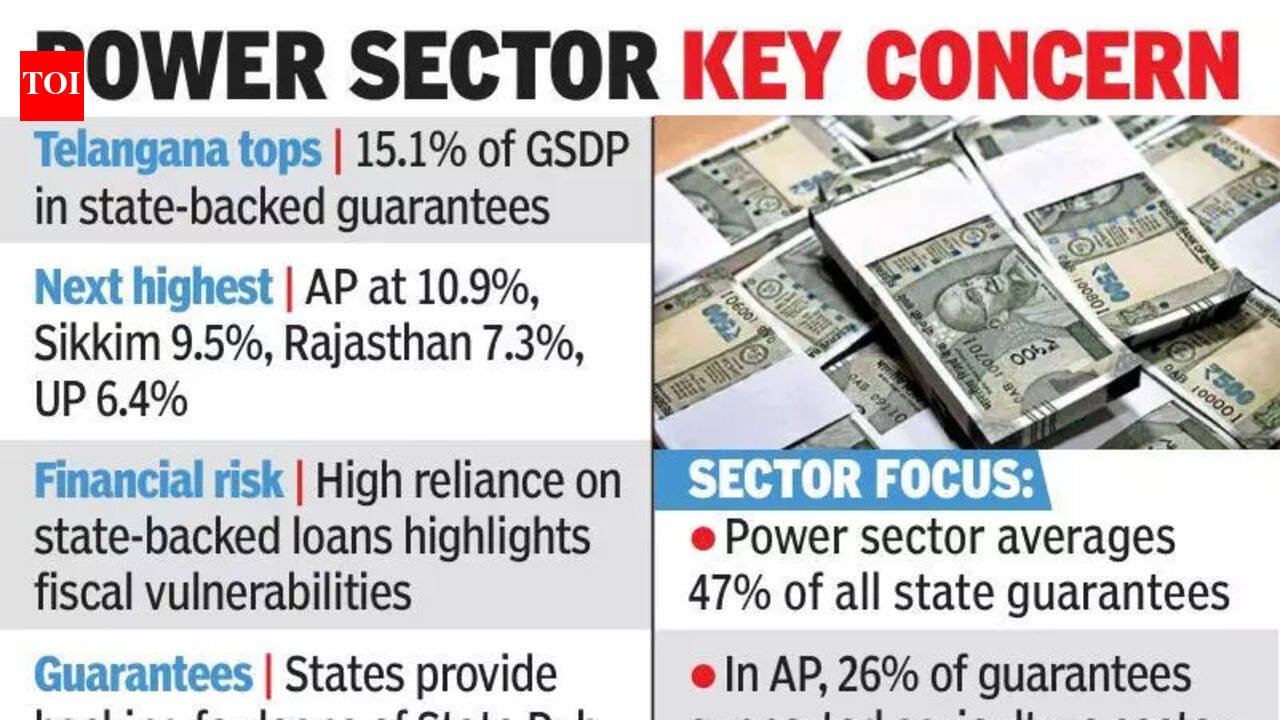
Hyderabad: Telangana leads the country with the highest ratio of state guarantees to Gross State Domestic Product (GSDP) at 15.1%, followed by Andhra Pradesh at 10.9%, Sikkim at 9.5%, Rajasthan at 7.3% and Uttar Pradesh at 6.4%, ahead of the state budget presentation. These figures highlight the significant financial reliance on state-backed loans and underline vulnerabilities in fiscal health, according to the State Finances Report 2025-26.Outstanding liabilities of state govts encompass a variety of financial commitments, but notably exclude certain contingent liabilities that arise under specific conditions. One key aspect of these liabilities is the guarantees that state govts provide for borrowings by State Public Sector Enterprises (PSEs) from financial institutions.‘Subpar credit profiles’ This reliance on govt backing often stems from the subpar credit profiles of these enterprises, which may struggle to secure loans independently. By offering a govt guarantee, states enhance the credibility of these enterprises, thereby facilitating their access to much-needed financial resources. However, this arrangement carries substantial responsibility; should the borrowing entity default due to unforeseen circumstances, the state govt is obliged to cover the debt.In 2023, a working group on state govt guarantees put forward recommendations aimed at curtailing the risks associated with these guarantees. It suggested instituting a ceiling on annual incremental guarantees, recommending a limit of either 0.5% of the GSDP or 5% of revenue receipts, whichever amount is lesser. As of March 2024, the total guarantees extended by 27 states reached 4.4% of their collective GSDP, indicating a trend that could threaten financial stability. For a number of states, the power sector emerged as the predominant area of concern, accounting for an average of 47% of all outstanding state guarantees. This overwhelming share underscores the significance of the power sector within the broader financial landscape of state liabilities. Beyond this, guarantees were also extended to various other sectors. For example, in Andhra Pradesh, 26% of guarantees supported the agriculture sector. Additionally, irrigation projects in Telangana accounted for a noteworthy 37% share of state guarantees.These allocations highlight the diverse priorities of state govts in guaranteeing loans across critical sectors vital to their economies and citizens’ livelihoods.


