



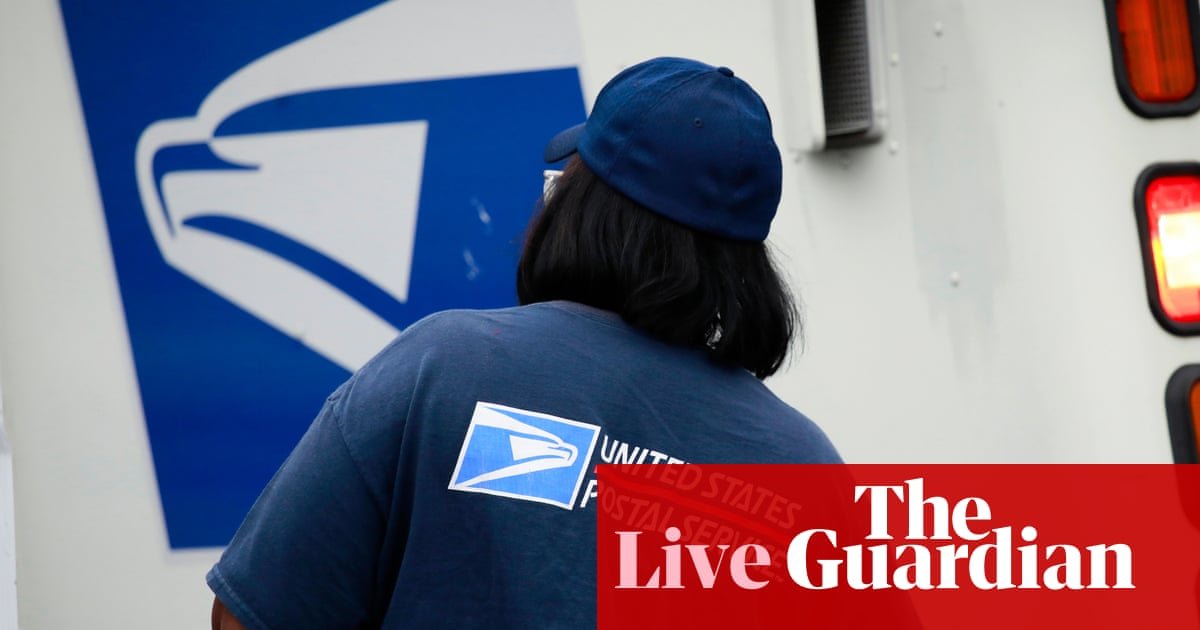
Judge again blocks Trump mail ballot executive order in ruling likely to be appealed
Hello and welcome to the US politics live blog.
A federal judge has halted, at least temporarily, attempts to implement Donald Trump’s executive order limiting mail voting.
The president’s directive stalled for a second time about a week before the first mail ballots are due to be sent out for the rapidly approaching midterm elections.
In the US district court, judge Indira Talwani placed a 14-day hold on the government implementing the order in a case that could be headed back to the supreme court, which on Monday overturned an earlier ruling of hers that had blocked Trump’s order from taking effect.
Talwani wrote in her ruling:
Plaintiff states have neither time nor funds to design new mail ballots, seek approval of the new designs, order production of mail ballots, update their own election management systems, train election officials to use the USPS portal and upload citizen data to the portal, all before the midterms.
The latest ruling came in advance of a 3 September hearing after Democrats and voting rights groups refiled their lawsuits to comply with the recent supreme court decision.
The high court’s conservative majority did not rule on the legality of Trump’s executive order. Still, it said the legal challenges against it that led Talwani to initially freeze it were filed too soon. Since then, the administration has issued a formal rule intended to govern whether the US Postal Service will deliver states’ mail ballots – effectively restarting the legal fight.
The president has long targeted mail voting, which he falsely blames for his 2020 election loss even though he himself uses it to cast his ballot. A report by the Brookings Institution published in 2025 found that mail voting fraud occurred in only about four cases out of every 10 million mail ballots cast.
The legal battle has major ramifications for the midterms. Nearly one-third of Americans vote by mail and election officials contend there is not enough time to revise their systems to comply with the new postal service directives.
Read the full story here:
In other developments:
-
Documents obtained by the Guardian and interviews with military leadership show the war in Iran has depleted the US Navy’s budget.
-
A senior Democratic senator is calling for a criminal investigation into the US health secretary, Robert F Kennedy Jr, following reporting by the Guardian that indicated he lied during Senate confirmation hearings last year.
-
Trump called the media into the Oval Office to watch him sign an executive order to rename Lake Ontario “Lake America”.
-
“The name Lake Ontario comes from the Wendat word Ontari’io, which, appropriately, means ‘the lake is beautiful, the lake is big’, Canada’s prime minister Mark Carney noted. “The name is more than 400 years old, predating both the Confederation of Canada and the Declaration of Independence of the United States of America.”
-
Three journalists who were fired by the Pentagon from a US government-funded news outlet sued the US Department of Defense in federal court in Washington DC on Thursday arguing that their dismissals were illegal and violated their first amendment rights to free speech.
Key events
Jonathan Freedland speaks to Dan Alexander of Forbes about how Donald Trump made so much money last year at the same time trade wars, military wars and a rising national debt hurt the US economy …
Tom Perkins
Every day $1bn worth of goods crosses the river dividing Detroit, Michigan, and Windsor, Ontario, two largely blue-collar US and Canadian cities that have come to act as one in the creation of North America’s auto industry.
News this week of Donald Trump’s escalating trade spat with Canada has everyone worried. Political and economic leaders and observers labeled the move an act of “hubris”, blamed Trump’s “ego”, and called the escalation “insanity”.
“We don’t need Canada, they need us,” Trump declared.
But many are hoping that Trump’s plans to impose 50% tariffs on Canadian goods from 1 January, covering everything from automobiles to honey to hockey sticks, will prove another empty threat and cite the upcoming midterm elections as a pivotal reason the plan may be scrapped.
Control of the US Congress hangs in the balance and will almost certainly be decided by several close Michigan races. It also comes just two months after polling highlighted Michiganders’ fatigue with and opposition to the president’s unprecedented tariff program.
By a 63%-31% margin, residents here oppose tariffs on Canadian goods, according to a June Epic-MRA poll, including 35% of Republicans. Meanwhile, nearly 75% of Michiganders said the tariffs are fueling high prices.
US civil rights leaders and politicians to march on Washington for voting protections
Representative Alexandria Ocasio-Cortez and senator Bernie Sanders are due to take part in the 63rd anniversary of the March on Washington later today.
The original march, in 1963, was to advocate for social justice and civil rights for Black Americans, culminating in Martin Luther King Jr’s I Have a Dream speech.
This year’s event is due to focus on voting rights in the wake of the United States supreme court’s decision to overturn section 2 of the Voting Rights Act, with attendees also expected to include Al Sharpton, Martin Luther King III, Arndrea Waters King and congressional black caucus chair Yvette Clarke.
“Defending the vote means defending the foundation of our democracy,” Martin Luther King III said in a statement to the Associated Press. “Sixty-three years after my father stood at the Lincoln Memorial, we are called to march again, not only in remembrance, but in action.”
In April, the supreme court struck down Louisiana’s congressional map and substantially rewrote section 2 of the Voting Rights Act, dismantling key protections against racial gerrymandering.
Campaign organisers told the AP that the decision had intensified a long-running fight over Black political representation. They describe the 28 August action as part of “the same call our elders answered” more than 60 years ago on their campaign website, and have planned a symbolic return to the Lincoln Memorial where King addressed voters during the peak of the civil rights movement.
“We return to the ground where a quarter million Americans once stood for jobs and freedom, and we carry their unfinished work into a new generation,” organisers said.
Pentagon’s blacklisting of Anthropic was unlawful, US judge rules
A US federal judge ruled Thursday that sanctions imposed in February by the Trump administration against AI giant Anthropic were illegal, finding that the government had punished the artificial intelligence company for publicly criticising the Pentagon.
“The empty invocation of national security is not a blank check to punish and retaliate against government critics,” Judge Rita Lin said in a 59-page decision.
She barred the federal agencies named in the lawsuit from enforcing President Donald Trump’s order to stop using the tools of Anthropic – creator of the Claude AI models – and overturned defense secretary Pete Hegseth’s designation of the company as a “supply chain risk”, a status previously reserved for foreign firms.
The ruling makes permanent the temporary suspension of sanctions ordered by the judge in March and takes effect immediately. The government may appeal.
“We welcome the court’s ruling that this supply chain risk designation was unlawful,” an Anthropic spokesperson said.
Hegseth’s unprecedented move, which followed Anthropic’s refusal to allow the military to use AI chatbot Claude for US surveillance or autonomous weapons, blocked Anthropic from certain military contracts. Anthropic executives have said it could cost the company billions of dollars in lost business and reputational harm.
Trump had lashed out at the company after its refusal, describing it in a February social media post as “a radical left, woke company” and “out-of-control”.
Trump official faces inquiry over claims he diverted wildfire resources to his own property
Anna Betts
Donald Trump’s administration is facing calls to launch an investigation into allegations that Michael Boren, a senior official who oversees the US Forest Service, pressed agency staff to deploy additional resources to fight a fire burning near his Idaho ranch.
Three Democratic senators accused Boren of “inappropriate interference” in a letter seen by the Guardian, demanding answers from Brooke Rollins, US agricultural secretary. Boren serves as undersecretary of agriculture for natural resources and environment.
Senators Ron Wyden, Amy Klobuchar and Martin Heinrich expressed “serious concern” over reports that Boren used his federal government position in July to remove firefighting personnel and resources from active fires elsewhere to tackle a fire near his private ranch in Idaho.
“We request a full investigation into the nature and extent of Boren’s involvement in response to the Cabin Creek Fire and a detailed accounting of the safeguards the agency has implemented or plans to implement to prevent political interference and conflicts of interest in wildfire response,” they wrote.
Their letter follows a report from the Washington Post earlier this month, in which several forest service officials, speaking on the condition of anonymity, said that Boren – who reportedly owns a 480-acre ranch in the Sawtooth national recreation area – contacted forest service officials multiple times in mid-July to question why more aircraft were not being used to fight the Cabin Creek fire in Idaho, which spread across several acres in Idaho’s Sawtooth national forest.
Judge again blocks Trump mail ballot executive order in ruling likely to be appealed
Hello and welcome to the US politics live blog.
A federal judge has halted, at least temporarily, attempts to implement Donald Trump’s executive order limiting mail voting.
The president’s directive stalled for a second time about a week before the first mail ballots are due to be sent out for the rapidly approaching midterm elections.
In the US district court, judge Indira Talwani placed a 14-day hold on the government implementing the order in a case that could be headed back to the supreme court, which on Monday overturned an earlier ruling of hers that had blocked Trump’s order from taking effect.
Talwani wrote in her ruling:
Plaintiff states have neither time nor funds to design new mail ballots, seek approval of the new designs, order production of mail ballots, update their own election management systems, train election officials to use the USPS portal and upload citizen data to the portal, all before the midterms.
The latest ruling came in advance of a 3 September hearing after Democrats and voting rights groups refiled their lawsuits to comply with the recent supreme court decision.
The high court’s conservative majority did not rule on the legality of Trump’s executive order. Still, it said the legal challenges against it that led Talwani to initially freeze it were filed too soon. Since then, the administration has issued a formal rule intended to govern whether the US Postal Service will deliver states’ mail ballots – effectively restarting the legal fight.
The president has long targeted mail voting, which he falsely blames for his 2020 election loss even though he himself uses it to cast his ballot. A report by the Brookings Institution published in 2025 found that mail voting fraud occurred in only about four cases out of every 10 million mail ballots cast.
The legal battle has major ramifications for the midterms. Nearly one-third of Americans vote by mail and election officials contend there is not enough time to revise their systems to comply with the new postal service directives.
Read the full story here:
In other developments:
-
Documents obtained by the Guardian and interviews with military leadership show the war in Iran has depleted the US Navy’s budget.
-
A senior Democratic senator is calling for a criminal investigation into the US health secretary, Robert F Kennedy Jr, following reporting by the Guardian that indicated he lied during Senate confirmation hearings last year.
-
Trump called the media into the Oval Office to watch him sign an executive order to rename Lake Ontario “Lake America”.
-
“The name Lake Ontario comes from the Wendat word Ontari’io, which, appropriately, means ‘the lake is beautiful, the lake is big’, Canada’s prime minister Mark Carney noted. “The name is more than 400 years old, predating both the Confederation of Canada and the Declaration of Independence of the United States of America.”
-
Three journalists who were fired by the Pentagon from a US government-funded news outlet sued the US Department of Defense in federal court in Washington DC on Thursday arguing that their dismissals were illegal and violated their first amendment rights to free speech.


