



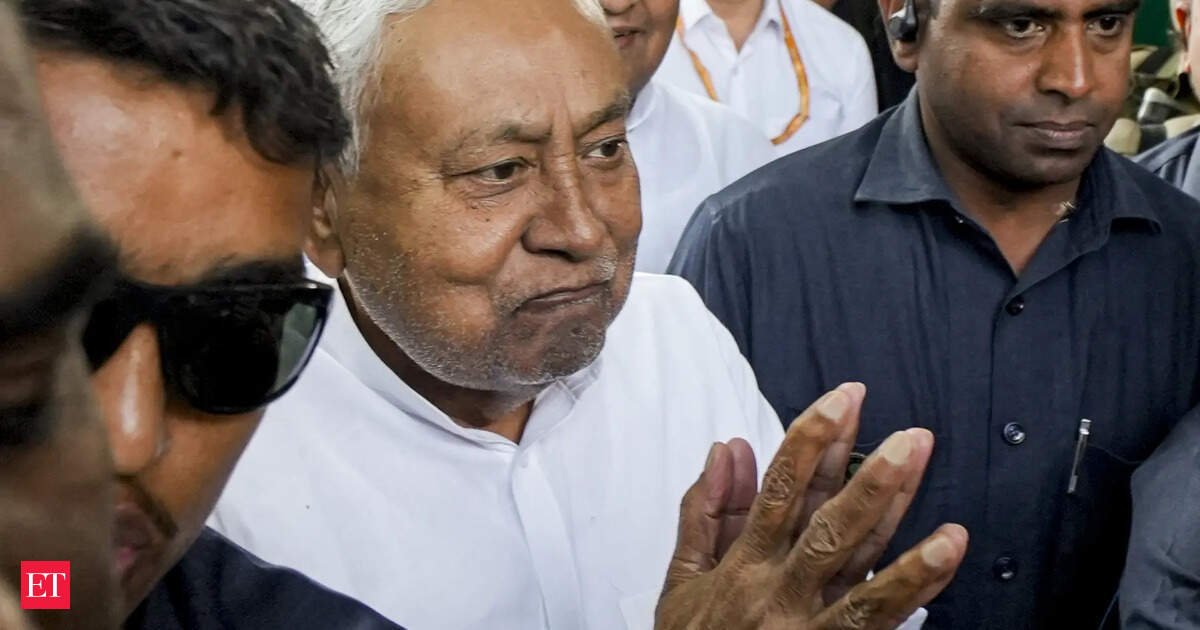
With Kumar stepping away from the chief minister’s chair, the NDA is expected to elect a new leader on April 14, an announcement that could redefine Bihar’s power dynamics.
The JD(U) supremo was elected to the Rajya Sabha on March 16 and was required to resign as an MLC within 14 days of his election. His exit signals the end of an era: from his early days as an MLA in the 1980s to becoming Bihar’s longest-serving chief minister with ten terms since 2005, Kumar has been the state’s most enduring political force.
A key figure in national politics, he also served as a Union Minister in the government led by Atal Bihari Vajpayee. Now, as he moves to Parliament, Bihar stands on the brink of a major political reset.
Journey as ‘Sushashan babu’
Nitish Kumar has remained one of the most enduring and influential figures in Bihar’s politics since the mid-1990s, skilfully navigating a complex landscape shaped by shifting alliances and caste equations while projecting a governance-driven image.
His rise as a central force began after the 1994 revolt within Bihar’s ruling Janata Dal, when he broke away from then Chief Minister Lalu Prasad Yadav and co-founded the Samata Party with veteran socialist George Fernandes. That moment marked the beginning of Kumar’s long and strategic political journey.
In March 2000, Kumar briefly became Chief Minister for just seven days—from March 3 to March 10—after a fractured mandate led to a hung Assembly. He was forced to step down after failing to prove a majority on the floor of the House, an early setback that would later shape his cautious and calculated political style.By 2005, amid President’s Rule in Bihar, Kumar launched his first major public outreach initiative, the ‘Nyay Yatra’, which became a turning point. Several of his signature governance measures—such as reservation for women in local bodies, prohibition, and the self-help group initiative ‘Jeevika Didi’—are widely believed to have been shaped by feedback gathered during these yatras. He recently concluded his ‘Samriddhi Yatra’, announcing multiple development projects.
Over the years, Kumar has cultivated the image of a “governance-first” leader, an appeal that has endured despite criticism over his age, health and alleged political fatigue. His ability to maintain social balance remains one of his key political strengths. In a deeply divided state, he has managed to build support across caste and community lines.
Though his own Kurmi community accounts for roughly 3% of Bihar’s population—far smaller than the over 14% Yadavs and around 18% Muslims—Kumar has drawn backing from groups beyond rigid political blocs. These include sections of upper-caste Hindus (around 10%), Kushwahas (over 4%), Paswans (more than 5%), Musahars (over 3%) and Mallahs (around 2.6%). He has also retained a degree of traction among Muslim voters, despite alliances with the BJP.
Another crucial pillar of his support base has been women voters. Over the years, Kumar has built significant goodwill among women, who have often acted as a stabilising force in Bihar’s electoral politics, helping cushion his leadership against broader political headwinds.
First BJP CM likely soon
BJP is going to have its chief minister for the first time. Nitish Kumar took oath as CM in November last year and now he will be in Rajya Sabha. Kumar has been CM of Bihar 10 times and his departure to the Upper House would open the door for new leadership within the JDU. BJP has 85 MLAs in Bihar while the JDU has 85 MLAs. In the past too, despite having more MLAs, BJP offered the leadership role to Nitish Kumar and played second fiddle. With a chief minister, the BJP will have a leading position in the most wanted eastern frontier of the country.
The NDA registered a historic landslide victory in the 2025 Bihar assembly polls, winning 202 of the 243 seats, while the Mahagathbandhan managed to secure only 35 seats. The ruling alliance secured a three-fourths majority in the 243-member Bihar Assembly, marking the second time the NDA crossed the 200-seat mark in state polls. In 2010, it won 206 seats.


