



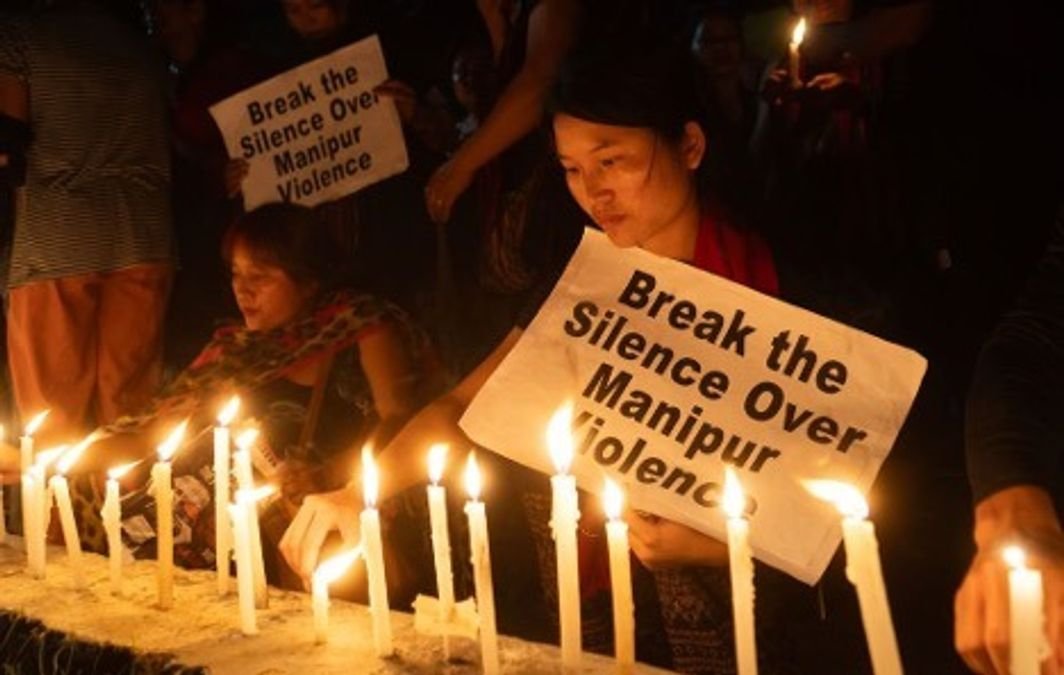
The Supreme Court’s proposal to establish special courts for criminal cases arising out of the 2023 Manipur ethnic violence is more than a procedural suggestion. It is a reflection of the extraordinary challenges involved in prosecuting mass violence and a reminder of the structural weaknesses that continue to burden India’s criminal justice system.
More than two years after one of the country’s worst episodes of internal conflict in recent history, investigations remain incomplete, victims are still struggling to access basic case documents, and the judiciary finds itself stepping beyond adjudication to ensure the justice process moves forward.
Hearing a batch of petitions relating to the Manipur violence, a Bench comprising Chief Justice Surya Kant and Justices Joymalya Bagchi and V. Mohana proposed the creation of special courts that could conduct day-to-day trials in criminal cases. The Court also directed investigating agencies, including the Central Bureau of Investigation (CBI) and the Special Investigation Teams (SITs), to expedite pending investigations.
The Bench took note of another troubling aspect of the proceedings: several victims and their families had not even received copies of the chargesheets filed in their cases. Recognising that meaningful participation in criminal proceedings is impossible without access to these documents, the Court permitted legal aid counsel representing the victims to approach the offices of the Chief Justices of the Gauhati High Court and the High Court of Manipur for copies. Investigating agencies have been directed to provide the chargesheets within one week.
While these directions appear administrative on the surface, they reveal a larger institutional concern. The criminal justice system is designed to investigate offences, prosecute the accused and deliver timely justice through regular trial courts. Yet, in cases involving large-scale communal or ethnic violence, that framework often struggles under the weight of hundreds of FIRs, multiple investigating agencies, displaced witnesses, political sensitivities and enormous evidentiary requirements.
The Supreme Court’s proposal for special courts implicitly acknowledges that ordinary criminal courts may not be equipped to handle such complex litigation within a reasonable timeframe. India’s subordinate judiciary is already burdened by an enormous backlog of cases. Adding hundreds of serious criminal prosecutions arising from a single conflict risks delaying justice for years unless dedicated judicial infrastructure is created.
Special courts are not a novel legal mechanism. They have been constituted in the past for cases involving corruption, sexual offences, terrorism and economic crimes where speedy disposal has been considered a matter of public interest. In the context of the Manipur violence, however, the rationale extends beyond efficiency. Delayed trials can weaken prosecutions as witnesses relocate, memories fade, evidence deteriorates and public confidence in the justice process diminishes.
Equally significant is the Court’s emphasis on victims’ rights. Traditionally, India’s criminal justice system has viewed the prosecution as a contest between the State and the accused, leaving victims with a limited procedural role. Over the past decade, however, judicial decisions and legislative reforms have increasingly recognised victims as stakeholders entitled to information, participation and protection.
The inability of many victims to obtain copies of chargesheets demonstrates how these rights often remain unrealised in practice. A chargesheet is not merely a procedural document. It informs victims about the conclusions reached by investigators, the evidence collected, the offences alleged and the individuals who will face trial. Without access to it, victims remain dependent on fragmented information and have little ability to monitor the progress of their own cases.
The Court’s directions therefore reinforce an important constitutional principle: access to justice requires transparency as much as it requires speed.
The Manipur violence has remained under the Supreme Court’s close scrutiny since the ethnic conflict erupted in May 2023. The Court has repeatedly intervened on issues ranging from the transfer of investigations to the CBI, witness protection, relief measures, and allegations of sexual violence. The present order continues that pattern of judicial oversight, reflecting the Court’s concern that ordinary institutional mechanisms alone have not been sufficient to ensure accountability.
This growing judicial involvement also raises an uncomfortable question about the functioning of India’s criminal justice institutions. Ideally, investigations should proceed efficiently, victims should receive information without judicial intervention, and trials should commence within a reasonable period after chargesheets are filed. The fact that the Supreme Court continues to supervise these processes suggests that systemic deficiencies remain unresolved.
The challenge extends beyond Manipur. India has witnessed repeated instances where prosecutions arising out of communal riots, caste violence, political unrest and other mass crimes have been delayed for years. Such delays affect not only victims but also the rights of the accused, who are entitled to a fair and speedy trial under Article 21 of the Constitution.
Fast-tracking criminal proceedings through special courts may therefore provide immediate institutional relief, but it cannot by itself address deeper structural problems. Investigating agencies require greater capacity, forensic infrastructure needs strengthening, witness protection mechanisms must become more effective, and trial courts require adequate judicial officers and resources to handle complex litigation without extraordinary intervention.
The Supreme Court’s latest observations should thus be viewed as more than a response to the Manipur violence. They underline a broader reality that India’s criminal justice system continues to depend on case-specific judicial supervision whenever major crises expose its limitations.
Whether special courts ultimately lead to convictions or acquittals will depend on the quality of investigations and the fairness of trials. Yet the Court’s message is unmistakable: justice delayed in cases of mass violence risks becoming justice denied. By seeking dedicated courts, faster investigations and greater transparency for victims, the Supreme Court is attempting to ensure that the pursuit of accountability does not become another casualty of institutional delay.
The true test, however, will not be the establishment of special courts alone. It will be whether India’s criminal justice system can evolve into one that delivers timely, transparent and credible justice without requiring the country’s highest constitutional court to repeatedly step in and keep the process on track.


