






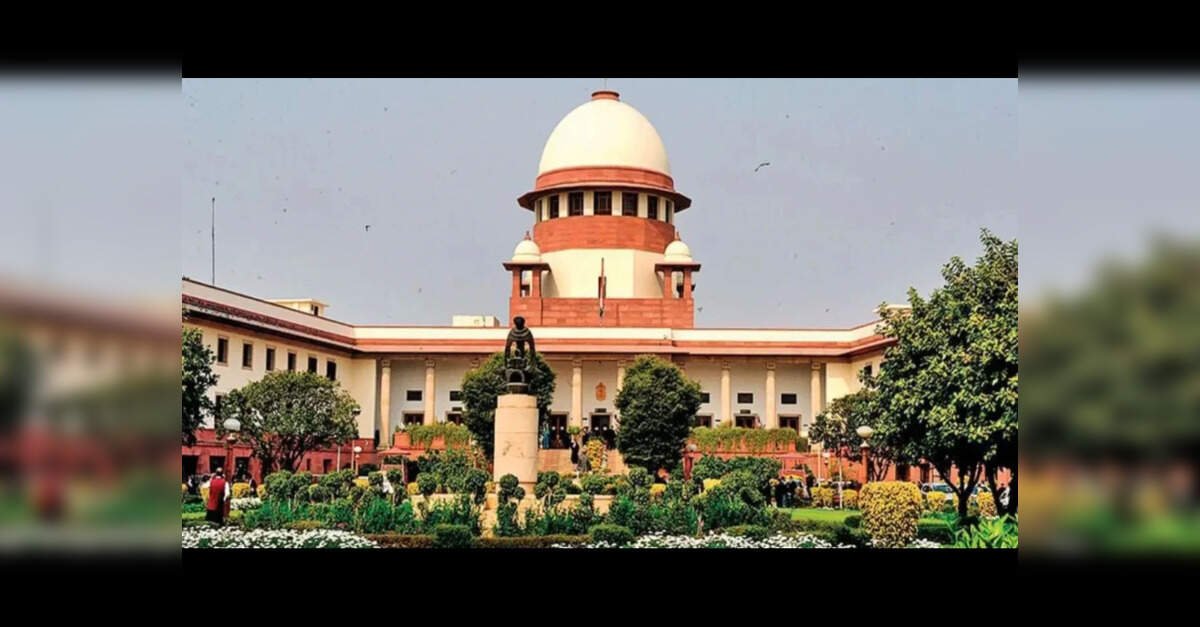
New Delhi, The Supreme Court on Monday asked the Centre to examine whether a statutory framework can be put in place for social media intermediaries to ensure that they and other digital platforms comply with Indian laws governing minors, including the legal bar on children below 18 independently entering into contracts.
On September 10, a bench comprising Chief Justice Surya Kant and justices Joymalya Bagchi and V Mohana had taken note of submissions made by senior advocate H S Phoolka, appearing for petitioner NGO ‘Just Rights for Children Alliance’, and sought responses on the plea from the Union ministries of electronics and information technology, as well as law and justice.
“We need some safeguards in India,” the bench had said.
The plea seeks safeguards for minors accessing social media, and to ensure no such platform enters into a contract with a child below 18 years of age.
“Something can be done, something should be done and will be done. We have to come back…” Solicitor General Tushar Mehta, appearing for the Centre, told the bench on Monday.
Phoolka submitted that contracts entered into by minors are void under existing Indian law, and argued that platforms should be subject to enforceable obligations rather than merely voluntary guidelines.
Justice Bagchi said the requirement should not remain confined to a guideline and asked the solicitor general to examine whether it could be incorporated in statutory form under intermediary rules.
“Please pass directions under the intermediary rules that they fashion their software, or whatever the platform is called, in conformity with Indian law. The software has to conform with Indian law. That is our request,” Justice Bagchi told the solicitor general.
“Not a request, a direction,” Mehta said.
Phoolka submitted that there is no need to wait for the proposed data protection framework, as existing law already recognises legal incapacity of minors to enter into contracts.
“Under existing Indian law, these contracts are void. We don’t need to wait for the Data Protection Act. Existing law bars them,” he said.
Mehta told the bench that the government would examine the issue and take appropriate steps.
The plea seeks directions to the Centre to take appropriate steps to inform “digital platforms including social media intermediaries that any contract entered into by them with any child below the age of 18 years is void ab-initio (from the moment of creation) and that any steps taken in furtherance thereof shall be immediately suspended”.
The plea seeks enforcement and protection of fundamental rights of children below 18, who, despite their statutory incapacity to contract under Section 11 of the Indian Contract Act are currently permitted to independently create and maintain accounts and access social media and other digital platforms without an effective, uniform and enforceable mechanism to safeguard their legal incapacity and constitutional rights.
The plea says it is a settled principle of law that a minor lacks contractual capacity and that a contract entered into by a minor is invalid at outset.
The continued exposure of children to contractual and data-driven digital ecosystems without meaningful age-assurance and parental safeguards is not a mere regulatory deficiency, but raises grave constitutional concerns, exposing a particularly vulnerable class to foreseeable and serious harms, including online grooming, sexual exploitation, trafficking, behavioural manipulation and profiling, misuse of personal data, cyberbullying and exposure to age-inappropriate content, it says.
Such unregulated exposure threatens the child’s right to life, dignity, privacy, safety, healthy development and overall well-being, and consequently calls for urgent judicial intervention to ensure that the digital environment does not become a domain where statutory and constitutional protection accorded to children is rendered illusory, the plea says.
The petition further contends that despite strict penal provisions prohibiting dissemination and storage of child sexual exploitative and abuse material, internet platforms have failed to deploy automated content-filtering tools and age-verification mechanisms.
It says platforms such as Facebook and Snapchat (India) permit users to create accounts from the age of 13 while Indian law treats persons below 18 as minors.
The PIL, filed through advocate-on record Sakthom Meheshwari, sought directions to amend the Information Technology (Intermediary Guidelines and Digital Media Ethics Code) Rules, 2021, or frame specific guidelines, to ensure that no digital platform enters into a contract with a child below 18 without consent of the parent or lawful guardian, subject to identity verification/e-KYC of the guardian. PTI


