



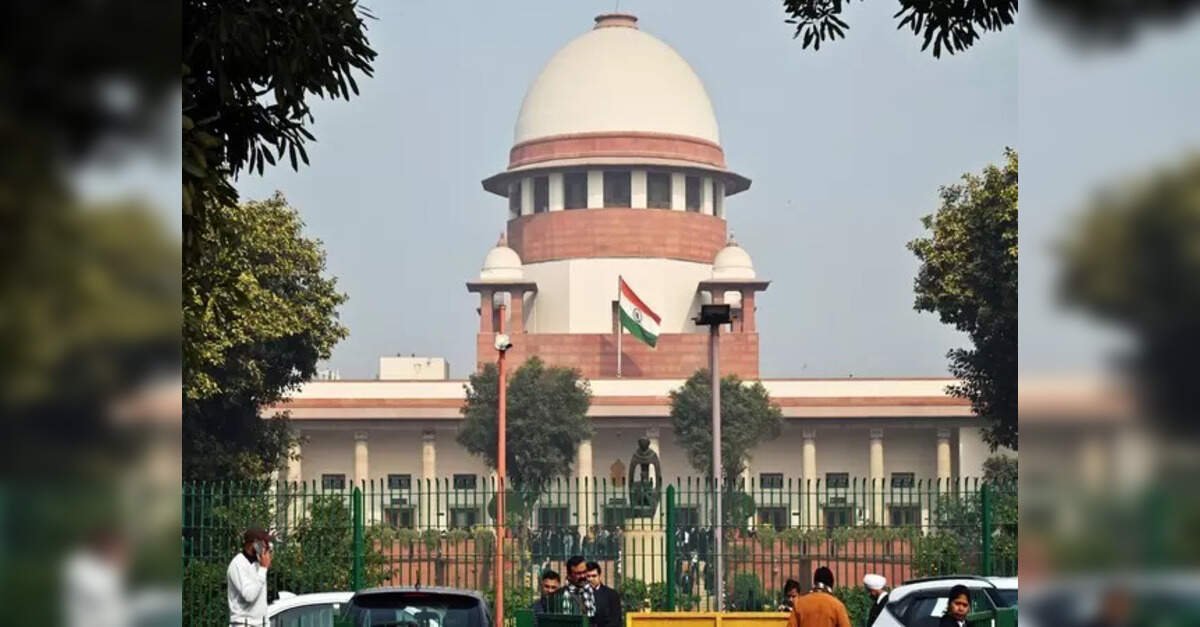
New Delhi, The Supreme Court on Wednesday resumed hearing on a batch of pleas relating to grant of retrospective environmental clearance (EC) by the Centre and other authorities to projects found violating environmental norms on payment of heavy penalties.
On November 18 last year, a three-judge bench headed by the then Chief Justice of India (CJI) B R Gavai reversed by a majority of 2:1 its own verdict by an interim order and paved the way for retrospective environmental clearance to projects found violating environmental norms, saying that otherwise “thousands of crores of rupees would go in waste”.
The top court had held that numerous vital public projects constructed with nearly Rs 20,000 of the public exchequer money would be demolished if the May 16, 2025, verdict, which barred the Centre from granting retrospective environmental clearance to projects, was not recalled.
It had ordered a fresh hearing on the pleas.
A three-judge bench comprising CJI Surya Kant and Justices Joymalya Bagchi and Vipul M Pancholi on Wednesday heard a battery of lawyers, including senior advocates Gopal Sankaranarayanan and Sanjay Parikh who are opposed to the grant of retrospective EC to the projects violating green norms.
Shankarnarayan argued that the current legal framework for retrospective clearance is flawed and lacks statutory backing. He highlighted that the 2017 notification, which allowed a one-time six-month window for violators to apply for EC, was a “protem measure” that expired in April 2018.
“Effectively, after April 13, 2018, there has been no legal regime in the country to apply for retrospective EC,” he said.
The senior lawyer further challenged a July 2021 Office Memorandum (Standard Operating Procedure) issued by the Centre, noting that the Madras High Court had already held this SOP unconstitutional in August 2024.
Shankarnarayan argued that the three-judge bench, while passing the November 18 order, failed to consider crucial precedents like the Alembic Pharmaceuticals and Common Cause cases, which established that “prior clearance” is a mandatory prerequisite under environmental law.
“We are seeking a review because this judgement (of November 18, 2025) creates three major obstacles that ignore established precedents. The court missed the opportunity to examine the Madras High Court’s findings, which had correctly applied the law,” he said.
Senior advocate Sanjay Parikh, also appearing for the petitioners, raised broader constitutional concerns.
He said that allowing post-facto clearances is in direct conflict with Article 21 (Right to life) of the Constitution.
“In the arena of environment, you cannot use general clauses as the results will be disastrous. You cannot say that after the act is done, permission can be given,” Parikh said.
He said that the “proportionality principle”, often used to balance economic interests with regulations, cannot be applied to override environmental safety.
During the hearing, CJI Kant said that the court’s intent was to provide a “composite judgement on merits” rather than a cryptic order.
While Additional Solicitor General Aishwarya Bhati, appearing for the Centre, stated that the government is ready for final arguments and sought interim orders.
The question was raised whether a different bench can hear the review and if a larger bench rendering findings on a review amounts to an intra-court appeal.
“Whether the court can render an opinion on merits during a review jurisdiction,” one of the lawyers asked.
The bench will resume hearing on Thursday.
Earlier, the bench had observed that as the highest court of the country, the endeavour should be to minimise the scope of committing any mistake which may have a far-reaching effect on the development and growth of the nation.
The top court’s May 16, 2025, verdict by a two-judge bench had barred the Ministry of Environment, Forests and Climate Change and the authorities concerned from granting retrospective environmental clearances to projects which are found in violation of environmental norms. PTI


