



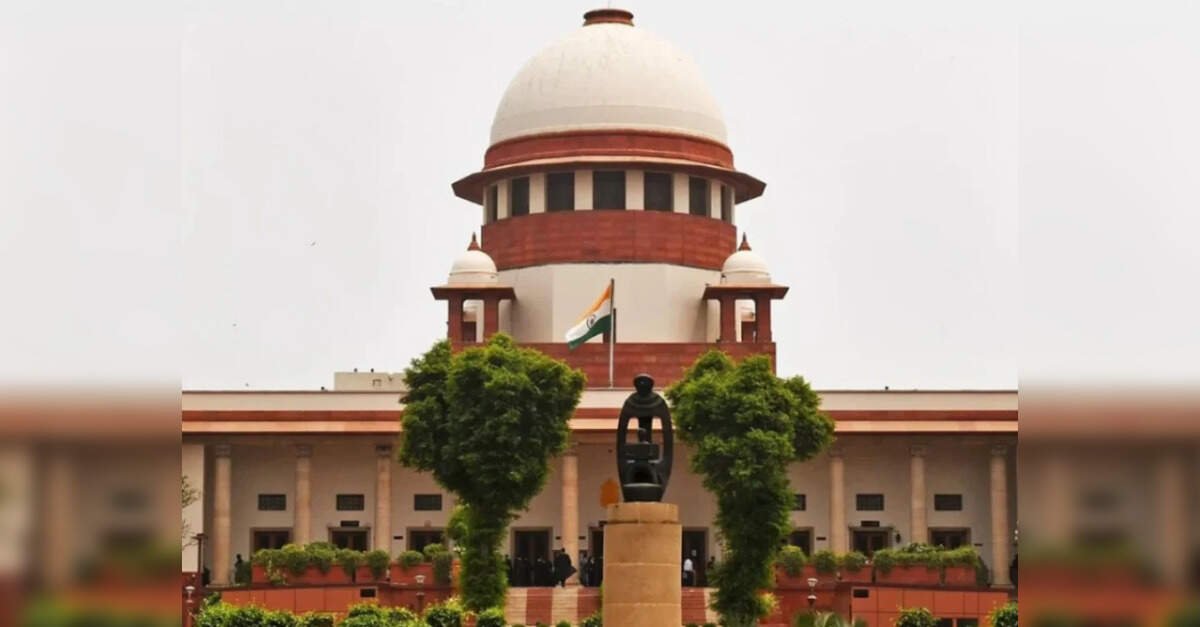
New Delhi, The Supreme Court on Tuesday sought the details from the Enforcement Directorate on several cases pending before its adjudicating authority with regard to confiscation of assets under the Prevention of Money Laundering Act.
Observing that there has to be application of mind in the adjudication process, a bench of Chief Justice Surya Kant and Justices Joymalya Bagchi and V Mohana questioned the pendency of a large number of cases before the adjudicating authority.
The bench reserved its decision on a batch of petitions which raised the question whether provisional property attachments carried out by the ED under the PMLA can be confirmed by a single member of the adjudicating authority, without the presence of a judicial member.
During the hearing, the bench asked the counsels appearing for ED, “If there are thousands of matters pending and are to be dealt with within 180 days prescribed under the law, will there be any real application of mind or will it become merely signing on the dotted line?”
The petitioners raised questions over interpretation of section 8 of the PMLA, which governs the adjudication of provisional attachment proceedings.
Senior advocate Vikram Chaudhari, appearing for one of the petitioners, contended that the 2022 verdict in the case of Vijay Madanlal Choudhary that upheld ED’s powers to arrest, stated that the PMLA adjudicating authority must be a three-member body headed by a district judge.
He said forwarding cases of provisional attachment to an adjudicating authority is a vital function and an independent check on the ED’s powers to provisionally attach property.
Justice Bagchi asked the counsels whether it is their argument that the facet of judicial identity is completely rendered nugatory, thereby going against the concept of separation of powers.
The petitioners’ counsels argued that the functions of an adjudicating authority under the PMLA require proper application of mind, whereas, on the other hand, such authority is often tasked with examining thousands of matters within a six-month deadline prescribed under the law for confirming property attachments.
Arguing that adjudicating authority often performs functions that have a judicial element, the counsels submitted that a judicial member must be part of such bodies in such cases.
CJI Kant told the counsels, “We will have to go by the statutory scheme, how the provisions are structured and how they are required to be interpreted.”
Senior advocate Gopal Sankaranarayanan, appearing for one of the petitioners, also contended that there was a need for a judicial member in the adjudicating authority to ensure that the adjudication is fair.
Additional Solicitor General Anil Kaushik and advocate Zoheb Hossain, appearing for the Centre and the ED, countered the arguments on behalf of the petitioners and said that there are around 400 cases to be adjudicated annually.
Hossain submitted that section 6 (appointment, composition, and powers of the adjudicating authority) of the PMLA itself provides for scenarios where even one or two-member adjudicatory authority can be formed.
He argued, “If, during the hearing of a case, it appears to the Chairperson or a member that the matter ought to be heard by a bench consisting of two members, it can be so directed. That itself shows that one member can hear a matter (in other cases).”
CJI Kant, while asking the ED to file an affidavit on the total number of cases pending before the adjudicating authority, said, “Even if there are 100 matters, why should you have only one officer to adjudicate?”
