



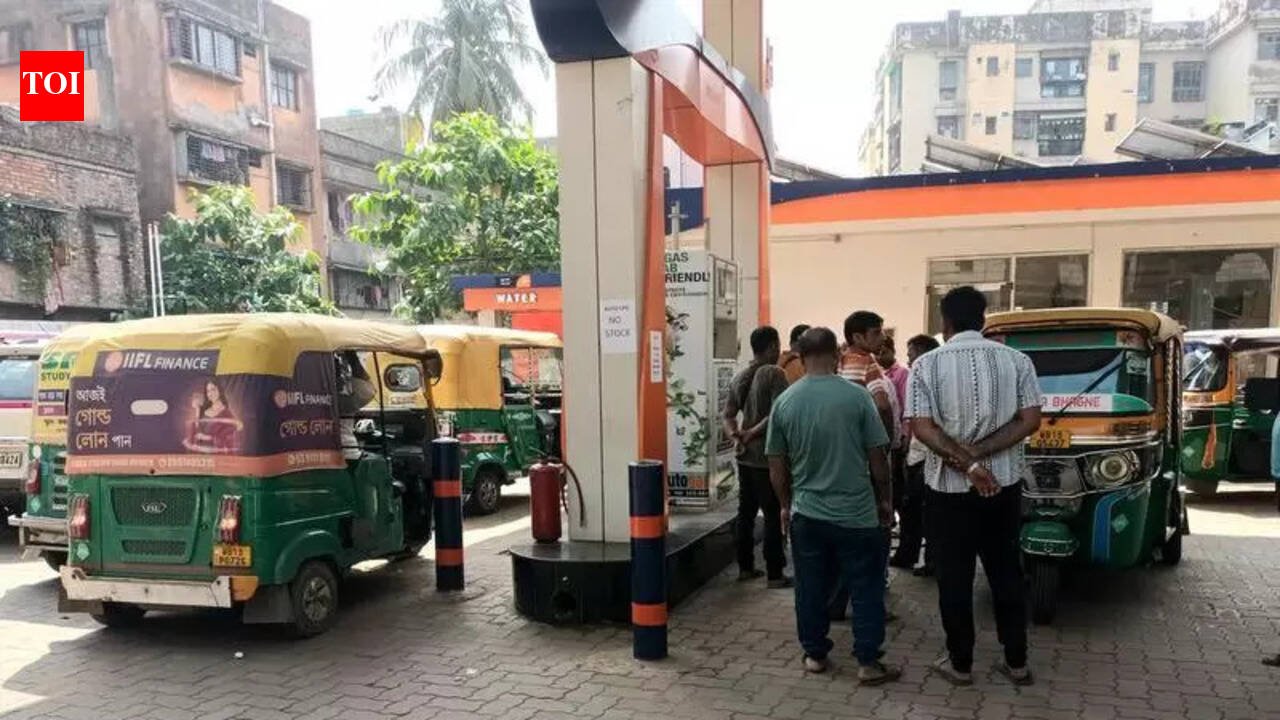
Kolkata: A sharp drop in the number of autos on the streets on Sunday left commuters across the city struggling to reach their destinations, with many reporting long waits and expensive alternatives. According to auto operators and route committees, nearly 60%–70% of autos stayed off the roads because of rising fuel costs and supply constraints.Autos form the backbone of last-mile connectivity in Kolkata, especially on weekends when buses and metro services are less frequent and crowded. The sudden shortage hit leisure travellers the hardest — those visiting friends and relatives found it particularly difficult to find a ride back home.“I went to my cousin’s place in south Kolkata. By evening, there were hardly any autos available. I waited for almost 40 minutes and finally had to book a cab at surge pricing,” said Rituparna Dey from Entally. Suman Chatterjee from Kalighat said, “Autos are the only dependable option for short distances. On Sundays, when they disappear, the entire system breaks down.”“Auto gas price rose by Rs 13 this month. Moreover, we are getting only 10 litres of LPG, which is insufficient for an entire day. Our route committees are not allowing us to raise fares. Under such circumstances, it is pointless to run an auto if you don’t have it full of passengers. On Sundays, it is very difficult to get all four passengers for a single trip,” said Asim Naskar, an operator on the Rashbehari–Ballygunge Station route.Auto drivers argue that the economics no longer add up. With a typical daily run of 120 km–170 km and mileage of around 16 km per litre to 17 km per litre, the current cap forces many to cut trips short or stay off the roads entirely. “If we can’t complete enough trips with full passengers to cover fuel and daily expenses, it’s better not to operate,” said another driver from the Garia route.Members of route committees in south Kolkata acknowledge the problem but say fare hikes are not a simple solution. “We understand the difficulties faced by operators, but increasing fares will directly burden passengers. We are trying to balance both sides while also taking up the issue with the leadership,” a route committee member said.Earlier, a lot of autos used to run on ‘kata’ gas (pilfered domestic LPG). But ‘kata’ gas has also become unaffordable as it is being diverted to commercial LPG cylinders at a premium. The situation has worsened following a shift from illegal ‘kata’ gas to authorised LPG, which has increased demand at official outlets. While the move was aimed at ensuring safety and regulations, it has inadvertently created a supply pressure.Officials point out that demand has surged significantly in recent days. On March 16 and 17, peak demand touched 47.6 tonnes and 47.5 tonnes respectively — far above the Jan–Feb average of 10.4 tonnes per day. Around 20 auto-LPG stations across the city are reportedly struggling to keep up. For commuters, however, the immediate concern is mobility. “If this continues, Sundays will become a nightmare for anyone who doesn’t own a car,” said Dey.


